“My ‘Normal’ is Someone Else’s ‘Different'”
Exploring Intersectionality Through Capsule Toys
3/27/26
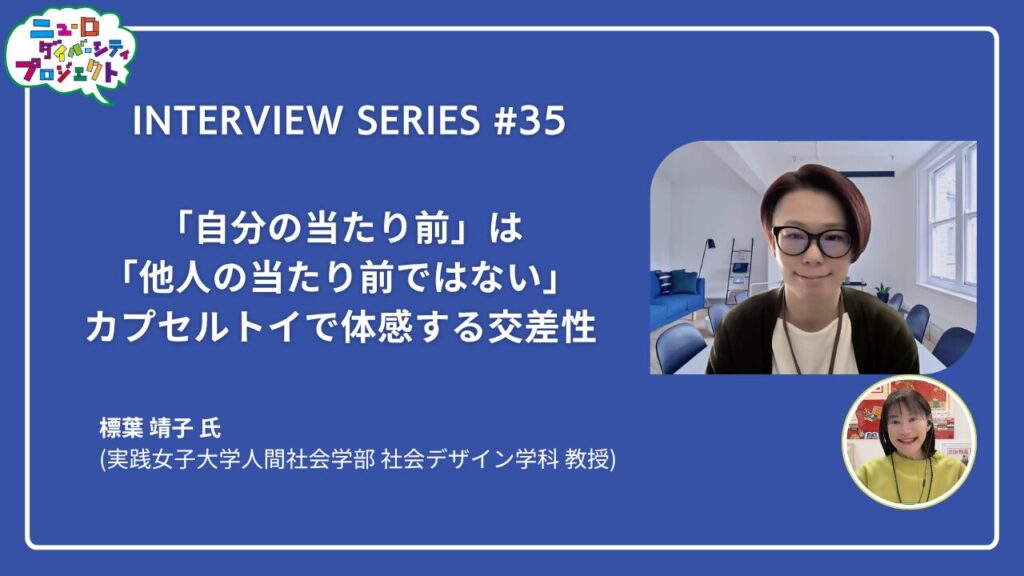
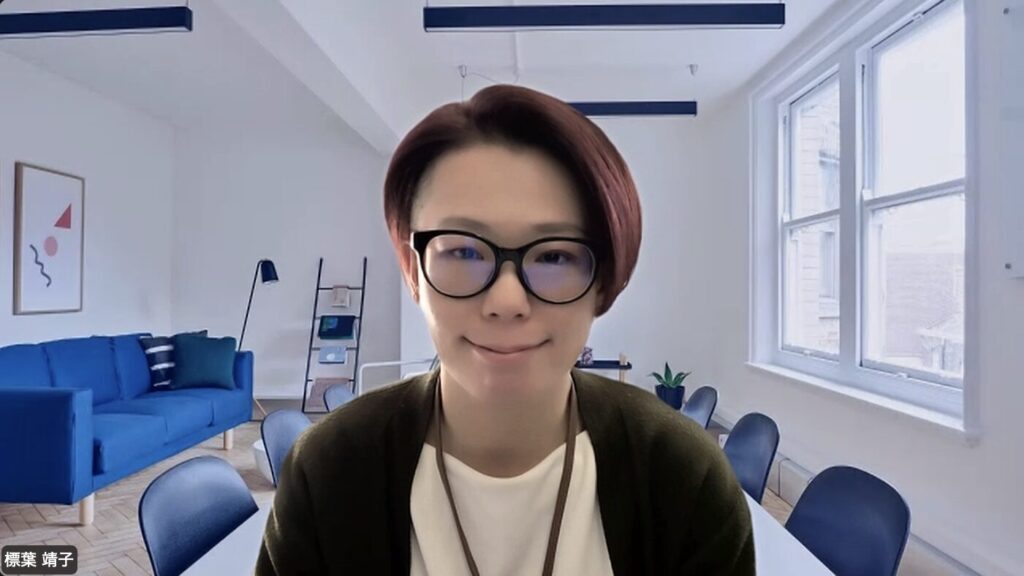
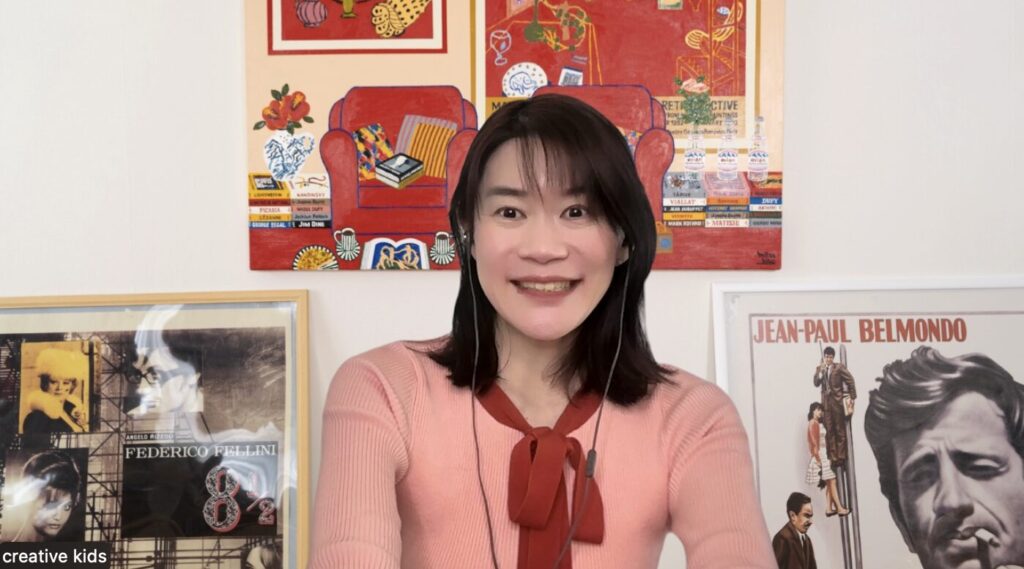
The Neurodiversity Project, led by B Lab, aims to create a society that respects neurological diversity and empowers everyone to reach their full potential. In this installment of the Neurodiversity Project Interview Series, we feature the work of Yasuko Shineha (▲Picture 1▲), Professor in the Department of Social Design at Jissen Women’s University. At the 2025 exhibition of “The World in Our Minds“, Professor Shineha presented a unique project featuring capsule toys containing slips of paper that described the personal experiences and sensations of others. This initiative encouraged participants to realize that “what is normal for me is not normal for everyone else,” highlighting the diversity inherent in our daily lives. Nanako Ishido (▲Picture 2▲), Director of B Lab, interviewed Professor Shineha to learn more about her research and activities.
> Interview videos are also available!
Diverse Perspectives and Values Born from the “Intersections” of Many Lives
Ishido: “Today, we have Professor Shineha of Jissen Women’s University here with us. Dr. Shineha introduced a very unique initiative in the “The World in Our Minds” in 2025, which encourages visitors to realize that “what is natural for oneself is not always natural for others. The event was covered by the media and generated a great response. First of all, please tell us about the contents of your exhibit and the research you are involved in on a daily basis.”
Dr. Shineha: “At “The World in Our Minds,” the Shineha Laboratory of Jissen Women’s University and the Jissen Institute for Gendered Social Innovation jointly presented an exhibition under the theme “Beyond Labels: Seeing the Everyday.” (▲Picture 3▲)
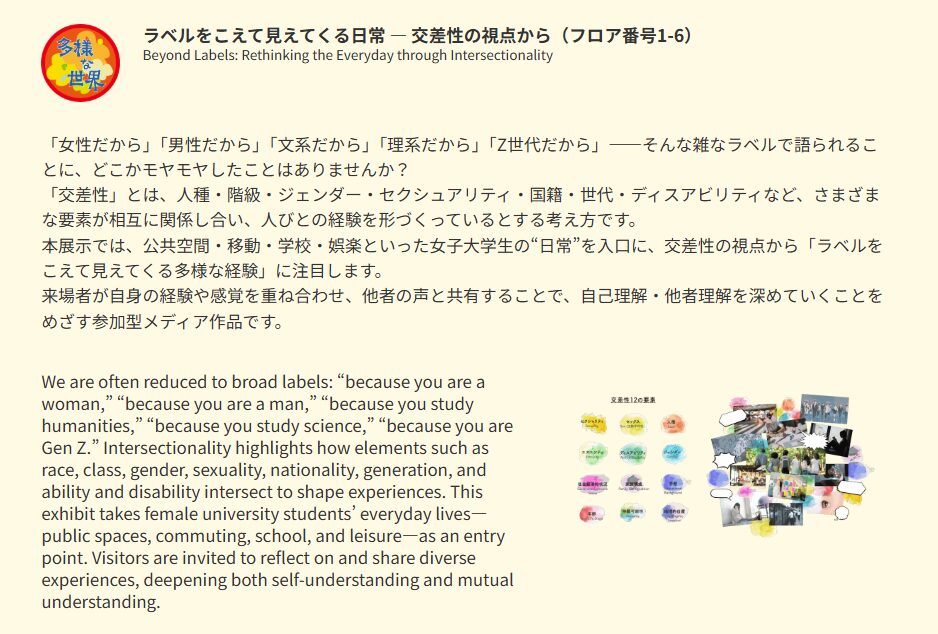
We are usually seen under a certain labeling, such as “because I am a woman, I am a female university student, I am this way,” or we ourselves are sometimes pushed into such a frame of possibility. The Institute for Gendered Social Innovation at Jissen Women’s University seeks to break down these stereotypes.
In the world, various ways of thinking and values emerge from the “overlapping of various things” of various people. Although people are happy, sad, troublesome, and troubled in different ways, our society has the aspect that the ideas and values that are easy to understand, visible, and mainstream are the so-called “standard”.
The institute focuses on the fact that there are many things that are out there that have not been seen before, and we are working on a variety of things to improve society from there.
We call the overlap of various elements such as race, class, gender, sexuality, nationality, generation, disability, etc. ‘intersectionality. Using the daily lives of students at Jissen Women’s University as a starting point, we are focusing on the fact that there is more intersectionality in our daily lives than we realize, and are creating participatory media, games, and other opportunities for many people to participate. As part of this effort, we exhibited at “The World in Our Minds”. I worked with students to create an exhibit that would allow visitors of all ages to casually verbalize what they take for granted, touch what others take for granted, and experience how things differ while having fun.
If you think about the elements of intersectionality throughout the initiative, you will find that it is not just simple gender differences, but also overlapping race, class, nationality, generation, disability, etc. From the various elements, think about ‘If I were to characterize myself, what label would I put on myself? In the case of students at Practical Women’s University, we tend to be ‘Shibuya Generation Z,’ ‘female college student,’ and ‘liberal arts student,’ but is that really the combination of your attributes that you think you are? I think it is important to think about this.
Sharing Others’ Experiences via Capsule Toys and Mapping Your Own Sensations
Based on these ideas, capsule toys were exhibited at “The World in Our Minds”. (▲Picture 4▲)
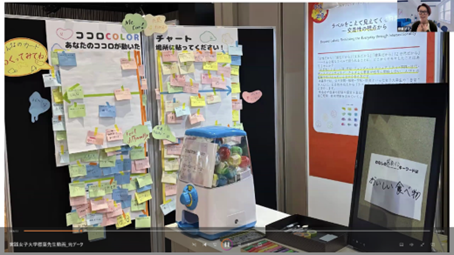
The capsule toy was prepared in order to create the sensation of ‘holding in one’s hands’ the sensations and experiences of a diverse group of people. When the capsule comes out of the capsule, it contains a piece of paper with a good story, a thrill, a blur, etc. that others have experienced. The exhibition asks visitors to touch on the experiences and sensations of others, and to think about how they felt at the time, whether they could relate to them, or whether it was a new discovery for them. In addition, they were asked to write down their own experiences, sensations, and feelings, which were then placed in a capsule for the next person to pull out.
You can enjoy seeing whether your happiness, a little blur, or something you wrote about is pasted in a place where someone “understands and can sympathize” with you, or in a place where it is a “new discovery” because you did not understand that feeling. This is an exhibition with a mechanism that does not end at one time, but rather circulates feelings and sensations.
To be a little more specific, I actually wanted them to write onomatopoeic descriptions of their favorite, positive, sad, and disliked sensations, but it was difficult to convey the idea of onomatopoeia. So, we asked them to write short sentences about feelings of happiness, sadness, joy, and dislike. On the back of the paper, I asked them to write “why do you think so” and “this is the person who wrote this” as if they were adding a hashtag to themselves.
Then, for example, an 8-year-old child might pull out something written by a 70-something university professor who came to the event and put it on the map, saying, ‘I have no idea. Of course, the opposite is also true. A person from one country writes, ‘This scenery is beautiful,’ or ‘I love this smell on the street corner,’ and a person from another country puts it on the map, saying, ‘I can understand it too, it’s fun. It is also a system where you can do a little correspondence with various people on the spot.
There are two reasons why we made these attempts. First, we wanted people to take another look at their own labels. The second reason is that we wanted everyone to “exchange” with each other, to realize that feelings are completely different from person to person. In a short period of time, less than 10 minutes, you can “exchange various experiences and sensations” by drawing a capsule toy, looking at the paper, knowing how you feel, and writing your own. Through these demonstrations, our current research is analyzing what kind of words are pleasant or disagreeable to what kind of people. In the process, we find that there are many things that are not understood, that the words themselves are not understood, and that the landscape we saw when we were little has some things in common and some things that are different. Based on the results of these analyses, we try to create new works or improve them to make them a little more immersive.”
The Convenience of Categorizing and Labeling, and the Risk of Discrimination and Bias
Ishido: “The more I hear about it, the more I find it a very interesting initiative. What we value in “The World in Our Minds” is to make people aware of the obvious but often overlooked fact that “what is natural for oneself is not necessarily the same as what is natural for others. We want to convey the message that diversity means rethinking society based on these differences. In addition, I believe that the act of “labeling oneself” is, in other words, “understanding oneself”. This is also one of the important concepts of “The World in Our Minds”. As I listened to the professor’s talk, I was reminded that this exhibition and research overlap exactly with the concept we have been trying to achieve.
So let me ask you a few questions. First, we hear the terms “stereotype” and “unconscious bias” more and more each year. On the other hand, why do stereotypical views persist so strongly despite the fact that times and values have changed dramatically?”
Dr. Shineha: “I believe that stereotypes are easier to understand, more convenient, and easier to live with in society. For example, when you are trying to start a conversation with someone you do not know, or when you are trying to build a casual relationship at work, it is easier to categorize people based on their roles and appearances and see them in that light. I think this is also the case.
For example, even though there is no evidence to support it, it is said that “people with blood type A have this kind of personality,” and this can be a good opportunity to talk about it. Even though we know that such categorization does not determine who a person is, and even though we understand that there is a risk of discrimination and prejudice, it is still effective and powerful to some extent in terms of convenience and ease of understanding as a clue to communication.
Thus, there is a part of us that has realized the convenience of using stereotypical categorization, but in the end, we are catering to those who find it convenient to use it.
When you don’t know how you should behave, it is very easy to conform to the labeling that you are this type of person or that you are this type of person. This ease inevitably becomes stronger. This makes those who have difficulty conforming to this type of labeling more and more invisible. I think there are many people who know that this is a very big problem and a bad sign.”
Ishido: “Certainly, labeling is very convenient in terms of reducing the cognitive load of each individual and facilitating communication by finding commonalities. On the other hand, it may also create a division between people. In this regard, I feel that the important thing is to “be aware of what we are doing. I felt that the Toy Capsule exhibition this time had the aspect of encouraging people to be “self-aware. So I would like to ask you, what methods and approaches can be considered for each of us to become aware of our own biases and labeling habits and to become self-aware? Also, once such awareness has been created, what next steps are you planning to implement?”
Dr. Shineha: “My own specialty is communication design. In that context, I work with people who are not in the mainstream and try to figure out what the key points are to make it easier for them to talk to each other. In the process of this research, I start by thinking about ‘what kind of people are there’ and becoming aware of ‘what kind of stance I take toward these people.
There will be a lot of activities such as awareness and interest arousal, but what is really important is the actions and activities that go on from there. If we can draw a route that makes people more aware and aware, we think about where that route could be drawn. For example, if there is no route for non-mainstream people in a school classroom to say ‘I’m in trouble’ psychologically and without load, it will be difficult for those around them to notice. It is important to think about how to set up that route.
We have to overcome a mountain before those who are not in the mainstream can say, “This is a little inconvenient,” and become aware of the fact that they could have said so, but didn’t. We tend to think that it is something that will never change, but our next goal is to increase the number of routes for people who are not in the mainstream to feel that it is OK to ask for changes, and to feel free to say so, even if only a little, in their daily lives.”
Neurodiversity: Valuing Spaces Where You Can Truly Be Yourself
Ishido: “There are still many differences between people. I believe that these differences are natural, and if both parties can remain tolerant of these differences, division will not occur. In this sense, I felt that your efforts are very meaningful. As I listened to what he had to say, I was reminded that we too would like to pursue our activities in the same direction.
Now, the theme of our projects and activities is “neurodiversity. From the perspective of realizing this neurodiversity, what kind of unconscious bias should we pay special attention to? Also, in what situations and structures in society do you think these biases are latent?”
Dr. Shineha: “When people who are not familiar with the concept of neurodiversity hear about the idea and concept, they may take the implications superficially. For example, they understand it as disturbing the atmosphere of the place or giving special consideration to those who do not fit in. You think of it as easily associated with words that are easy to understand.
But neurodiversity is not that simple. For example, many college students tend to think that ‘it is good to be inconspicuous’ among their friends. Such pressure is so strong that when we discuss neurodiversity, some students may think that ‘special consideration is too much trouble. At first, we started the discussion to accept even small requests from non-mainstream people so that everyone can have their own way of life and value a place where they can behave in their own way, but before long, the idea that “being inconspicuous is good” became the mainstream, and small requests became prejudiced as “selfishness of certain people”. However, the idea that “being inconspicuous is a good thing” has become the mainstream, and small requests are prejudiced as “selfishness of a certain group of people. I think we have to be careful about this.”
Ishido: “There is also a debate about whether the term “reasonable accommodation” itself is really appropriate. In the field of education, I have heard that some people ask, “Why is that child the only one who should be given special treatment? I feel that these perceptions and structures you have just described are also related to the background of this way of thinking.”
Dr. Shineha: “Yes, I think you are right.”
Ishido: “Given this, what is important to communicate to students in the educational field? More to the point, what kind of environment should be created so that perceptions and misunderstandings such as the one mentioned earlier are less likely to arise? What are your thoughts on this?”
Dr. Shineha: “The environment and educational space differ between primary and secondary education and higher education, so I will talk about higher education such as universities. At universities, the emphasis is on creating proper relationships with the people around you, but I think it is necessary to guarantee a space within the university where students can spend time comfortably and without any problems, even if they are on their own. This is a space where it is acceptable to have friends or act differently from others, a place designed for spending time as an individual.
These days, group work is becoming a necessity. The ideal group work is for students with strong personalities to seriously clash with each other and make the most of their individual characteristics, but there are some students who just want to “get along with everyone and get it over with without making waves. Students who are not in harmony with others and have their own particular preferences may think, “I have to get along with others in group work in order to get credit. Such an environment should not exist in higher education. However, it is not possible for teachers to supervise all group work, so we also need to be aware of the need for flexibility and an atmosphere that allows for individual play among students.”
Empowered to Choose How You Are Seen: The Importance of Guaranteed Autonomy
Ishido: “I mentioned at the outset that while labeling has its useful aspects, it also has its disadvantages. The term “neurodiversity” is a concept that originated with people with developmental disabilities, but there is an argument that this in itself may lead to new labeling. There are many situations where the presence or absence of a diagnosed name of developmental disability changes the reactions of those around you and society. While some people may be able to understand their own characteristics more accurately and live more comfortably with a diagnosis, others may feel that they have been labeled in a way that they do not want to be labeled. How should we view and deal with these points? Please let us know your thoughts.”
Dr. Shineha: “I believe that we must have a society in which people can properly choose ‘how they are seen’ by themselves, a state in which such a right to choose is guaranteed. Along with the convenience of labels and diagnostic names, we also need to have a clear understanding of their limitations. Connected to intersectionality, for example, even if a person with ASD (autism spectrum disorder) has exactly the same symptoms and characteristics, his/her personality will be completely different depending on the environment. In order to choose for ourselves what part of ourselves we want to be seen as, we need to understand that the labeling in the world has its limitations, that it inevitably highlights one aspect, and that we need to expand our understanding a bit more that the same characteristic can change depending on the environment. After that, I think it is important to be able to choose for yourself, ‘This is how I want to define myself at this moment.”
Ishido: “This is exactly the direction we have been taking with “The World in Our Minds”, and I felt a sense of relief that we have not made a mistake in proceeding in this direction. However, let me ask a slightly mean-spirited question. I felt that your exhibition focused on ‘understanding differences. On the other hand, I think that “thinking you understand” someone may itself give rise to another bias. Did you give some consideration or devise some kind of design to this point in the exhibition design?”
Dr. Shineha: “When it comes to labeling myself, I end up concentrating on words that are easy to understand and that I know. For example, there were some women who had trouble putting things on paper because the sense that came out of them was out of the ‘girlish’ sense. When you think about it from that perspective, there may be times when you think you understand, but it is still an assumption about yourself, or it may be a bias. In the exhibition, we were careful not to create new stereotypes by saying, ‘There are also cases like this.”
Discover Your Inner Diversity: Reflections Inspired by “The World in Our Minds”
Ishido: “In the environment of a women’s university, you have been engaged in various exhibitions and research while confronting labeling such as ‘girlishness. Considering neurodiversity from such a perspective, one of the labeling that leads to difficulty in living is the word ‘normal. Up until now, society has shaped “normal” on the assumption of a certain standard. However, I believe that we need to reexamine these assumptions and create a “new normal” in the future. What are the important points to keep in mind in order to review the past “normal” and “standard” and build a new “normal” in society? If there are any initiatives or perspectives that could lead to a breakthrough, please let us know your thoughts.”
Dr. Shineha: “Recently, with the advancement of AI and data science, I feel that standards and averages have become easier to quantify in various areas. When such standards and averages are presented, we can understand that there is more than one average or standard by returning to the common sense that ‘there is no one who is average in everything. It is the same as saying that there are few people whose height is average but whose arms and legs are all within the average. In other words, there are many standards, such as average height and average length of arms and legs, and it is important to get used to such a situation.
A standard is also one axis that is easy to understand. There was a lot of discussion about creating an axis in our exhibition. Since an axis presents a certain way of looking at things, we tried to shift the axis from time to time. I think we have to make sure that people experience the fact that no matter how you do it, there will always be things that deviate from the standard or average, and that they will come out, and we have to make sure that there is an understanding that deviation is never a bad thing. If we don’t do that, in the future, what AI calculates and derives will be easy to understand, and if that becomes the standard, only data that is close to it, data that matches it, and data that is easy to ride on it will remain.”
Ishido: “That’s right. The use of technology has the potential to pull things in a more uniform direction. That is why I think it will become increasingly important to consider how to use technology in a direction that is tolerant of diversity. I also found it very suggestive that there are various axes of perception. While quantitative indicators are easy to understand, they tend to be averaged out. On the other hand, I was reminded that it is also difficult to see the differences between people because they are in the minority or not so obvious.
So I would like to ask you a few questions about the reactions of visitors to “The World in Our Minds”. I feel that people’s reactions when they become aware of their biases can be very different. Some people may try to change their behavior as a result of their awareness, while others may become defensive. What was the reaction of visitors who actually saw the exhibit? I believe that the exhibition was designed not to elicit defensive reactions, but rather to generate small changes in visitors’ behavior and thinking. In this context, please tell us how you encouraged and talked to visitors.”
Dr. Shineha: “From the reactions of visitors at the actual exhibition, I don’t think that many people were aware of their own biases and clearly and strongly conscious of them. I would say that only about 10% of the visitors were able to discuss the possibility that what they had written and pasted on the wall might have originated from stereotypes and assumptions that they usually think about.
On the other hand, many people said that when they wrote and pasted what they thought they would do, they realized that there were people who felt differently than they did, and that it was “normal” for people’s “daily lives” to be different. In particular, I think many people mentioned their awareness of generational differences. It seems that many people felt joy and happiness in meeting people who presented different perspectives from their usual selves, and in learning about the sensitivities of people of different generations.”
Ishido: “It may depend on the characteristics of the visitors. I think the wide range of visitors, from small children to senior citizens, may have made the differences in the way they perceived the exhibition stand out even more.
Finally, let me ask you two questions. First, if you had a “question” that you would like people who have experienced this exhibit to continue asking in their minds when they return to their daily lives, what would it be? And second, if you have a message for each of us, or for society as a whole, toward the realization of a neuro-diverse society, please let us know.”
Dr. Shineha: “What I want people to continue to think about after our exhibition is that, as I wrote in the title “Beyond Labels: The Everyday Life”, you do not have to be an entity that bears the characteristics of some specific category, but an entity that is a combination of various things, and that is not one fixed thing, but something that changes dynamically, and that changes depending on the environment. It is not one fixed thing, but a dynamic thing that changes dynamically, and changes with the environment. By thinking this way, you can easily think about the diversity within yourself when you feel the pain of, for example, ‘I may have to act this way in this place right now. I expect that through repeated reminders that there are overlaps within you that you were not aware of, and when you feel uncomfortable with a particular way of looking at things, you will think, ‘This person just doesn’t have that perspective yet,’ and as you do this, your perspective on diversity will gradually expand. I hope that this will gradually expand the viewpoints of people considering diversity.
I believe that the realization of a neuro-diverse society will also lead to this. We should not easily assume that this person is like this, but accept them with tolerance, even if they are different from us. It is not necessary to accept people who are completely different 100% as they are, but I believe that with a little ingenuity we can come to understand each other. I think it would be wonderful if many people would be aware of the accumulation of such small things and put them into practice.”
Ishido: “Thank you very much. I found your exhibit to be very simple and easy to understand, but at the same time very thought-provoking, as it gave me an opportunity to notice differences between people and at the same time to reflect on myself. I have been involved in primary and secondary education, and I would love to bring these experiences to many children. I feel that it would be wonderful if we could work together in the future to expand your research results and initiatives to even younger children. Thank you very much for your valuable talk today.”