Using VR to Simulate Infant Care: Moving Childcare Beyond the Home and Making It a “Society-wide Initiative”
3/2/26
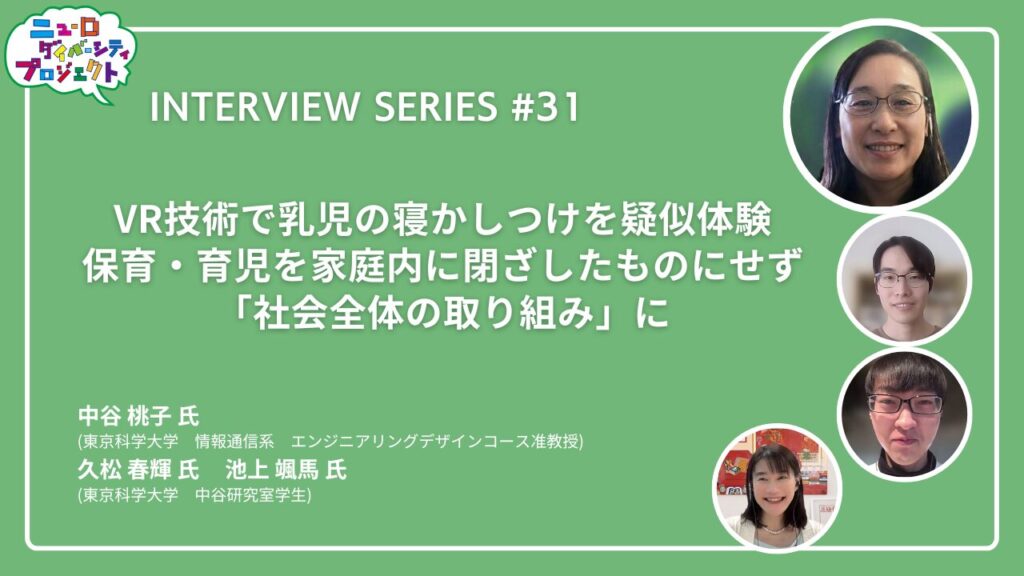
The Neurodiversity Project, organized by B Lab, aims to create a society that respects neurological diversity and empowers everyone to reach their full potential. In this interview series, we feature the work of Associate Professor Momoko Nakatani (▲Picture 1: top-left▲), along with her students Haruki Hisamatsu (▲Picture 1: bottom-left▲) and Soma Ikegami (▲Picture 1: bottom-right▲) from the Department of Information and Communications Engineering, Engineering Sciences and Design at Institute of Science Tokyo. At “The World in Our Minds” event in 2025, Dr. Nakatani introduced a VR-based project that simulates the experience of putting an infant to sleep. This initiative aims to foster empathy and interest among young people who are not yet in the child-rearing stage. Nanako Ishido (▲Picture 1: top-right▲), Director of B Lab, sat down with Dr. Nakatani to discuss her research and vision.
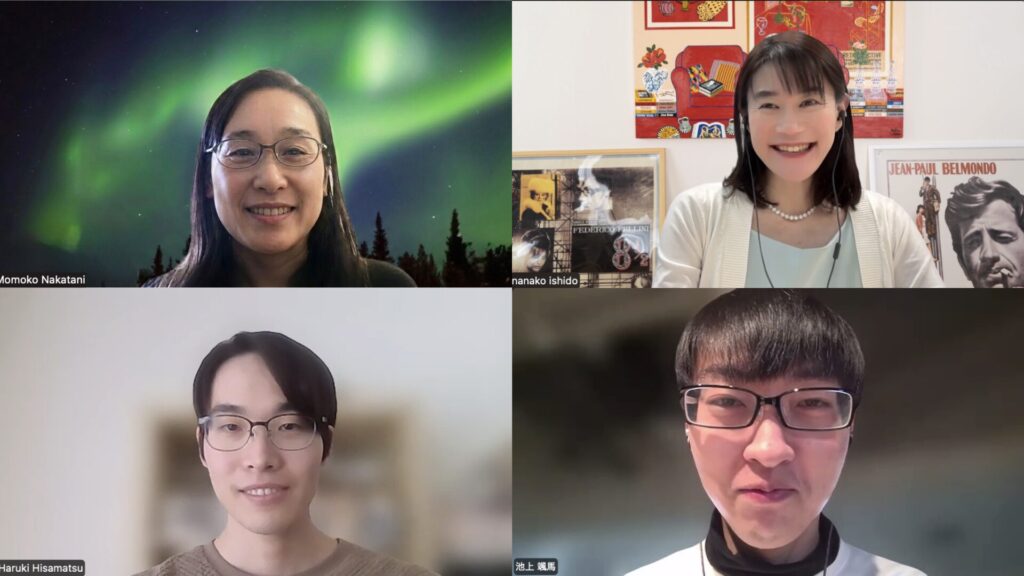
▲Picture 1: Top-left — Dr. Momoko Nakatani, Associate Professor, Department of Information and Communications Engineering, Institute of Science Tokyo
▲Picture 1: Bottom-left — Haruki Hisamatsu, Nakatani Laboratory▲
▲Picture 1: Bottom-right — Soma Ikegami, Nakatani Laboratory▲
▲Picture 1: Top-right — Nanako Ishido, Director of B Lab▲
> Interview videos are also available!
Sharing Childcare Expertise with the World:
Aiming for a Society that Raises Children Together
Ishido: “Professor Nakatani’s team at Tokyo University of Science exhibited at “Brain World for Everyone” for the first time in 2025. We will ask Dr. Nakatani, his students Mr. Hisamatsu and Mr. Ikegami about the details of their exhibit and their usual research and efforts behind the exhibit”.
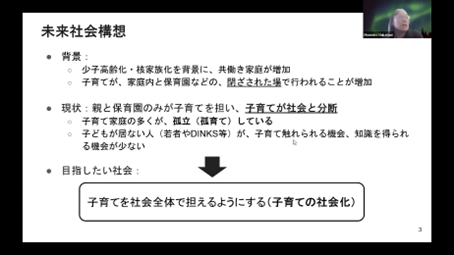
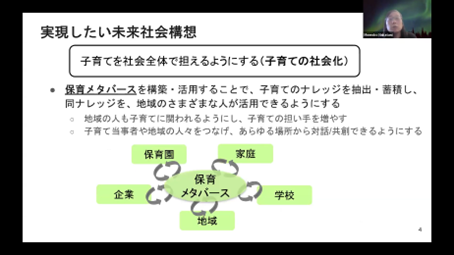
Dr. Nakatani: “First, let me explain what we usually do at Nakatani Lab. (▲Picture 2▲)
Nakatani Laboratory has spent about two and a half years so far in research activities within the JST (Japan Science and Technology Agency) Future Creation Project. Currently, we are engaged in research on a daily basis as a project of RISTEX (Research and Development Center for Social Technology).
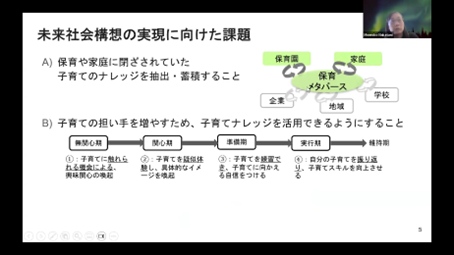
What I felt was that childcare is practiced in a “closed field,” and that although knowledge and know-how have been accumulated, it is not widely shared, and is, so to speak, separated from society. With such a diverse range of children, various innovations are being made in the field of childcare. Against this background, we have been working on various projects with the aim of disseminating our accumulated knowledge to the outside world, socializing our childcare know-how, and socializing child rearing.
Specifically, the JST project first worked on creating a metaverse of nursery schools to accumulate knowledge. (▲Picture 3▲)
The exhibit at “The World in Our Minds” in 2025 was designed to widely disseminate the knowledge that has been accumulated in this way. The exhibition also aimed to increase the number of people responsible for childcare and childrearing, so that university students and children who visited the exhibition could experience simulated childrearing and visualize scenes in which the knowledge would be utilized. (▲Picture 4▲)
Hisamatsu-kun, a student, will explain the specifics of the exhibit.”
From Simulation to Empathy: How Putting Infants to Sleep Sparks Interest in Childcare
Mr. Hisamatsu: “In light of the current situation in childcare, child rearing, and childcare, the reality is that opportunities for young people to directly interact with infants are decreasing year by year. As a result, we often hear comments such as “I don’t know how to interact with infants” or “I feel distant from them” before they feel “cute” toward them. Our research is intended to first break down such awareness, distance, and barriers.
So what kind of experiences should we have in order to increase interest in infants? Although we usually conduct our research in a laboratory setting, we have always felt that it is not enough to investigate the experience in a closed environment.
Therefore, “The World in Our Minds” was designed to explore the effects and acceptance of simulated childcare experiences for a wider range of people, based on the content and accumulated knowledge from our research. Participants wore HMDs (head-mounted displays) and experienced a simulated experience of putting a baby to sleep using a baby doll. (▲Picture 5▲)
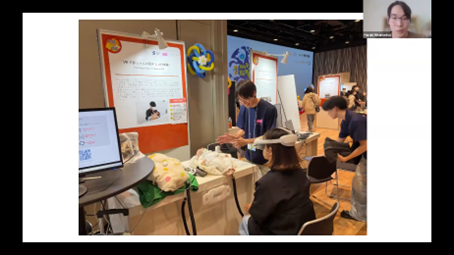
In the HMD, you can see the baby’s facial expressions. The baby is crying when you hold it in your arms, but as you gradually soothe it, it subsides, and you can experience the entire process of putting the baby to sleep. We designed this program with the intention of creating a kind of sense of accomplishment that you were able to put your baby to sleep by continuously fussing over him or her, and also to create positive feelings toward the infant through the experience that his or her condition has changed as a result of your involvement. In this case, we are providing that through a sleep-putting experience.
In fact, more than 180 people experienced the program. Although we had previously conducted experiments on university students and others, we received comments from parents that it reminded them of their own children. Many elementary school students also had the opportunity to experience the experiment, and although it may have been a little out of the original intent of the research, we have received many comments that it was a fun experience. It was a meaningful experience for us as well, and we were able to obtain a lot of useful information. I can honestly say that we are very happy to have participated in the exhibition.
Dr. Nakatani: “In the actual “Brain World for Everyone” exhibit, participants were asked to wear HMDs. Mr. Ikegami will explain what kind of images can be seen”.
Mr. Ikegami: “In fact, you have seen the video shown next. (▲Picture 6▲)
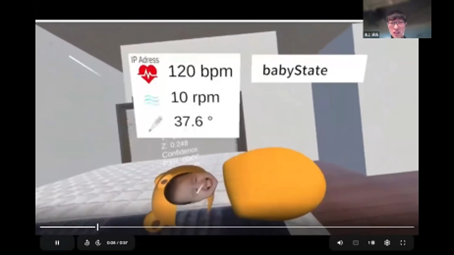
At first, you can see an image of an infant crying. When the experiencer actually holds the doll and shakes it, the crying baby gradually stops crying and dozes off. The experience eventually puts the baby to sleep.
Ishido: “I actually experienced it myself on the day. I felt nostalgic and thought, ‘Babies are so cute after all,’ but at the same time, I naturally felt various emotions such as, ‘They don’t sleep well. I understand that the concept of Professor Nakatani’s laboratory is “how to prevent the division between child-rearing and society,” and I would like to know what kind of effects or changes you were hoping for through this exhibition.
As I mentioned, I myself experienced a variety of emotions at the same time. Some of the participants strongly felt that “small children are cute,” while others may have felt that “raising a child is hard work. What did you think would lead to easing the division between child-rearing and society?
Dr. Nakatani: “When we started our research, we did not know what kind of changes would actually occur as a result of this kind of experience. So, we just tried it out first. What we have learned recently is that even people who are scared or uninterested in babies because they don’t know anything about them, when they learn something concrete, such as ‘this is how heavy the baby is,’ or ‘the baby will fall asleep if you rock it,’ the experience leads to positive feelings.
At this point, I feel that the first concrete effect is that people are beginning to understand what they did not know at all about babies, and that they are becoming more interested in them through concrete experiences. Then the next issue is how to sustain such feelings. Our current goal is to sustain the effect and make people more interested in the real baby rather than the doll,” he says.
Experience the Joy of Infant Expressions: Finding Love and Delight Through VR
Ishido: “At the “The World in Our Minds” exhibition in 2025, there was an exhibit that simulated menstrual pain for women. Based on those exhibits, I felt again that it is very important to create an entrance to the exhibition, where interest is generated by actually experiencing it firsthand. I also understand that Dr. Nakatani’s research is also about carefully creating such an entry point.
What I would like to ask then is still the next step. How do you think it is possible to realize a structure in society that allows those who are not currently raising children to become involved in some way after interest is generated through the simulated experience? We would love to hear your thoughts, Dr. Nakatani.
Dr. Nakatani: “There is a medium- to long-term approach in which these experiences are repeated over and over again, and the baby gradually becomes accustomed to them. Currently, Mr. Ikegami is researching an approach in which the baby who cannot stop crying is given an experience that transforms the negative into a positive, and the baby gradually gains confidence through the experience of being able to overcome a difficult situation, rather than simply having fun with the baby.
Furthermore, we are creating VR content not only for university students but also for parents. For example, think about when a child throws a tantrum. It is very difficult to deal with it, and no one can tell you the right answer or the correct way to handle it. We are also working to have parents experience such a situation and understand that different people can do things in different ways. It would be nice if we could gain experience with real babies, but that is not always realistic. We are working on this by using a combination of methods, such as using VR to supplement what we can’t do.
Ishido: “You mentioned that you started from a place of ‘just trying things out.’ What was the reason why you chose the theme of ‘putting babies to sleep’?
And there is one more point I would like to ask. In the past, there have been simulated experiences such as a small child holding a baby doll, but in this exhibition, VR technology was used. In addition, could you tell us about the technical and design aspects of the VR technology and how it was used to enhance emotional empathy?
Mr. Ikegami: “We also implemented an initiative to experience interacting with infants using toys before the bedtime experience. We created this as an opportunity for young people to interact with infants, but originally, the idea was to have them experience the change from a neutral state to a positive state by fussing with the infant with the toy. After this experience, the next step was to have them experience the change from negative to positive by putting the crying infant to sleep, so that they could experience a deeper contact with the infant.
One reason for using VR was that it was difficult to create facial expressions with dolls. We also felt that it was difficult to create interaction. We knew that in order to have the infant experience positive, cute, and fun emotions, the infant’s facial expressions were important, as well as the sensation of actually touching and caring for the infant by moving his or her hands, which is why we used VR.
Ishido: “For this exhibition, when we used VR technology to have visitors experience holding a baby, we did not set a strong direction in advance in terms of what emotions we wanted to evoke, but rather we tried to reproduce an experience as close as possible to the feeling of actually holding a baby, and as a result we were able to create an experience that was positive and positive. Some people may experience positive emotions, while others may experience negative emotions such as confusion or difficulty.
Mr. Ikegami: “Yes. First of all, I can say that it was significant to see what kind of emotional changes there would be”.
Heartbeats and Warmth: Providing a Truly Realistic Experience of Putting an Infant to Sleep
Dr. Nakatani: “We have talked about how this is unique to VR, but Hisamatsu, you are working on an initiative using dolls. Please explain that research.”
Mr. Hisamatsu: “We are reproducing biological signals by using baby dolls to mimic the heartbeat, breathing, and body temperature of actual babies. By having people feel these signals, we are able to enhance the sense of reality, and we are researching what kind of emotions and effects can be observed when actually holding the baby.
This time, two dolls were also set up at the exhibition, and participants were able to experience a case in which no biological signals were reproduced, a case in which only the heartbeat was known, and a case in which only the body temperature was known. Through this experience, we received comments such as “I didn’t know babies’ heartbeats were this fast,” “Their heartbeats are faster than our own heartbeats, and I feel they are living hard,” and “Having their body temperature made me feel closer to them. We were able to gain insight into the various effects that can be seen when biological signals are added.
Ishido: “I was listening to your talk, feeling that you are pursuing how to realize reality while working on various senses such as sight, hearing, and touch, including biometric information. Which of these senses do you think has the greatest influence on the simulated experience? Even when people are having the exact same experience, some people may feel as if they are really having it, while others may not feel the same way.
Mr. Hisamatsu: “This is still an unknown quantity because I have not yet conducted a proper scientific study, but the most frequently mentioned factor in my research and experiments is ‘weight. The baby doll itself reflects the weight of an actual infant, but many people who have never had much contact with babies have no knowledge of their weight, and are surprised when they hold the doll and realize how heavy it is to be a baby with a life.
As to what sensations are connected to the reality of holding the baby, I feel that there are many different elements in a complex way. I think they all affect each other in a uniform and interactive way rather than just which element is important. For example, if there are no biometric signals and the baby is just heavy, some participants may not be interested and want to stop fussing immediately. On the other hand, if there are changes such as biometric signals and facial expressions in the VR, participants can feel that they are actually comforting the baby and have a sense of accomplishment from having put the baby to sleep, and they will say, “It was a little heavy, but it was good because it felt like I was actually comforting the baby. I think it is very important to combine various elements.
Connecting with Local Childcare Centers: Expanding VR Experiences to Students
Ishido: “I would like to ask you not only about this research but also about the research conducted by other professors, if you have any research results that have shown how simulated experiences affect changes in people’s emotions and cognition.
Another point, and this may be a bit of a mean-spirited question, but I feel that there is a risk that pseudo-experience may in fact lead to misunderstanding. I think there is a possibility that people will think they “get it” by experiencing it, and as a result, the division may be strengthened. I would be very interested to know what you think about this point, or if there are any measures you are conscious of in your research or exhibition design.
Mr. Ikegami: “From the results of the simulated experience many people had with “Minna no Brain World” this time, we have seen changes such as the relief of anxiety and a sense of accomplishment and peace of mind that comes from actually being able to touch an infant and make it stop crying. On the other hand, some felt that it was difficult to actually try. From this perspective, some people experienced a change in the form of increased anxiety. However, some of them also felt that such anxieties, etc., conversely generated empathy for the child-rearing generation, and they felt that various changes could be seen.
Dr. Nakatani: “I would like to make a few remarks about the risks associated with simulated experiences. In Ikegami’s experiment, there was a case in which a person who originally did not like children very much and had feelings of rejection experienced the experience, and as a result, the negative feelings did not change. In other words, this is a case where the negative feelings were not amplified by the experience, but a certain creepiness and fear that they originally had remained. I think that the fear is connected to the fact that we don’t know how the baby will behave, but negative feelings have reasons, so if we know why they are negative, we can think of ways to resolve them. That is what I am working on now.
Ishido: “I think Dr. Nakatani told you that rather than pursuing perfection, he first emphasizes having as many people experience it as possible, and then spreading the word and educating people about it. Based on this thinking, in what situations and contexts would you like to utilize this VR experience in the future?
Dr. Nakatani: “There are local child-rearing support centers throughout Japan, such as children’s centers, for example. There are places where they are practicing the experience of interacting with infants as a project, but most of them take actual babies to junior high schools, for example, to give junior high school students a chance to experience realistic contact with babies. This is very costly and requires finding mothers and fathers who are willing to donate their babies, which we hear is a very high hurdle. Therefore, we think it would be good if we could offer the VR childcare experience at elementary and junior high schools. We are now thinking of expanding the VR experience to elementary and junior high school students in cooperation with the local community.
Ishido: “It is true that in recent years, child-rearing, childcare, and childcare activities have tended to be talked about as something to be done within the family. Under such circumstances, what elements do you think are necessary to reposition child-rearing as an activity of society as a whole, based on your past research and practice?
Dr. Nakatani: “I believe it is necessary to approach this issue from many angles. I believe that it is inevitable that we have fewer opportunities to physically interact with children due to the declining birthrate, but it is not true that there are no opportunities to encounter children, including infants, on the street. I am sure that there are opportunities to meet parents with infants on the train, or to see small children playing in the park while walking. I think it would be good if there were some kind of mechanism to draw people’s attention to such scenes. I think that one of the things we can do is to create opportunities for as many people as possible to come into contact with childcare, childcare, and child rearing, and to learn more about them.
Transforming Hidden Expertise: The Need to Visualize Childcare Knowledge for All
Ishido: “We, too, want to challenge how we can realize a neuro-diverse society while utilizing technology, and are working on exhibitions such as “Brain World for Everyone. What do you think are the possibilities for technological approaches other than VR to open up childcare and care to society? In addition to VR, what do you think are the other possibilities for technological approaches to opening up childcare and care to society?
Dr. Nakatani: “Through our various practices, we have accumulated know-how on how to interact with babies and infants. I think there are various ways to provide such opportunities, and in what ways we can disseminate them widely. Recently, AI can also be used, so I think it is necessary to utilize the latest technology to convert the experience and knowledge of those actually involved into various forms, not just VR, and present them in a form that is easy for everyone to understand, read, and see,” he said.
Ishido: “In listening to what you said, I strongly felt that you are carefully addressing the issues of first getting people interested, getting them to know about you, and what you can do to help them.
We are working to realize a neuro-diverse society. Taking this perspective into consideration, I would like to ask you one last question. What kind of vision do you, Dr. Nakatani, Mr. Hisamatsu, and Mr. Ikegami have for the society of the future, and what kind of research do you hope to conduct to realize this vision?
Mr. Hisamatsu: “I myself had very little experience working with babies before this research, and I was very anxious about getting involved. However, as I actually had more opportunities to interact with them through my research, I began to think about many different things. The biggest change I felt was that I came to strongly believe in the existence of “free love.
I think it would be wonderful if we can realize a future in which as many people as possible can feel kindness toward babies based on such experiences, and can think about a society in which not only babies but also children can live comfortably, and can involve the entire society in such a movement.
Mr. Ikegami: “As I worked on my research, I gained more experience actually interacting with infants and visiting childcare support centers. In the process, I felt that the feeling of ‘how cute they are’ was getting stronger day by day. After coming into contact with babies, I began to notice children on the train and strollers on the street. I believe that if all young people can take an interest in making society a better place for children to live, it will be a better society.
Dr. Nakatani: “As with childcare and nursing care, there are a diverse range of people, and there are people who are involved with such diverse people and have truly diverse experiences. I think it is important to know and understand that this is a reality.
What can we do to help? I believe it is to create “opportunities to know. Our ultimate goal is to create opportunities to know, to gather and share knowledge and experiences, and to create new knowledge and mechanisms to solve issues such as how to make people’s lives more enjoyable and how to make everyone happier.
In that sense, I think we had a great opportunity to exhibit at “Brain World for Everyone” this time. I was able to have concrete discussions with many of the people who came to the exhibition. I believe that this is where ideas are born and where we can create a better society.
Ishido: “The aim of “Brain World for Everyone” is to let people actually experience and know through technology that the world they see and feel and the world the person next to them sees and feels are actually different. As I listened to today’s talk, I felt that the concept of “Brain World for Everyone” and the research conducted by Dr. Nakatani’s team have a great affinity with each other. First of all, we must create a society in which as many people as possible are interested. I look forward to working with you in the future on efforts to achieve this. Thank you very much for your valuable talk today.