
Capturing Children’s “Invisible SOS” with Science Screening Changes the Shape of Schools and Support
4/17/26
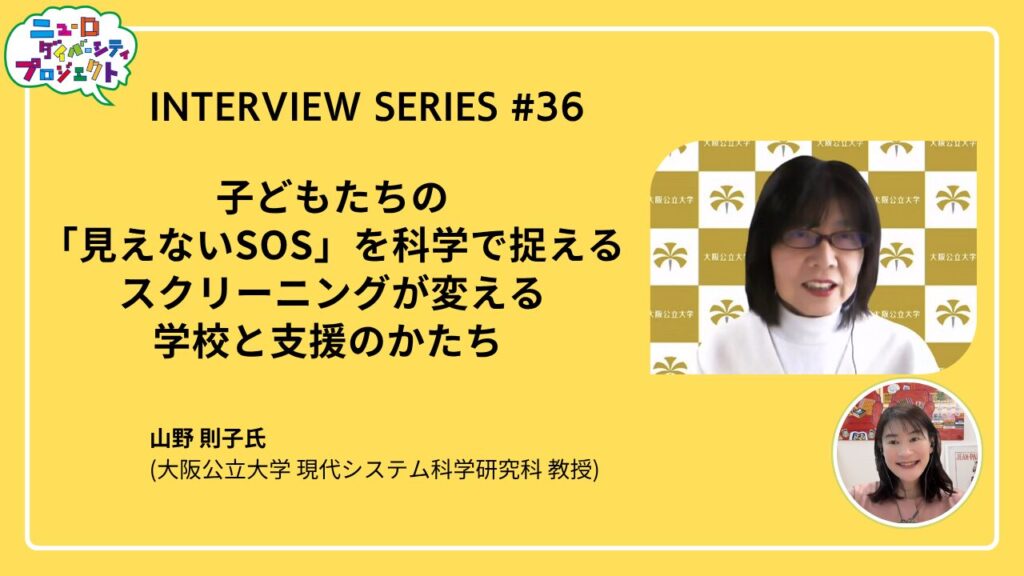
The Neurodiversity Project, sponsored by B Lab, aims to realize a society in which the diversity of the brain and nervous system is respected and everyone is empowered to be their own person. Introduced in this Neurodiversity Project interview series is the work of Professor Noriko Yamano (▲Picture 1▲) of Osaka Public University’s Graduate School of Modern Systems Science, who was the first exhibitor at “The World in Our Minds” in 2025. Noriko Yamano’s laboratory conducts research on “screening” for early detection and early response to children’s problems that are difficult to surface, such as abuse, bullying, and poverty. Nanako Ishido (▲Picture 2▲), Director of B Lab, spoke with Ms. Yamano about her research.
> Interview videos are also available!
The “small signs” that children are giving off
Screening to scientifically catch the “small signs” that children give
Ishido: “Dr. Yamano exhibited for the first time at ‘The World in Our Minds’ in 2025. Please begin by introducing the details of your exhibit.”
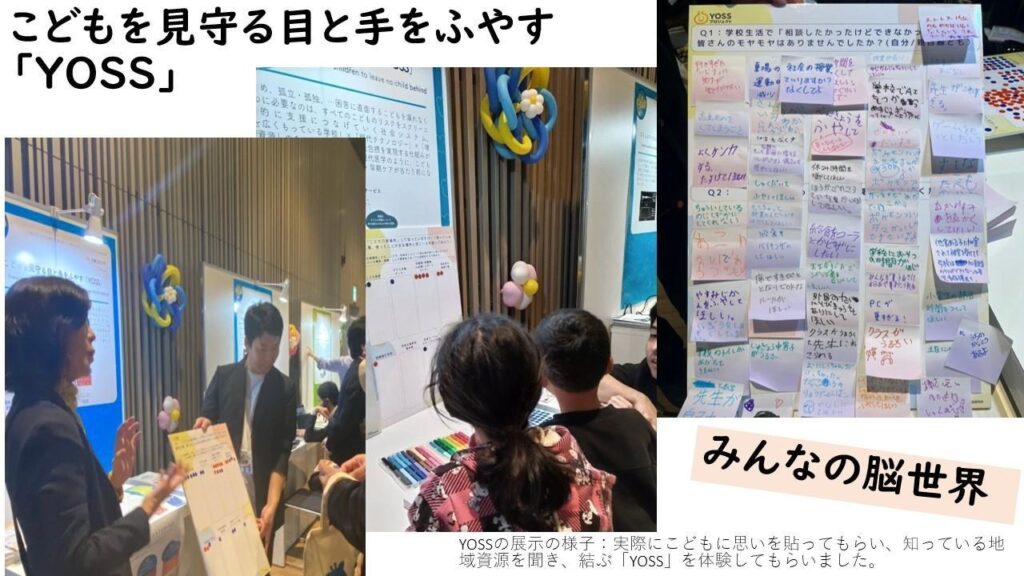
Dr. Yamano: “We exhibited ‘YOSS (Youngsters’ Obstacle Screening System),’ which increases the number of eyes and hands looking after children. This is aimed at providing necessary care for ‘a world where no child is left behind’ and ‘a satisfying life for parents and children.
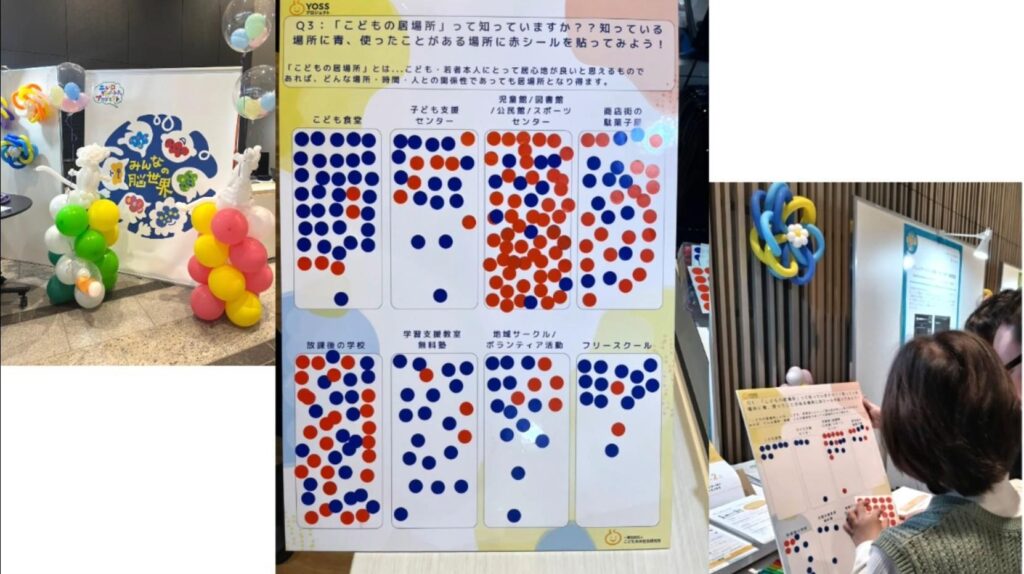
At the venue, the children were asked to write down their blurred thoughts on sticky notes and to put stickers on “places for children” that they know. (▲Picture 3▲/▲Picture 4▲)
It was a great benefit for us to hear more from the children and their parents than we had expected, as they seemed to enjoy participating.”
Ishido: “I felt that the contents of your exhibit this time are deeply related to the research that you are engaged in on a daily basis. Could you please tell us about the research themes that you are working on on a daily basis?”
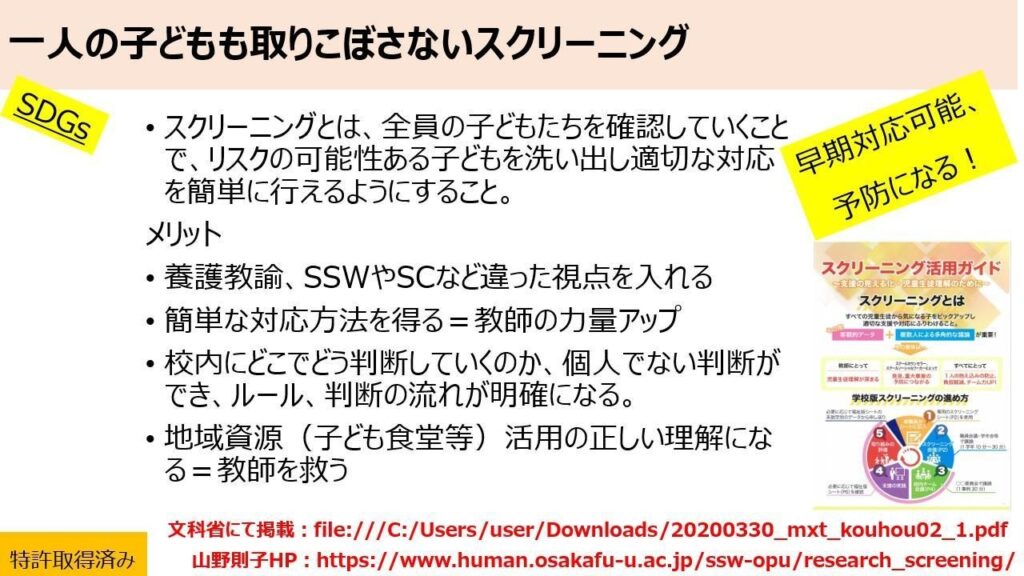
Dr. Yamano: “I am conducting screening research from the perspective of ‘leaving no child behind. Screening is to identify all children so that children who may be at risk can be identified in advance and appropriate measures can be taken at an early stage. (▲Picture 5▲)
It is difficult to accurately assess the condition of children. This is because children may feel it is difficult to voice their concerns, and parents may be hesitant to discuss such matters with their children’s teachers. The current situation is that both children and their guardians are unable to speak up and express their concerns.
However, children are always giving signs somewhere. For example, “I am speaking less,” “My grades have suddenly dropped,” and “I am forgetting more things,” are all signs from children. It is important to catch these signs from the child and ask, “Are you okay? The screening method is to catch these signs from the children and ask them, “Are you okay?
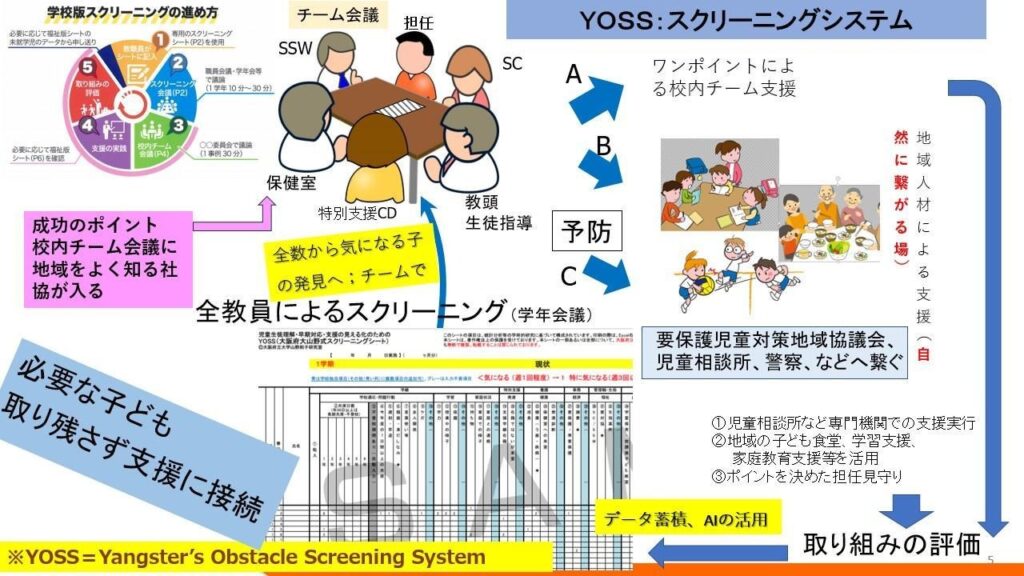
For screening, we use a dedicated screening sheet that is managed in the cloud. All teachers participate in a screening meeting to pick up items of concern from the screening sheet and carefully consider how to respond to the children, for example, “This child needs attention,” or “It might be better to talk to the child. We call the process from detection to support a screening system.(▲Picture 6▲)
Note: We have patented and trademarked all of these methods for YOSS🄬. Please be sure to consult with us regarding its use.
One thing you must understand is that screening is not about ‘labeling’ children or families. Rather, we have received positive reactions from parents who have said, “I didn’t know they were so attentive” and “I didn’t know the school teachers cared so much about my child.
School teachers are very busy and tend to focus their attention on children who are “extremely high achievers” or “extremely challenging. Parents are notified of such children. On the other hand, it is difficult to notice changes in the so-called “normal” children who are in between the two, and this can lead to bullying and incidents. In the press, it is sometimes pointed out that “why didn’t we find out about it earlier?
Therefore, we have created a system to pick up children of concern and call on them by using a screening sheet constructed based on scientific evidence. In addition, NPOs and local communities are now becoming more active, and local resources such as learning support and children’s cafeterias are being created. However, the necessary resources are not being connected to the children who need them. YOSS serves as this hub, introducing social resources and how to utilize them.
When teachers try to solve children’s problems alone, homeroom teachers are inevitably forced to deal with them alone, which often results in a situation where children in need of help are not reached. Therefore, Cloud YOSS will not only accumulate evaluation data on screening efforts and suggest optimal local resources while utilizing AI, but will also create a system in collaboration with team schools and the community.”
New truancy is now “zero”.
Data Proves the Effectiveness of Screening
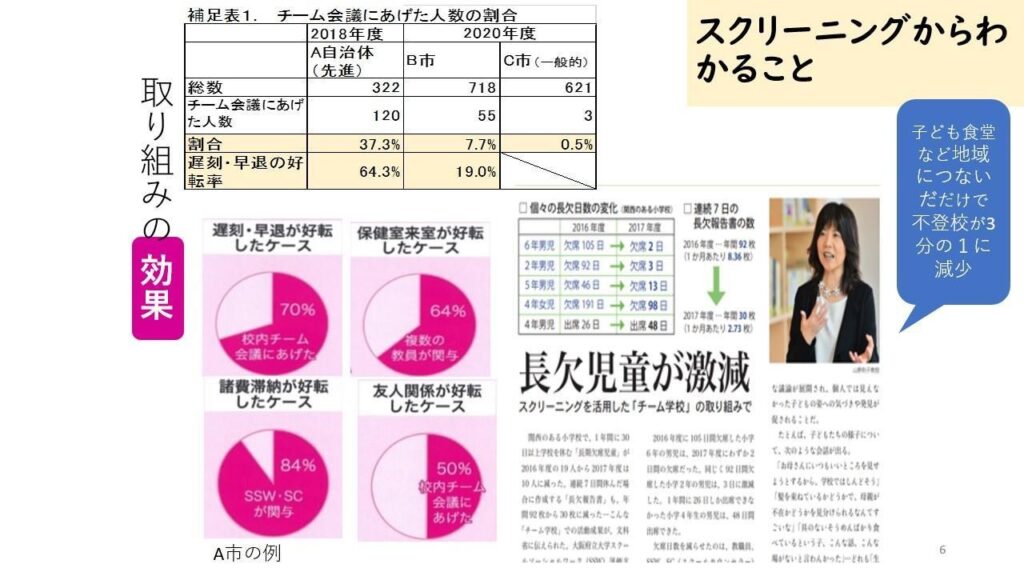
Dr. Yamano: “Next, I would like to introduce the concrete effects of the screening process in identifying children in need of help and reaching out to them appropriately. In one municipality, ‘tardiness and leaving school early’ and visits to the infirmary improved by 70% and 60%, respectively. In addition, bullying and other friendship problems improved by 50%, and 84% of students who were delinquent in paying school fees improved. In addition, truancy and long-term absences from school decreased by one-third. (▲Picture 7▲)
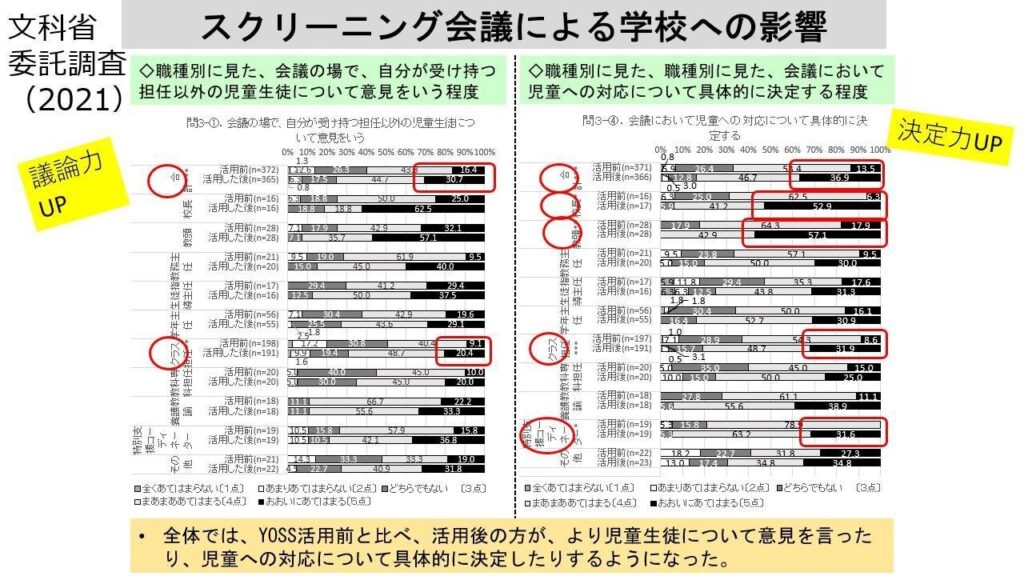
It is not only the children who have seen results. Schools have also seen a positive impact. Schools that have adopted screening conferences have seen a significant change in the stance of their principals in particular. Before the screening, only 6.3% of principals responded that they “make specific decisions on how to deal with children at the meeting. After the screening, the percentage increased significantly to 52.9%. (▲Picture 8▲ Results of the survey on the right)
By utilizing screening, instead of going ‘eh’ after an incident occurs, teachers are now able to assess the children’s situation in advance and decide on specific responses while connecting them with various supports. This has led to improvements in tardiness and visits to the health room.
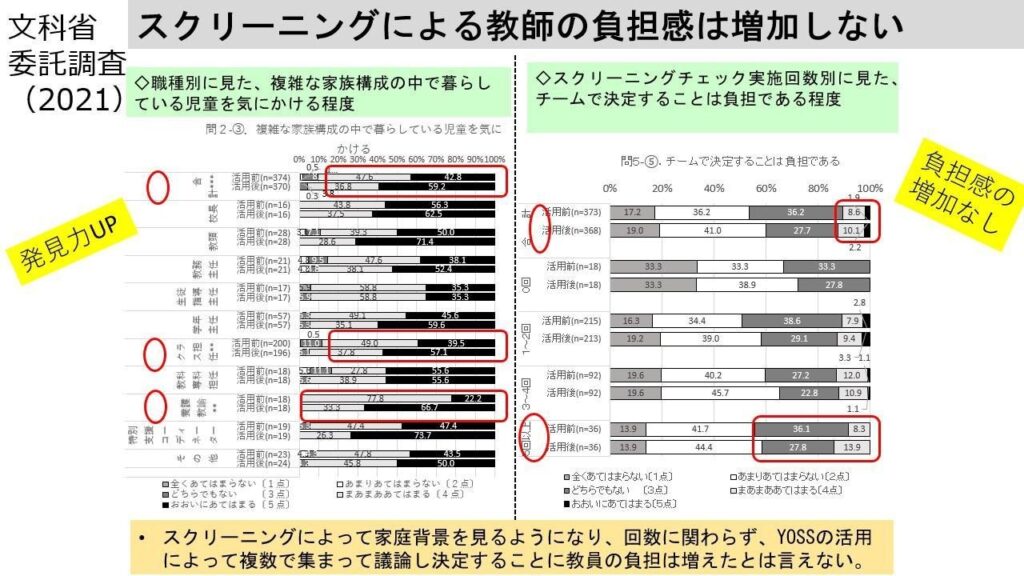
Screening is not particularly burdensome, as the use of scientific evidence-based sheets allows all teachers to check from the same perspective. In fact, we have found that the burden on teachers is reduced in schools that check monthly. Even if they are checked at least once a semester, changes should be seen. (▲Picture 9▲ Right side of the survey results)
In addition, in schools, there is sometimes a so-called “classroom kingdom” (a closed environment where classroom management is conducted by the homeroom teacher without interference from others), and it is difficult to speak up about children in classes where you are not the homeroom teacher. Screening tends to improve such situations. The number of respondents who “express their opinions about children other than their homeroom teachers at meetings” has nearly doubled. (▲Picture 8▲ Results of the survey on the left)
In addition, the percentage of teachers who ‘care about children living in complex family structures’ has also increased nearly threefold among school nurse teachers. One of the results of the screening process is that teachers’ perspectives have changed and a sense of unity has been created.” (▲Picture 9▲ Survey results on the left side)
Courses to increase the number of personnel who understand and practice screening
Courses are also offered to increase the number of people who understand and practice screening in schools.
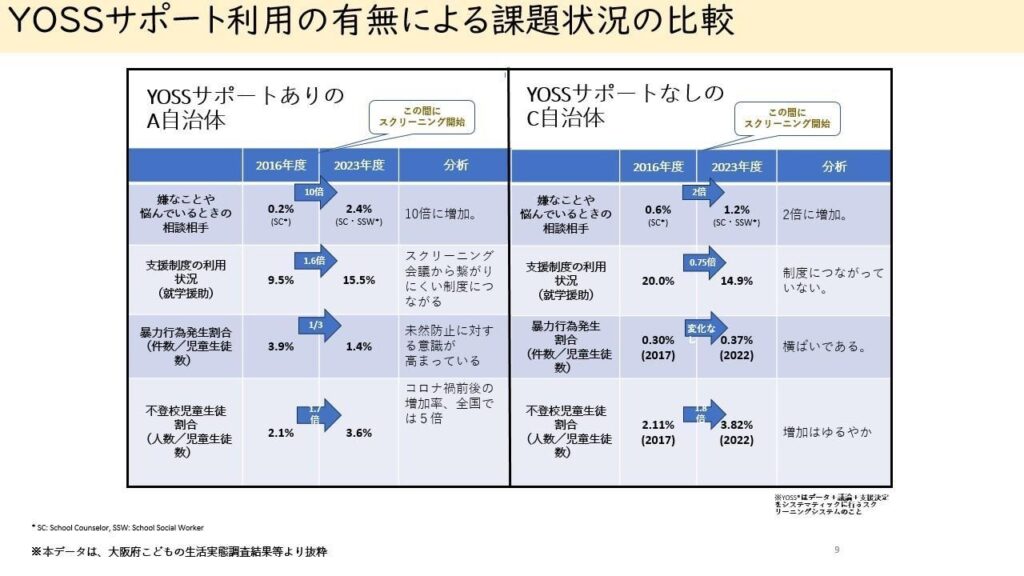
Dr. Yamano: “We have converted these YOSS screening systems to the cloud, and support is provided there. With this YOSS support, municipalities can receive detailed suggestions on the support they need and the services available to them. As a result, in municipalities that have used YOSS Support, the number of students who “go to for advice when they are having a bad day or are worried” has increased tenfold, the rate of violence has decreased by one-third, and the use of support systems (schooling aid) has increased 1.6-fold. (▲Picture 10▲)
Because YOSS support carefully suggests a screening system that leads to the supports and services needed, it is often clear that the presence of support makes a difference in the outcome. When screening is performed with an understanding of the value, philosophy, and meaning of support, rather than simply using screening data, it can be more effective in the early detection and appropriate response of children who may be at risk.
Some people think that this kind of support is the job of school social workers. However, of the 4,000 or so schools surveyed by the Ministry of Education, nearly half had a school social worker assigned less than once every two months. (▲Picture 11▲)
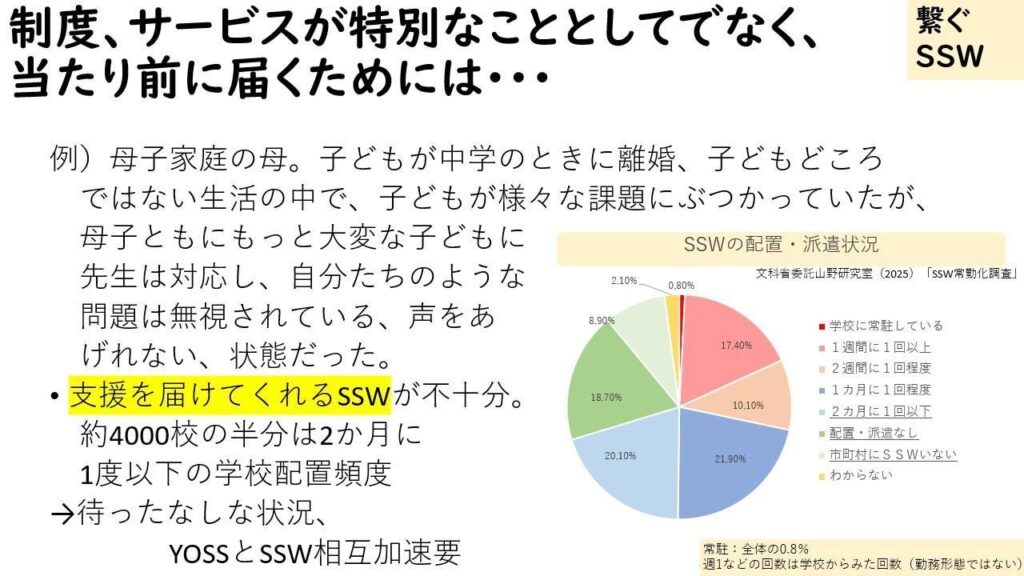
This makes it impossible to provide careful support, and inevitably leads to dropouts. We believe that using screening in such situations is very effective. It is not that school social workers are unnecessary, but rather that we started screening in the hope of first delivering actionable responses and support to children, rather than continuing to do nothing.
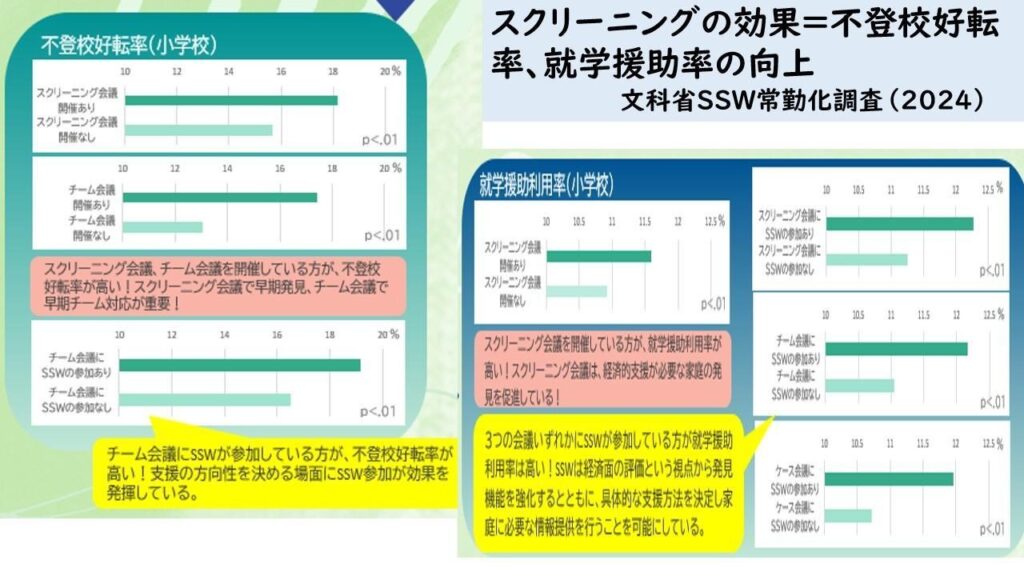
Let’s look at another set of screening results. The results show that the more screening is conducted in a school, the more truancy is turned around. We can expect to see a definite effect if we deal with children in two stages: a “screening meeting” to pick up children and a “team meeting” to decide what to do with the picked up children. The same is true for schooling assistance, and results are better when screening meetings and team meetings are held .(▲Picture 12▲)
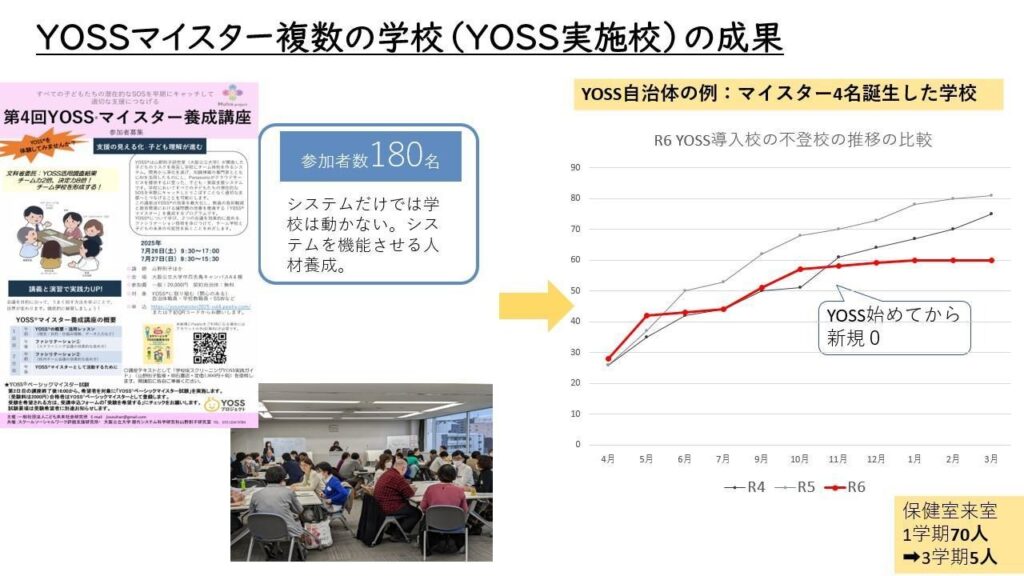
In addition, our laboratory holds “YOSS Meister Training Courses” in the hope of increasing the number of human resources who understand and can practice screening. We believe that human resources are needed to make the system function and utilize it, so we are conducting a training course for human resources.
As a result of the YOSS Meister Training Course, the number of new truancy cases has dropped to zero at schools with four faculty members who have taken the course and become Meisters. While the national trend is for truancy to continue to increase without stopping, it has come to a complete halt since the introduction of YOSS. In addition, the number of students visiting the infirmary decreased from 70 in the first semester to 5 in the third semester. (▲Picture 13▲)
For more details on why this is so effective, I highly recommend that you take the YOSS Meister course.
It is possible to create a world in which children can say “I’m having a hard time” as a matter of course, and in which their attachments are fulfilled as a matter of course, without being a social work or child counseling specialist. It is not necessary to spend a lot of time for this purpose. Since all teachers work with all children, we can change the world around them with the little things that we decide at YOSS.”
Visualization of children’s cafeterias and “children’s places” on a digital map
Visualizing Children’s Places on a Digital Map
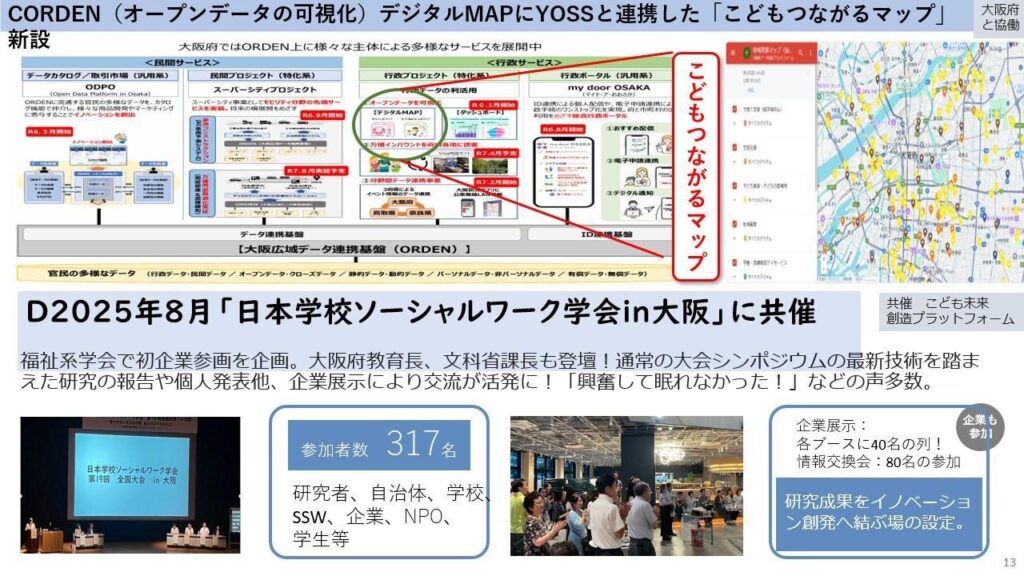
Dr. Yamano: “Let me introduce some other activities. Osaka Prefecture is creating a digital map as part of its smart city initiative, and they have created a “Children’s Connecting Map” for it.
Many teachers do not know where the children’s cafeterias are located in their school districts or where the places are located, and school social workers do not necessarily know much about the school district. By using this map, school social workers with specialized skills can take the lead in providing a more optimal approach to students.
This map is only available in Osaka Prefecture at this time, but we are working on system modifications to incorporate this into the YOSS Cloud and make the service available to any municipality in Japan.
In addition, the “Japan Association of School Social Work in Osaka” was held at our university in August 2025. Our exhibition booth was so successful that there was a line of people waiting to get in, and some visitors said they were so stimulated and excited that they could not sleep. We realized that it is very important to let people know about our activities through this kind of interdisciplinary approach. (▲Picture 14▲)
In addition, there is talk of making it into a movie. When YOSS spoke at a talk show for the documentary “The Plight of Single Mothers in Japan,” which won 17 awards worldwide, the director, Mr. McAvoy, took the issues of isolation, truancy, and suicide very seriously and plans to feature YOSS in a second film in his “People Left Behind” series. The film is scheduled to appear in the second film of the “Left Behind” series.(▲Picture 15▲)
On March 8, 2026, we reported on the YOSS system at a public symposium of the Science Council of Japan. We hope that the YOSS initiative will be widely recognized in this way and lead to support for children throughout Japan.
It is not easy to incorporate the latest technology into the “hard, old-fashioned” world of schools. Nevertheless, YOSS has attracted a great deal of attention, and at the ‘The World in Our Minds’ exhibit in 2025, an impressed parent posted on social media on the spot, “I want YOSS in my district,” and “We need this kind of initiative. The next day, we received a hearing from a school that had seen the post, which was a great surprise.
In the past, YOSS activities have often dealt with specialists and researchers, but I feel it was very meaningful to participate in “The World in Our Minds” and hear many opinions from parents.”
To address the issues that emerged from the screening
Team Schools and Communities
Ishido: “I found this research extremely thought-provoking in that it visualizes concrete results. You mentioned earlier that truancy has decreased by one-third; is this a trend that has been confirmed for the municipality as a whole?”
Dr. Yamano: “It is one school. You had a very large number of non-attending schools to begin with.”
Ishido: “I would like to ask a little more about the background behind the one-third reduction in truancy. What issues and signs were revealed through the screening, and what kind of support was provided to address them?”
Dr. Yamano: “Usually, when a child is absent from school for seven days, the school becomes concerned about that child. The teachers are too busy to take immediate action. If 30 days pass in the meantime, it is counted as ‘truancy.
The key point is what kind of support can and will be provided during this 7 to 30 day period. During this period, it is important for teachers to proactively reach out to children, and for children to have the opportunity to see a different world and experience recognition at community resources such as “children’s places” and support schools that they can easily visit outside of school.
In fact, research has shown that self-efficacy is about twice as high for children who visit places outside of school, such as community resources, than for children who attend school. In other words, having a third place outside of school and home can help children regain confidence and “recharge their energy,” so to speak. This is where they start to think about going to school.
Children who have been truant for months need individualized specialized care. On the other hand, for children who show early signs of truancy, if the right approach can be taken within 7 to 30 days, the truancy trend will improve.”
Ishido: “I understand that one of the reasons for the decrease in truancy to one-third is that early intervention from the symptom stage prevented the transition to truancy. On the other hand, for the remaining two thirds, there are many cases where truancy has already become prolonged, so is it correct to think that this approach alone is not sufficient?”
Dr. Yamano: “What I am offering is a ‘screening system. Children who are already in a serious condition are already screened. By approaching them one step before that, we can prevent the child from suffering. If you think, ‘I’m not going to school, so I’ll get counseling from a certified psychologist, clinical psychologist, or psychological counselor at an educational center,’ you will end up waiting for months. However, it is possible to immediately connect children to a “place for children,” such as a community resource. I think there is a big difference.”
Ishido: “One survey shows that ‘sensory sensitivity’ is the most frequently cited reason for non-attendance at school. Earlier, you mentioned an approach to connecting to a third place, and I felt that if there are children who are experiencing difficulties at school due to sensory sensitivity, it is important to improve the environment at the school.
In your research, have you identified any issues or areas for improvement related to the school environment? Also, please tell us what kind of efforts are being made to address these issues.”
Dr. Yamano: “A child of concern is picked up at the screening meeting in a vague way. At the team meeting, the school counselor and school social worker are also involved to discuss the child in more detail. For example, if a hypothesis emerges there that the child ‘may be suffering from sensory sensitivity,’ then we become aware of the child’s thoughts and feelings, and this leads to a movement to ‘change the school room.
I mentioned earlier that since the YOSS Meister was put in place, there have been zero truancies. In that school, this process led to the discovery that there were children with dysgraphia, and with the guidance of specialists, we were able to connect them to the appropriate support.
Specific efforts include: providing additional staffing (assigning additional instructors individually to children who need support), creating a safe place for children in each grade level, and creating time for children to laugh and be lively. It has been decided to change schools not only by responding to individual cases of children’s issues that have emerged from screening, but also by taking a mezzo approach from the perspective of adjusting the environment of classrooms and school units.”
Don’t keep teachers and parents on their own.
Use the school as a hub to expand the “bathtub of support
Ishido: “Let me ask from a slightly different perspective. I understand that the reduction in tardiness, attendance at the school nurse’s office, and truancy is extremely significant. On the other hand, in an age when it is possible to design a variety of learning styles for a variety of children, returning to school itself is not the only goal.
From the perspective of designing a comprehensive environment for children’s learning, not confined to schools but within society as a whole, what goals do you envision for your teacher screening system?”
Dr. Yamano: “The results of the decrease in truancy include not only children who have necessarily returned to school, but also those who have settled into various forms of learning, including free schools. While some parents have researched and applied for free schools on their own, there are many parents with limited resources, such as busy working families or single-parent families, who have difficulty coping on their own. First of all, we believe it is important to show these people the options that are available in the world so that they will not be left out.
My goal in screening is to build a society and environment that can support children not only at home but also in the community and school. There is no need for the problems to be faced only by the family or the school. I think of the child as the subject, and consider expanding the “bathrock of support” so that the child can obtain the services and resources necessary to fulfill his or her needs.
Screening is just one tool for creating an ideal society, but many children spend a lot of time at school. We would like to make a breakthrough to expand the ‘support envelope’ by first utilizing screening in schools.”
Ishido: “You are saying that schools will play a role as a hub in supporting children in society as a whole. In relation to this point, let me ask you one more question.
Regarding the connection with local resources, we feel that the more we connect, the more we may face a lack of capacity and acceptance on the local side. What issues do you see in this regard at present?”
Dr. Yamano: “You are right. However, on the community resource side that we have now, we want to connect more with schools and connect them to children in need. In other words, our first goal is to solve the issue of even the existing resources not being used appropriately. For example, there are 10,000 children’s cafeterias in Japan, but only 10% of people in Osaka use them, and about 2-3% nationwide. This is 2-3% for both families with high incomes and those in financial difficulty. This cannot be considered successful. After all, it can only be considered a success if children from economically challenged families are able to use it appropriately.
Looking at the reasons for this, the number of children’s cafeterias is increasing, but there are no tools to connect children and families there. Due to personal information, local people who are involved in children’s dining halls are not able to lure children themselves, so the current issue is that children who really need support are not being reached.
Therefore, if we use screening for all children to connect children who need support with children’s cafeterias, we can create a three-way world that benefits the three parties: the children, the school, and the community. For this purpose, schools need to become the hub.”
Ishido: “You mentioned something about personal information, and I think there are some risks that could be pointed out in such an initiative. For example, screening may lead to labeling, early detection may instead lead to early immobilization, or how to handle sensitive child data. You mentioned earlier that it is not a matter of labeling, but what measures or design innovations are you taking to address these concerns?”
Dr. Yamano: “Only school teachers have access to personal information in the screening process. This personal information is merely an easy-to-read, centralized version of the tardiness and forgotten items information that teachers should be aware of on a daily basis.
As for labeling, we do not make any judgments such as ‘you are being abused’ or ‘you are being bullied’. We only flag things that concern us in order to consider support for them, and we try to make sure that this does not lead to labeling.
In fact, when we talked to teachers at the school, many of them said, “It is not a label,” but rather a visualization of daily life itself, as the items change one after another, for example, a child who has been tardy for a long time now is forgetting more things.”
Ishido: “What do you see as the barriers to implementing a screening system nationwide?”
Dr. Yamano: “There are three major reasons. First, many schools are not very good at introducing new technologies and IT and dealing with them. The first barrier is that schools are reluctant to introduce a screening system.
Second is the issue of budget. The screening mechanism itself can be introduced at low cost, but the question is whether it can be budgeted based on its necessity and effectiveness. Since it is to be introduced as an administrative organization, it will be difficult without a supervisor who understands the necessity and can make a budget request.
Furthermore, instructional supervisors and those on the school board who make the budgets have been with the company for less than one year on average, and there is a rapid turnover of staff in charge. The third challenge is that it is difficult to accumulate know-how and significance.”
Ishido: “How have you been able to break through the resistance of schools?”
Dr. Yamano: “By holding the meister training course I mentioned earlier, we were able to get people to understand the content. Once one person in the school understands it, that is the breakthrough point, so the key is how to find the key person.”
A place where both children and teachers can “smile” (*reference)
That is the ideal image of a school.
Ishido: “Regarding the current situation where the number of children who are not attending school is increasing, what do you see as the underlying factors?”
Dr. Yamano: “News reports emphasize the viewpoint that ‘truancy has suddenly increased’ or ‘growth from last year,’ but the fact is that the rate of increase has increased nearly five-fold since the Corona disaster.
I was commissioned by the Ministry of Health, Labor and Welfare to conduct a survey for “Post-Corona Policy Recommendations” in the fall of 2020. In the process, I found that about 90% of the children were clearly stressed and about 30% had difficulty going to school. Adults live their lives as if the corona disaster is a thing of the past, but for the children, the impact of the corona disaster was devastating. In particular, the fact that they were not able to form relationships when they should have, and the fact that many families are now facing economic hardship, have left a lasting impression.”
Ishido: “I would like to ask you two final questions. One is about what Dr. Yamano thinks is the ideal image of schools in the future, and the other is about what we should do for our future society from the viewpoint of neurodiversity.”
Dr. Yamano: “Regarding the ideal school, I think it is a school where stress is low and both children and teachers are smiling and at ease.
The second question is a difficult one, but I am very excited about ‘The World in Our Minds’ held from a neurodiversity perspective. I too received a variety of advice when I exhibited. I hope that more people will be able to move between the complex and busy direct field of schools and the world of neurodiversity, which presents an objective and bird’s-eye view of diversity, and I will continue my studies.”
Ishido: “Through today’s talk, I have once again strongly felt the significance of holding ‘The World in Our Minds’. I could clearly see that your research and practices are based on scientific data to create a foundation for realizing a desirable environment for each child. As a person involved in the EdTech field myself, I would be very happy to have the opportunity to work with you in the future. Thank you very much for your valuable talk today.”
REFERENCES
Noriko Yamano Laboratory (2021), “March 2021, Health and Labor Administration Promotion Research Project, Cross-Sectional Study on the Impact of the Corona Disaster on Children and Support Measures: Report of Survey of Parents and Children,”
Noriko Yamano Laboratory (2021), “Research on School Counselors and School Social Workers for Full-Time Employment, Commissioned by the Ministry of Education, Culture, Sports, Science and Technology in 2020.
Noriko Yamano, Supervisor (2024), Screening YOSS Practice Guide: Toward Understanding Students and Realizing Team Schools, Akashi Shoten
Noriko Yamano Laboratory (2025), “2024 Ministry of Education, Culture, Sports, Science and Technology Commissioned Research Study on the Full-Time Employment of School Counselors and School Social Workers,” Report.
*The Osaka Public University School Social Work Evaluation and Support Institute (2026) “Tsunagibito” https://www.omu.ac.jp/orp/ries-ssw/assets/2026%E5%B9%B4%E3%81%A4%E3%81%AA%E3%81%8E%E3%81%B3 %E3%81%A8.pdf