A society where we share our thoughts and accept one another I want to create a society where people have that kind of mindset
9/28/26
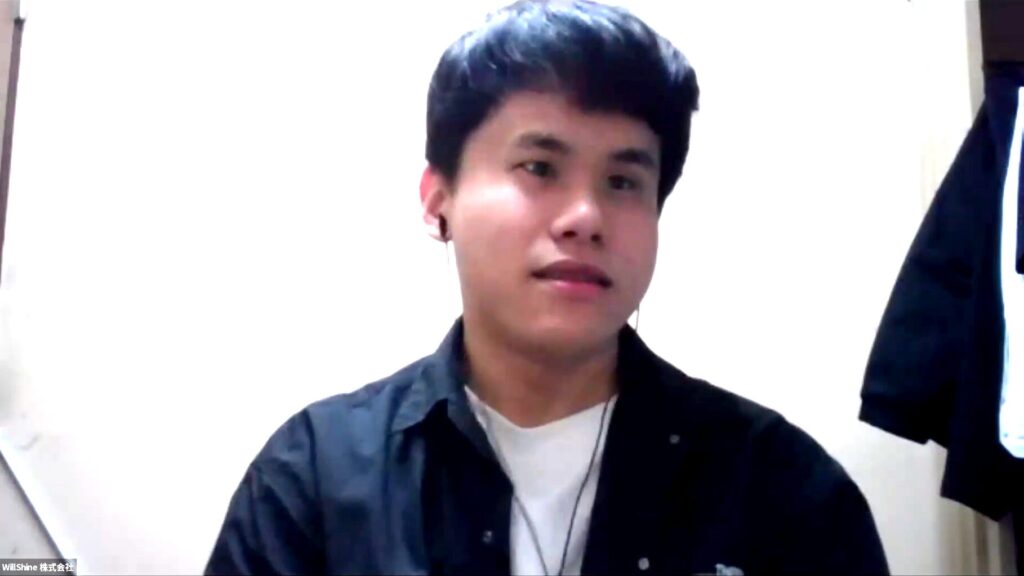
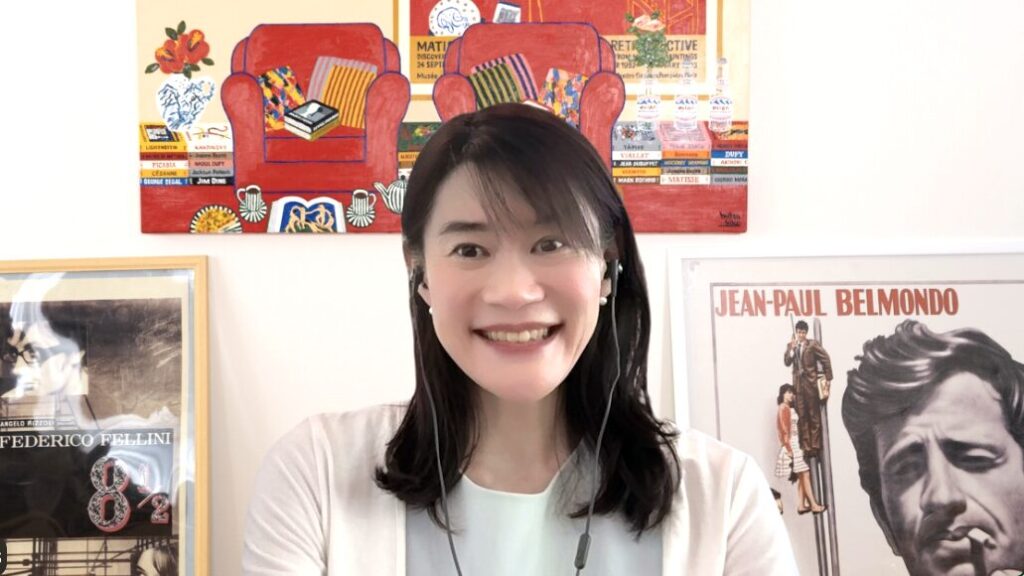
The “Neurodiversity Project,” organized by B Lab, aims to respect brain and neurological diversity and create a society where everyone can thrive as their true selves. In this installment of the Neurodiversity Project interview series, we feature Kazuki Kawamoto (▲Picture 1▲), Representative Director of WillShine Inc., who will be exhibiting for the first time at the 2026 “The World in Our Minds” event. Nanako Ishido (▲Picture 2▲), Director of B Lab, spoke with him about the initiatives of “Vreach,” an online tutoring service specializing in children and students with visual impairments.
>> Interview videos are now available!
For Children with Visual Impairments
Providing services for children who are blind or have low vision
Ishido: “Today, we’re joined by Mr. Kawamoto from WillShine Inc., who will be exhibiting for the first time at the upcoming ‘The World in Our Minds’ event. Without further ado, I’d like to ask you to tell us about your exhibit, your day-to-day activities, and the content of your classes. Thank you for joining us.”
Mr. Kawamoto: “At WillShine Inc., we primarily operate ‘Vreach,’ an online one-on-one tutoring service for children with visual impairments—those who are blind or have low vision. I myself used to have low vision, and now I am completely blind—though I can still perceive differences in light and dark. Drawing on my own experience, our company’s distinctive feature is that we provide a variety of services for people with visual impairments, placing great importance on the concept of ‘peer-to-peer support.’”
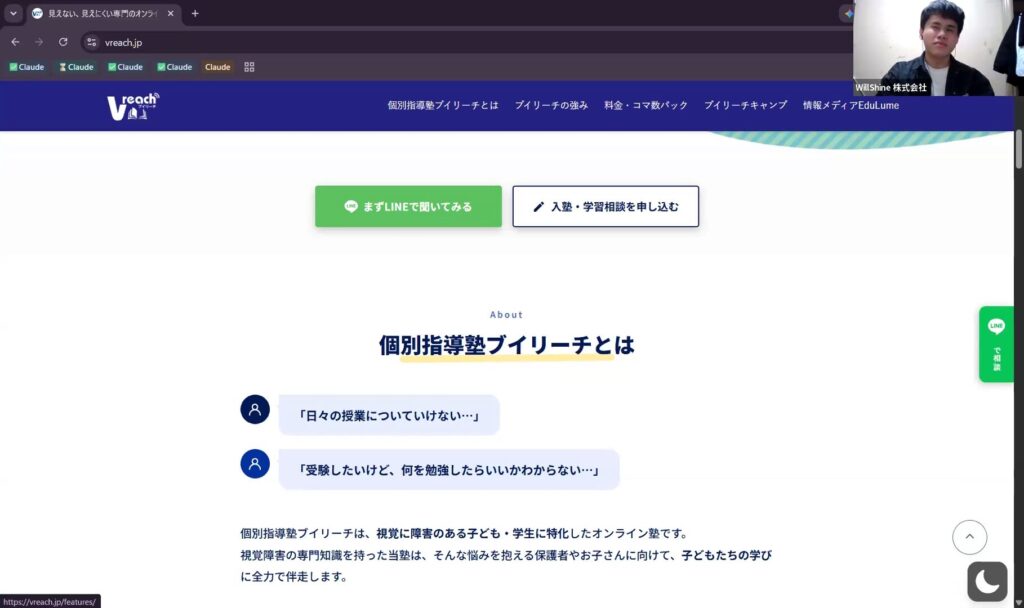
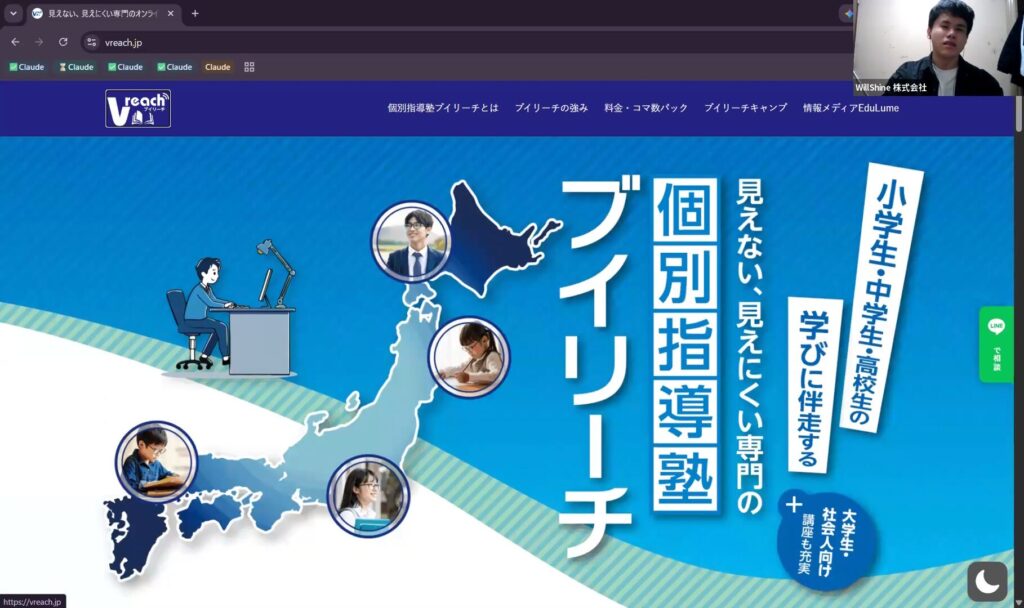
Vreach currently offers four services. Its main service is an online one-on-one tutoring program. Teachers with visual impairments—who themselves “cannot see or have difficulty seeing”—teach children who “cannot see or have difficulty seeing.”
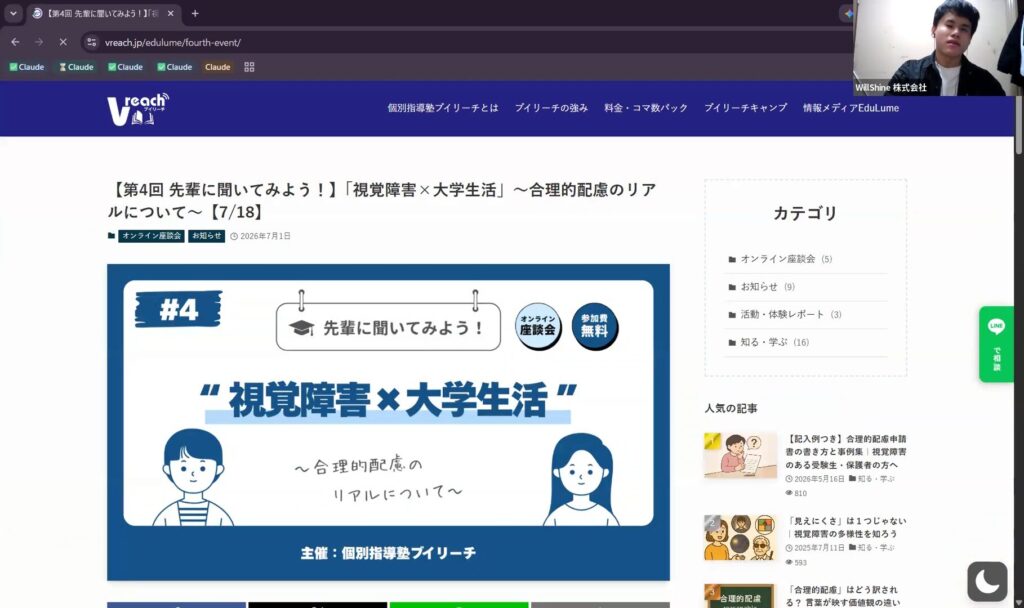
The second is online events. For example, under the banner “Let’s Ask Our Seniors!,” we host talk events aimed at people with visual impairments. Last time, we held a talk event for elementary, middle, and high school students and their parents on the theme “The Reality of Reasonable Accommodations,” featuring a college student with low vision as a guest speaker.
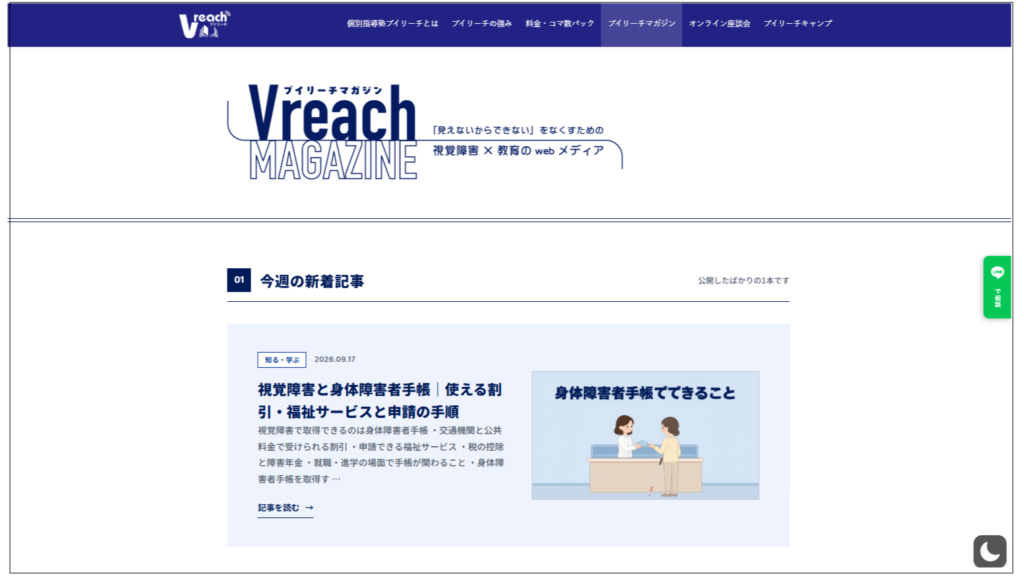
The third is our media business. The publication is called Vreach Magazine, and it is a media outlet that “provides tips on further education, school life, and taking on new challenges to children and students with visual impairments and those around them.”For the community itself, we publish experience-based articles—such as “What Does ‘Reasonable Accommodation’ Mean?” and “How Do You Come to Terms with a Visual Impairment Diagnosis Right After Receiving It?”—as well as event reports.
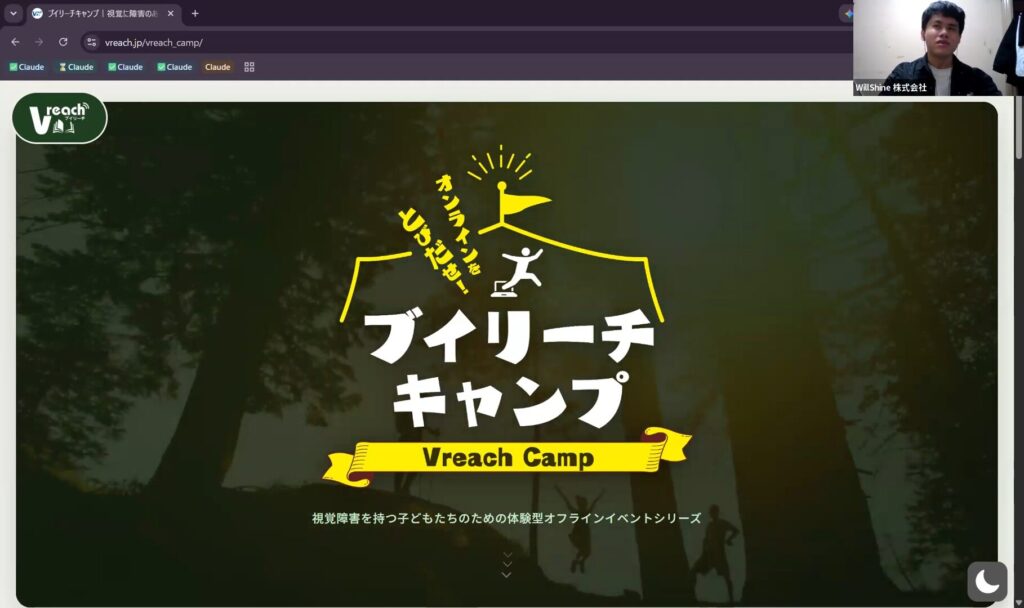
The fourth is the Vreach Camp. It is a camp that combines “learning and nature experiences” for children with visual impairments.
In this way, we are expanding our initiatives for children with visual impairments based on these four pillars.
Next, I’d like to introduce what we’ll be showcasing at “The World in Our Minds.” First, we plan to share footage from this Vreach Camp. I imagine it can be difficult for the general public to picture how children with visual impairments experience nature or cook curry over an open fire using a mess kit. We hope to give you a glimpse of what that looks like.
Another aspect is the “experience” of “not being able to see or having difficulty seeing.” At Vreach, we provide one-on-one online tutoring to children who “cannot see or have difficulty seeing.” We want to create a space where visitors can experience firsthand the strategies we use to describe in words the things you normally ‘understand by looking at them’—such as diagrams, 3D shapes, colors, and pictures—and the specific language we employ when teaching geometric shapes and 3D objects.”
Instead of starting from what we can’t do,
I’d like us to work together to figure out how we can make it happen
Ishido: “Thank you very much. Those are some wonderful activities. Have you already graduated from college, Mr. Kawamoto?”
Mr. Kawamoto: “I’m still on the staff.”
Ishido: “You’re still a student, aren’t you? As I listened to you speak, I was impressed by how much you’ve accomplished despite your busy schedule. I’d like to ask you a few questions. First, could you tell us about the circumstances that led you to start this kind of business, including your own personal experiences, Mr. Kawamoto?”
Mr. Kawamoto: “When I was two years old, I had my left eye removed due to retinoblastoma—simply put, a cancer of the optic nerve—and my right eye also developed amblyopia.From the time I was old enough to understand, I’ve lived with only one eye, and even that eye has limited vision. Moreover, since there was no one around me with a similar visual impairment or who saw the world the same way I did, I found it incredibly difficult to envision my future career.”
I think there’s a common perception that people with visual impairments tend to work in massage or acupuncture, but I personally didn’t think I was suited for those professions. I wanted to go to college and continue my studies, but living in a rural area made that quite difficult. Universities were reluctant to accept me, and I wasn’t even sure how to go about studying in the first place. That’s why I wanted to create a space where people with visual impairments could learn directly from those who are currently attending college and thriving, build connections with them, and forge bonds with their peers—and that’s how Vreach was born.”
Ishido: “I imagine this service was launched because, based on your own experiences, you felt there was a gap in society. Earlier, you mentioned future options.I previously read an interview with Mr. Kawamoto where he mentioned that he had faced difficulties due to assumptions like, ‘This is how it is because you can’t see.’ If there are specific changes you’d like to see in society to help people with visual impairments shine even more, I’d love to hear your thoughts.”
Mr. Kawamoto: “I think this applies to any disability, but rather than starting from the ‘line of what can’t be done,’ I’d like people to work with us to figure out how we can make things happen. To do that, it’s important for people to learn about the disability itself.In this edition of ‘The World in Our Minds,’ we’ve made an effort to help people learn about visual impairments; the first step is for them to understand how people with visual impairments live their lives and what they’re thinking. I’ve always believed it would be best if this starting point weren’t one that assumes, ‘People with disabilities can’t do this,’ but rather one where we ask, ‘How can we make this possible?’”
Ishido: “In ‘The World in Our Minds,’ there’s a section called ‘Expanding the Self Through Technology.’ The goal is to use technology to turn what was once ‘impossible’ into ‘possible,’ or to further expand the scope of what we can do.Would it be correct to view Mr. Kawamoto’s service as a challenge to transform ‘can’t’ into ‘can’ in the realm of learning—such as acquiring knowledge?”
Mr. Kawamoto: “From the perspective of someone with a visual impairment, things that are ‘just a given’ might lead people who aren’t very familiar with the issue to ask, ‘Can you really do that?’For example, ‘Can you study online even if you can’t see?’ So I think this initiative serves not only to turn ‘can’t’ into ‘can,’ but also to update the perceptions of people who aren’t very familiar with these issues.”
Ishido: “I see. It’s true that when it comes to learning that relies on visual cues—such as shapes and colors—I can’t help but wonder, ‘Is that even possible?’ or ‘How do they do it?’ It might be one of the highlights of the ‘The World in Our Minds’ event, but I’m very interested. Would it be okay if I asked a little more about how you actually teach these concepts?”
Mr. Kawamoto: “For example, in a lesson teaching three-dimensional shapes like a hexagonal prism, simply saying, ‘It’s a hexagon shaped like a column,’ doesn’t help students visualize it. Even if they touch a Braille diagram, it’s hard to grasp the three-dimensional form, so it can be confusing. In such cases, I ask, ‘Do you know the big box of “Koala’s March” candy?’That box—which many children have touched—is a hexagonal prism. The ‘Chipstar’ box is a cylinder. In this way, I make a conscious effort in my lessons to teach by linking concepts to familiar, easily understandable, and tangible objects from their daily lives.”
Ishido: “You mentioned that you wanted to change the mindset—from thinking, ‘I can’t do it because I have a visual impairment,’ to thinking, ‘I can do it even with a visual impairment.’ Could you tell us what strategies you’re using to shift that mindset—from ‘I can’t’ to ‘I can’—in areas other than academics as well?”
Mr. Kawamoto: “We have an initiative at the Vreach Camp. The August camp is held at a ‘Youth Nature Center,’ similar to a forest school, where the children spend four nights and five days away from their parents. When children who are completely blind gather to make curry or have a campfire, the first thought that comes to mind is, ‘It’s dangerous because they can’t see—they won’t be able to do it, right?’”
The key to dealing with this is, after all, the accumulation of various small adjustments.“For example, in daily life, something as simple as tying a string to a doorknob can make it much harder to get lost. If you provide thorough orientation beforehand and teach them the basics—like, ‘This is how you get to the restroom’—they won’t just say, ‘It’s hard when I can’t see,’ but will be able to move around on their own. I truly believe it comes down to the accumulation of these small things.”
Ishido: “In a previous interview, you mentioned, ‘For example, when I drop an eraser, people around me always pick it up for me. But as this happens over and over, I start to think that everyone around me will do it for me. That, in itself, becomes a new hurdle.’From that perspective, what kind of shift in mindset do you think is necessary for both people who are visually impaired and those around them?”
Mr. Kawamoto: “I think there are so many things that children with visual impairments cannot do, find difficult, or find dangerous. Even so, these children are individuals in their own right. Before anything else, they are human beings—not just people with visual impairments. I believe it is important for those around them—those who are considered their supporters—to understand this and interact with these children in a way that is appropriate for their age.”
It’s common for middle school friends to pick up an eraser that’s been dropped for each other. I think it’s only natural to say thank you when someone does that for you. However, while it would be easier if those around them simply stepped in to help and avert the danger right then and there, I feel they should instead be taught how to find it themselves.When a person with a visual impairment faces a difficulty, they want to know how to solve it on their own—in other words, they want to be “taught how to fish, rather than given a fish.”
“I think that for those directly affected, the people around them are often very kind in their daily lives—reaching out to help and protect them. Even so, I want them to always be thinking about what they can do themselves. I want them to maintain a proactive attitude—not just be passive, but to take action themselves.”
Creating the right learning environment is important for inclusive education.
Ishido: “What you just said is very important—not only for people with visual impairments, but also from the perspective of building a society where people from diverse backgrounds can live together.”
I understand that Mr. Kawamoto himself was born and raised in Tokushima, and that there were no special education schools there when he was a child. I wonder if growing up in that environment had its benefits, and conversely, if it also presented some challenges.The Japanese education system has a strong tendency toward segregated education, and the United Nations has issued recommendations calling for this practice to be corrected. On the other hand, I believe there are pros and cons to both environments where diverse students learn together and those where they are segregated. What do you personally consider to be the ideal learning environment for the future?”
Mr. Kawamoto: “Inclusive education and separate education are frequently discussed topics in this field, but from the perspective of someone with a visual impairment, I believe it’s important to have a ‘choice.’The advantage of separate education is that students can acquire the skills necessary to live independently in a world where they cannot see at special education schools. There are specialized teachers, and there are also classes dedicated to independent living skills. One of the benefits of special education schools is that students can learn during school hours how to navigate using a white cane or how to use their residual vision to read text.”
The downside, of course, is that connections with society continue to weaken. But I think that, conversely, is actually one of the benefits of inclusive education.When I was in elementary school, I studied in an environment similar to what is known as “inclusive education,” but elementary school students can be quite cruel, so I went through some pretty tough times. While it was a valuable experience for me personally, I wouldn’t want my own children to have to go through the same thing if possible.
The idea of adopting inclusive education simply because the United Nations has recommended it actually places a burden on people with disabilities. It also places a burden on the children learning alongside them.I think it’s difficult for elementary and middle school students to accurately learn about and understand disabilities, and if children without disabilities and their parents come away from the classroom with the impression that “we’re the ones getting the short end of the stick,” I worry that this could lead to negative consequences once they enter society.
“Therefore, creating a suitable learning environment is essential when implementing inclusive education. We must consider whether the arrangement places an excessive burden on both students with disabilities and their so-called ‘typical’ peers, as well as whether it ensures that all students can learn effectively. From that perspective, I believe it would be best if students had the option to choose either path.”
Ishido: “Having a wide range of options is truly important. It’s not a matter of which is better or worse; rather, as I listened to your remarks, I was reminded once again that what truly matters is ensuring that everyone—including those considered ‘able-bodied’—has their right to learn fully guaranteed.”
From the perspective of ensuring learning opportunities for all children, I believe the use of technology is also important. I have previously proposed a policy to provide each student with their own digital device. I view this as the infrastructure necessary to provide personalized learning for all children and to ensure reasonable accommodations for everyone.I also believe that the online one-on-one tutoring service you provide, Mr. Kawamoto, contributes to ensuring learning opportunities through the use of technology. From that perspective, what do you expect from technology? Also, if you have any ideas—beyond technology—about other approaches that could help ensure learning for every individual, I would appreciate hearing your thoughts.”
Mr. Kawamoto: “When it comes to technology, the first thing I notice is how much it has evolved. Our company has built its own learning management system (LMS) and offers it in a format that can be accessed via LINE, and it’s become much easier to develop than it used to be.Furthermore—though this may apply specifically to people with visual impairments—the progress in AI and text recognition technologies like OCR has been remarkable, and I believe they are becoming a ‘substitute for the eyes.’ Thanks to these technological advancements, I think not only learning but also daily life and work have become much easier.”
AI, in particular, is quite effective at tasks that people with visual impairments have traditionally struggled with—such as extracting specific information from large amounts of text. However, since sighted people can use the same tools, I worry that even people with visual impairments may fall further behind and be unable to keep up if they don’t keep pace with technological advancements.I’ve seen that, as part of the “Giga School” initiative, tablet devices are being deployed in schools to support children with visual impairments, and I thought that was wonderful. Unless a solid foundation is established for mastering new technologies, people with visual impairments risk being left behind.
However, while Chromebooks have actually been distributed to schools, it seems there aren’t many people with visual impairments who are actively using them. Even when I search online, I can’t find much information about it.“I occasionally hear stories about elementary and middle school students who are still figuring out how to use their Chromebooks. I think it would be ideal if we could share more of this kind of information and eventually discover new ways to use them.”
Ishido: “There have been many instances in the past where new technologies and services have emerged from the idea that ‘because of this limitation, we’d like to see improvements like this.’ I believe that ideas originating from people who are directly facing certain challenges can sometimes lead to solutions that are easier to use for a wider audience.At ‘The World in Our Minds,’ we’ve also made solving social issues through technology one of our core pillars, so I was listening to your story hoping that there might be something we could do together.”
Let me ask you a slightly more in-depth question. Mr. Kawamoto, you yourself have experienced both the world as seen through low vision in the early stages and the world after you lost your sight.When you look at the world, I think there are often differences in how people who can see and those who cannot perceive things. Sharing these differences with one another is one of the missions of “The World in Our Minds.” If there are any differences in how you perceive the world based on your experiences in both worlds, or if there are things “you can’t see precisely because you can see,” I’d appreciate it if you could share them with us.”
Mr. Kawamoto: “To start with, I had low vision when I was a child, so while I’m aware that what I saw back then was colored by a child’s perspective, I believe that the information we take in through our eyes is only one element of the essence of how we perceive the world. When I could see, even when looking at a landscape, I used to think I understood it based solely on what I could see.”
At the time, I really thought I understood, but once my vision started to fade, I realized I couldn’t truly understand things unless I touched them, held them, or smelled them. For example, when I could still see, I used to think, “This house is really beautiful,” but after I lost my sight, when I passed by it and touched the fence,I’d think, “Huh. I thought it looked pretty smooth, but it’s actually kind of rough,” or “There’s more grass growing here than I expected.” There are things I couldn’t tell when I could see, but now I’ve come to notice them by touching or getting closer—“Even the places I walk by every day have a smell,” or “I can smell curry,” or “This area might actually smell a bit,” and so on. I feel that since losing my sight, I’ve become able to pick up on things that I couldn’t tell just by seeing.
In relation to the exhibits at “The World in Our Minds,” I’d like visitors to experience explaining something while neither they nor the person they’re talking to can see anything. Through this, they’ll come to realize just how much they rely on their eyes, and they may be surprised to find that terms like “that,” “this,” and “it” aren’t as easy to understand as they might think.I think that for some people, conveying the sensation of touch might actually be easier than describing what they see. I believe it would be an interesting experience for visitors to try communicating without the element of sight.”
At Vreach, you can connect with instructors who are just a step ahead of you.
Having instructors like them is a tremendous asset.
Ishido: “I think that by relying too much on our sense of sight, we end up missing out on a lot. To help everyone view things and events from multiple perspectives, we should try to sharpen our various senses and perceive the world through senses other than sight. As I listened to your story, I found myself thinking that such experiences must be incredibly valuable.”
I think that at Vreach, they place a lot of value on having people with visual impairments serve as instructors. Since there are likely many things they can convey precisely because they have firsthand experience—beyond just teaching academic subjects—I believe that’s what makes this service so valuable.
“May I ask how you view the value of having the parties themselves share their perspectives?”
Mr. Kawamoto: “I think there are two key aspects. One is learning—specifically, how to study using Braille. I suppose you could call it a skill. I believe this is something we can teach precisely because we’re in this situation ourselves.”
What I consider most important is that there are children with visual impairments who are still learning and growing—and I wonder if there are things they find difficult to talk about as they grow up, such as their various feelings, their relationships with their parents, siblings, and friends, as well as their anxieties and expectations regarding entering high school or college.
I’ve experienced this myself: there are things I can’t do right now—things I want to do but can’t—simply because I can’t see them. When I run into a barrier caused by this lack of visibility, it’s quite common for people who can see those things to tell me, “Well, maybe you should just give it up,” or to treat me with pity.I have memories of really hating that, so I think I can speak from the perspective of someone who’s actually gone through similar experiences and hit those same walls. I also believe it’s incredibly valuable just for people to know that a senior with a similar visual impairment is currently attending college like this.
“So, while thoroughly teaching skills and academic subjects is one major focus, I also think that the fact that instructors themselves provide tremendous value by helping students connect with seniors who are just a step ahead of them—and by letting them know that such people exist.”
Ishido: “Finally, I’d like to ask you what you hope to see from society. Up until now, I think many things have been created based on the assumption of what is considered the ‘majority’ or the ‘average’—whether that refers to institutions, educational and workplace environments, perceptions of age, or even products.However, moving forward, I would like to design a new society based on the premise that each individual is unique and that everyone perceives the world differently. If there’s anything you, Mr. Kawamoto, would like to see in society or any changes you’d like to see made, I’d appreciate it if you could share a few closing remarks before we wrap up.”
Mr. Kawamoto: “As you just mentioned, since each person’s perception and sources of information are bound to differ, I hope people will first seek to understand that—that such differences exist. I think a society where many people have the initiative to learn about these things is wonderful. I believe that initiative—the drive to change things on one’s own—is crucial. So, whether it’s people with disabilities,and people without disabilities—I want everyone to recognize that they have their own way of perceiving the world and their own perspective, and I hope they’ll have the open-mindedness to accept others’ perspectives with a sense of “Ah, I see.” Ultimately, I want everyone to feel that they are an active member of this society, helping to shape it.”
I think the ideal society would be one where everyone embraces the mindset that this isn’t about exclusion, but rather about sharing our ideas and accepting one another.
“I think the actual products will follow from there, so I believe it all starts with the heart—or rather, the mindset.”
Ishido: “Our ‘The World in Our Minds’ also features a section called ‘Creating Society.’ It explores how we can all work together to build a new society while respecting each other’s differences.Our fifth section focuses on building a neurodiverse society through each person’s proactive participation in social creation, and I thought it fit perfectly with what Mr. Kawamoto just said.”
First, he shared that instead of assuming “I can’t do it,” we should think about “what we need to do to make it happen.” Listening to Mr. Kawamoto talk about his life so far, I can’t help but wonder if he’s often heard people say, “But you can’t see.”To dive into a new world, she moved to Tokyo on her own to attend college; she then studied abroad numerous times, took on challenges in various countries, and even started her own business while still a student. Hearing these stories makes me wonder anew: What does “I can’t” really mean? Perhaps saying “I can’t” is actually a way of creating limitations within our own minds.And I think one of the triggers for creating those mental limitations is a casual remark from someone around us—one that’s certainly not meant maliciously—which, in some cases, can make us feel that “I can’t do it.” That’s why, based on the premise that every single person has infinite potential, we must ask ourselves how we’re going to build a new society moving forward. Listening to today’s talk, I felt once again just how important that is.
“Thank you very much for taking the time to meet with us today despite your busy schedule.”