The DABOT Project promoting a successability society where everyone can achieve self-fulfillment, regardless of disabilities
12/8/25
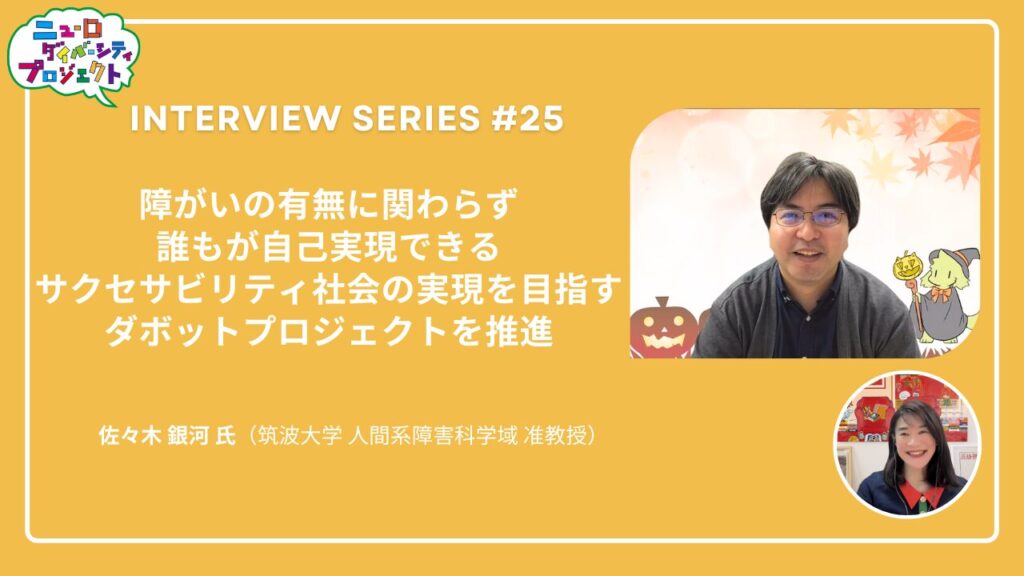
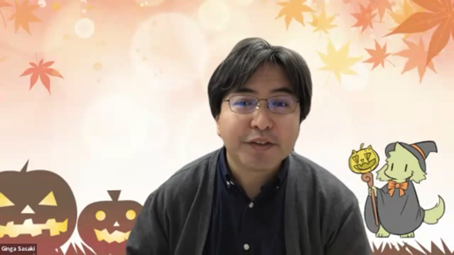
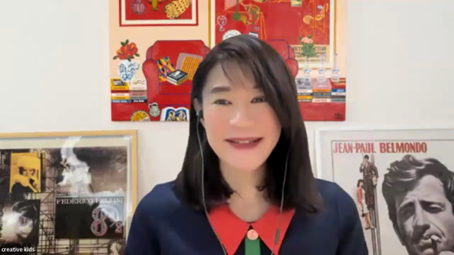
The Neurodiversity Project, sponsored by B Lab, aims to realize a society in which the diversity of the brain and nervous system is respected and everyone is able to demonstrate their abilities in their own way. In this Neurodiversity Project interview series, we will introduce the efforts of Dr. Ginga Sasaki (▲Picture 1▲), Associate Professor, Faculty of Human Sciences, University of Tsukuba, who exhibited at “Brain World for Everyone” for the first time this year. Based on the idea that developmental disabilities are not judged by whether or not a person has a diagnosis, but rather on a gradation of characteristics that exist in all people, Ginga Sasaki’s laboratory is engaged in the research and development of a chatbot called “Dabot” that can support not only people with developmental disabilities, but also their supporters. Nanako Ishido (▲Picture 2▲), Director of B Lab, spoke with Mr. Sasaki about his research.
> Interview videos are also available!
Developmental disabilities are not broadly classified according to whether they are diagnosed or not.
but rather a gradation of characteristics that are present in all people.
Ishido: “Dr. Sasaki exhibited at “Brain World for Everyone” for the first time this year. Please tell us about your exhibit and research.”
Dr. Sasaki: “Our laboratory (Sasaki Ginga Laboratory, University of Tsukuba) is working on a project to develop and deploy a chatbot called “Dabot,” which supports people’s sense of self regardless of whether or not they have a developmental disability diagnosis. My field of expertise is “disability science. It is an interdisciplinary field that deepens research on disabilities from various angles, and I specialize in research and education on developmental disabilities and autism spectrum disorders.
In addition, the University of Tsukuba has a department dedicated to supporting students with disabilities within the Human Empowerment Promotion Bureau, and I am also the manager for promoting operations there. In addition to research and education, I am also involved in specific support for students with disabilities.
The University of Tsukuba has long been committed to supporting students with disabilities. In particular, since I was appointed to this position, we have been focusing on supporting those with developmental disabilities. Developmental disabilities are easily distinguished in various ways depending on whether they are diagnosed or not. In other words, although they are innate characteristics, social responses to them are divided depending on whether they are diagnosed later or not.
This is especially true for adults with developmental disabilities, who are the primary focus of my research. Without a diagnosis, adults with developmental disabilities may not be eligible for employment or welfare services. On the other hand, from the viewpoint of neurodiversity, developmental disabilities cannot be clearly divided only by the presence or absence of a diagnosis, but rather should be viewed as a “gradation of disabilities. It is also considered to be a “way of being human. My understanding is that the institutional design and support system have not caught up with the actual situation of people with developmental disabilities, or in other words, with the way people are. (▲Picture 3▲)
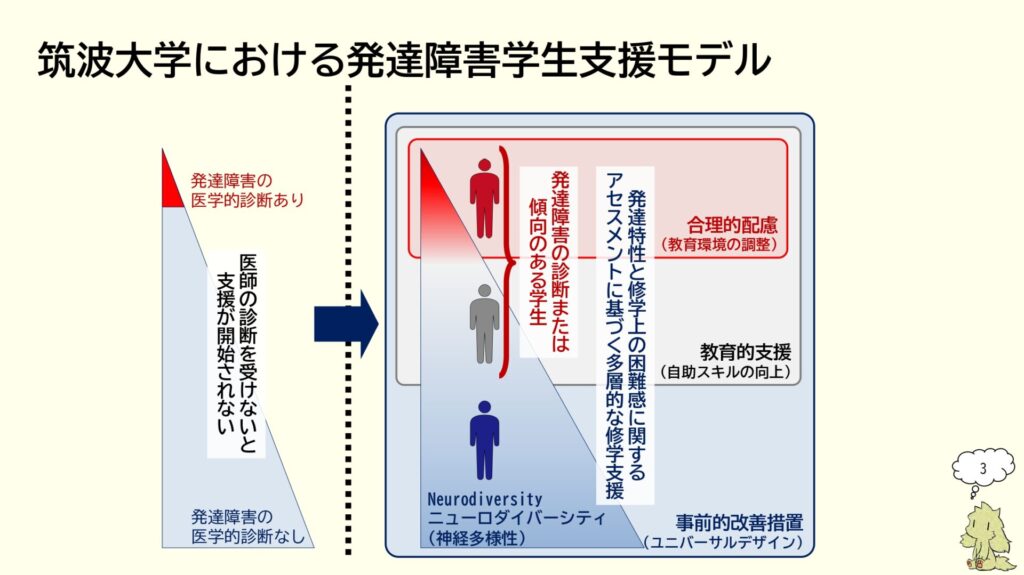
Based on these ideas, we examined what support should be based on neurodiversity. It is necessary to build support based on assessment evaluations of the characteristics and traits of each individual, with a deep consideration of the efforts that should be made for all people regardless of their disabilities, environmental improvement, education to deepen understanding of people with strong characteristics such as developmental disabilities, as well as reasonable accommodation This is why I began my research at the University of Tsukuba.
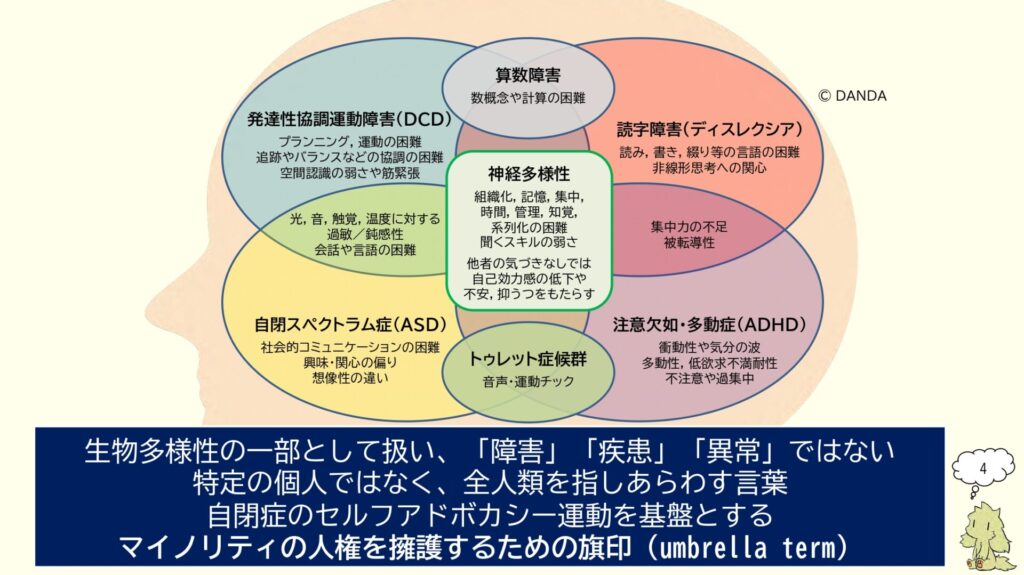
From a neurodiversity perspective, rather than claiming characteristics or diversity, I believe it is appropriate to view developmental disabilities themselves as gradations, and that there are shades of these gradations that apply to all of us.
The foundation of this idea is the autism self-advocacy movement. It is a movement for those involved themselves to express and realize their own needs and rights to society, and is considered to be a so-called umbrella term that defends the human rights of minorities. With this in mind, our research is based on the premise that it does not focus only on the characteristics and talents of those who excel in something.” (▲Picture 4▲)
The Dabot Project aims to
Successive society where everyone can achieve self-fulfillment
Dr. Sasaki: “The Dabot Project was conceived based on this conceptual design. There are people who have not been diagnosed with developmental disabilities, but who may be left out of society because they have such characteristics, or because they manifest such characteristics in such a strong way. The gray zone has not been defined academically, but because these people have not been diagnosed, they often do not know where to find support services or what kind of support they can receive, even if they have needs for such support. It is also very difficult for those who are concerned to reach out to those who are in need. We believe that some of the people who are left behind are those who cannot receive support because they do not have a diagnosis. (▲Picture 5▲)
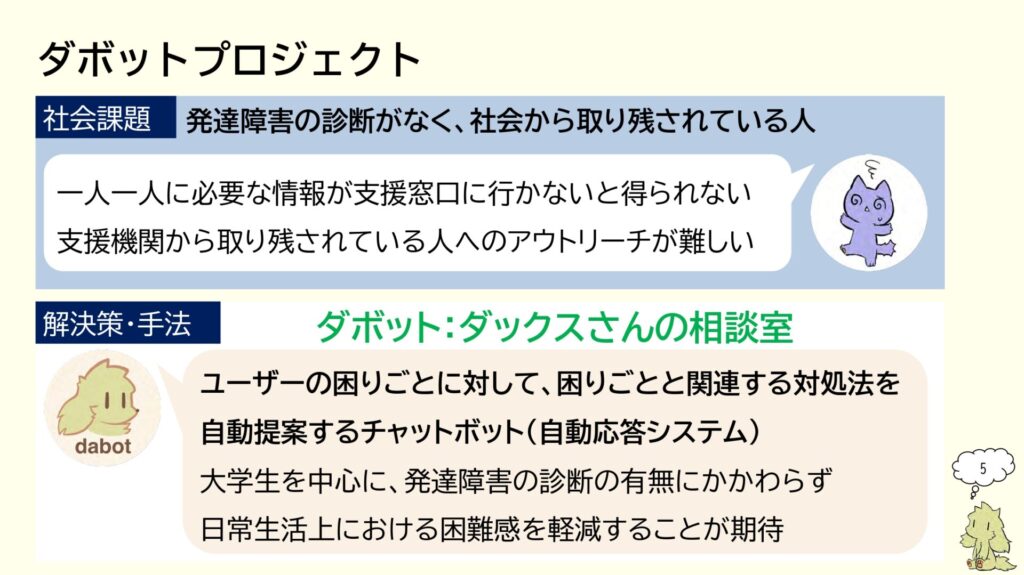
What kind of support can we provide to these people? Since the resources of support providers are limited, technology must be utilized. That is why we created “DaBot,” a system that utilizes chatbots. Dabot” is equipped with a function that interacts with the user and suggests solutions to the user’s problems. After conducting demonstration experiments with university students, we are now trying to expand the system to high school students and people who are working or about to work. Funded by the Research and Development Center for Social Technology (RISTEX) of the Japan Science and Technology Agency, we will continue our research beyond March 2026.
Next, I will explain the “Dabot Project” using Dabot, a chatbot. Our goal is to create a society where everyone, regardless of disability, has access to education, work, and support services, and where access is not enough, but also where people can demonstrate their abilities and self-actualize. SuccessAbility” is a coined word from “AccessAbility” and “SuccessAbility. (▲Picture 6▲)
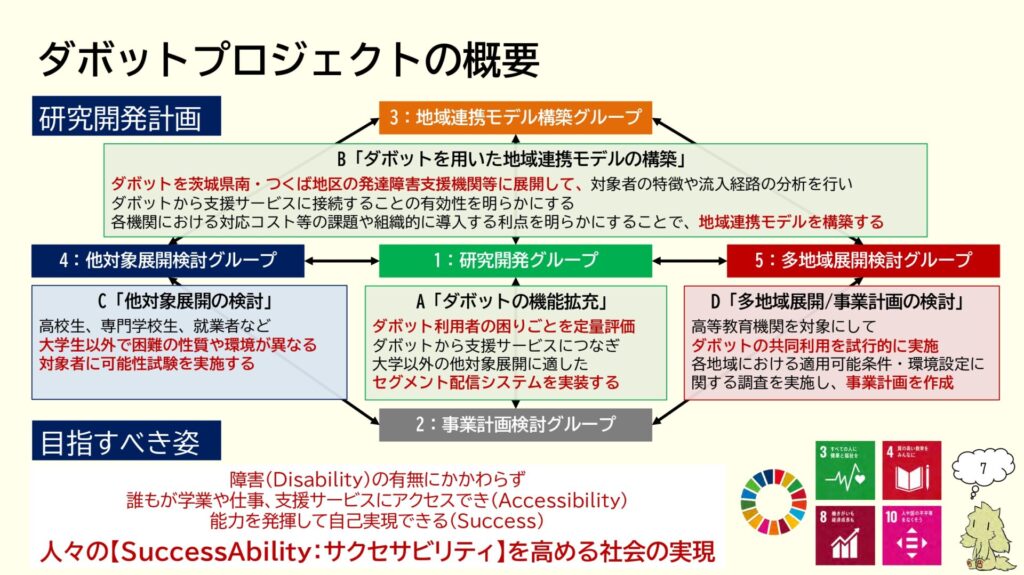
The chatbot “Dabot” can be used on LINE, a popular social networking service in Japan, and can of course be used outside of LINE as well. The chatbot does not use the word “disability,” but instead uses natural language, such as “I am having trouble managing my schedule,” “I am having trouble communicating,” “I want to know about my daily rhythm,” and so on, and then automatically suggests ways to deal with the problem based on data on people with developmental disabilities. The system automatically suggests solutions based on data on people with developmental disabilities (▲Picture 7▲).
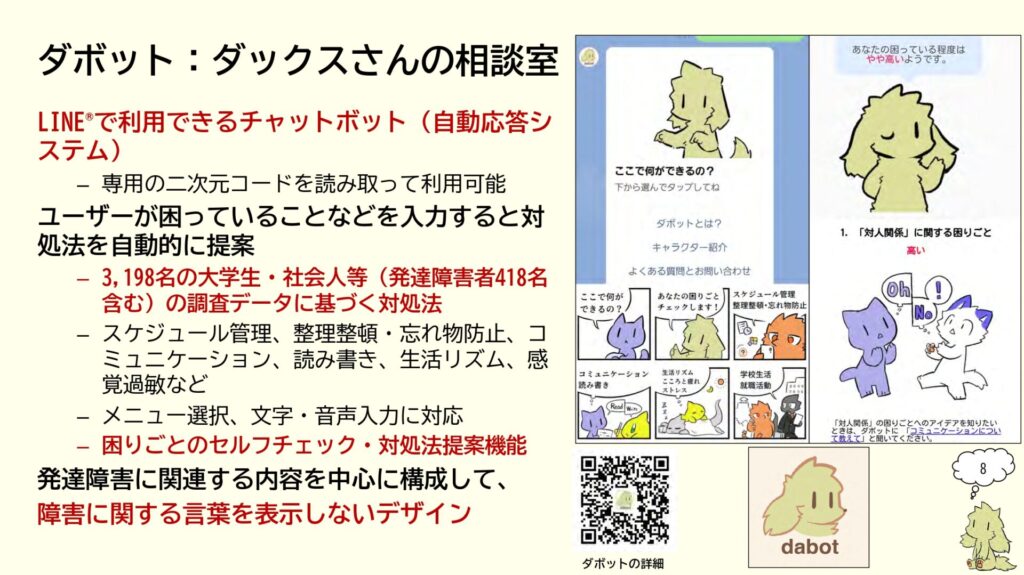
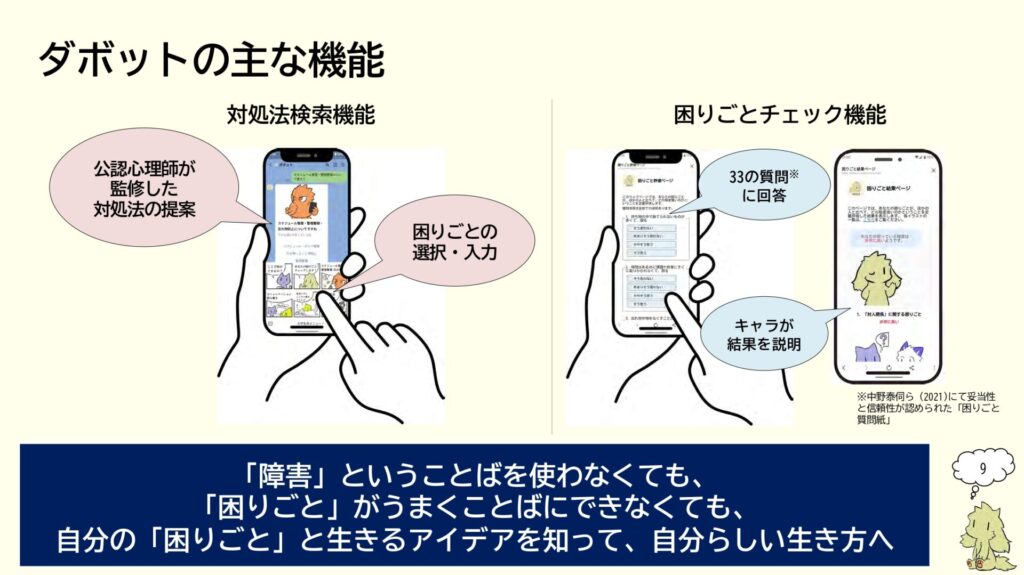
Dabot” also has a function that allows people with developmental disabilities to self-check their own difficulties. It is difficult for people with developmental disabilities to compare themselves with others or to objectively grasp how much trouble they are having. We have created our own standardized scale to enable people with developmental disabilities to self-check their own difficulties. Since our goal is not to obtain a diagnosis of a developmental disability, we have designed the self-assessment to help people understand the extent of their difficulties and identify ways to cope with them, so that they can access support resources to improve their self-help skills.
The coping method search function is supervised by a certified psychologist and other experts, and users can use the trouble check function to grasp the level of their own problems. Even if they do not use the word “disability,” or even if they cannot express their problems in words, this project is designed to help people learn ideas for living with their problems, and to live in a way that is unique to them. (▲Picture 8▲)
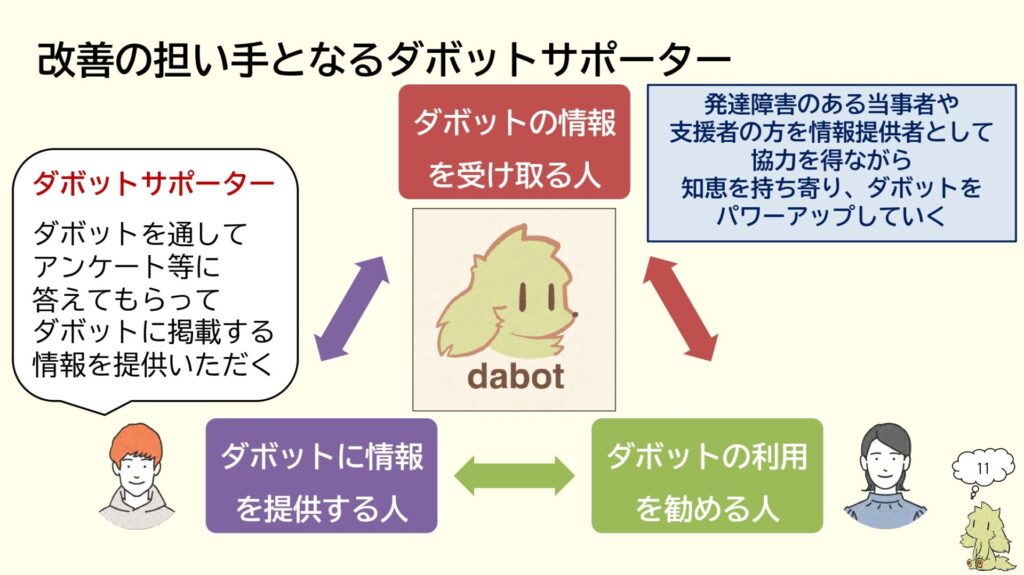
The characters were drawn by people with developmental disabilities. An educational cartoon is available on the Web, and we hope that by interspersing the characters of developmental disabilities and a dog named Dax, as many people as possible will take an interest in the cartoon. In order to attract the interest of a wide range of people, we are calling the people who recommend the use of “Dabot,” the people who provide information to “Dabot,” and the people who receive information from “Dabot” “Dabot Supporters,” and we are working together to create this project. (▲Picture 9▲)
In a demonstration experiment conducted in 2022 with university students, data showed that regardless of diagnosis, those who used “Dabot” experienced less difficulties in their daily lives than those who did not use it. To find out how to cope with problems, users can use search or generate AI, and we learned from user interviews that it is difficult for them to verbalize their problems well.
We are also learning a lot by asking “daBot” various problems in the demonstration experiment. Since it is a chatbot, it can be used at any time of the day, even during hours when no one is available. As with a generative AI, it is possible to make mistakes, but we try to ensure that you see the correct knowledge by having the reliability of the information supervised by university researchers and certified psychologists. We are currently expanding the trial to include medical institutions, universities, and support organizations in Ibaraki Prefecture.
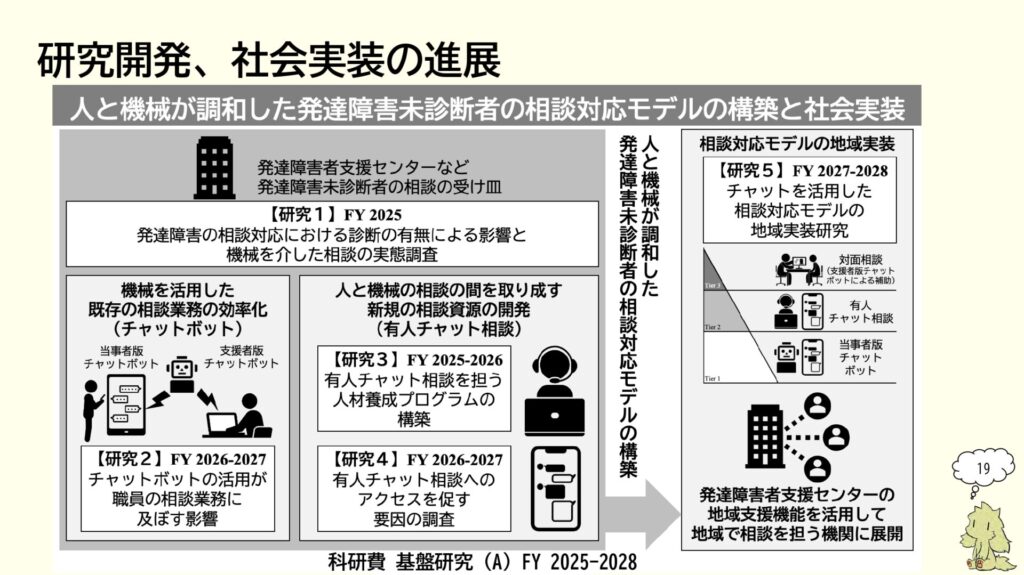
We believe that in the process of our efforts, we can also connect with specialists and other people, and we are also piloting a manned consultation system. In the future, regardless of whether a person has a developmental disability or not, we will work with various support organizations to harmonize people and machines, such as chatbots, so that machines can do what people do, and people can do what people are good at, in order to create a consultation response system that harmonizes what machines are good at and what people are good at.
We are also continuing to expand “Dabot” itself to various support organizations through the University of Tsukuba and a newly established corporation. We have already started trials in eight prefectures, and are expanding from Ibaraki to the rest of Japan. ”(▲Picture 10▲)
Dabot is a tool that can be used by people with disabilities to
can also be used to improve their own skills.
Ishido: “I read your book, “Human named it a developmental disorder. With its cute characters and manga-style structure, it is very easy to read and I felt that it is a book that I hope will reach many people.
As the professor mentioned, the viewpoint that ‘all people are eligible in the gradation, not just those with or without a diagnosis’ is a concept that overlaps exactly with our neurodiversity project. I deeply sympathized with this viewpoint.
Then, I would like to ask you something. Regarding problems and characteristics, while there are core tendencies such as “ASD people tend to have these tendencies” or “ADHD people show these characteristics,” each person is unique and there are differences among individuals. In this context, what kind of data and knowledge do you use to build the ideas for solutions and comments that “Dabot” proposes?
Also, please tell us how you accumulate and update such data.”
Dr. Sasaki: “Currently, we are accumulating data by unraveling the category of diagnostic names. In the category of diagnostic names, there are truly ten different people with ten different diagnoses. For example, difficulty in focusing attention is often mentioned by those with ADHD, but of course it is also said by those with ASD. If we use diagnostic names as a cohesive set of data, we inevitably end up with inconsistencies.
Therefore, we have created an index or scale to measure the trouble by breaking down the level of attention, well-knownness, communication, and difficulty in detail during the assessment, and have built an information database of coping methods in a way that corresponds to some degree with the index or scale. I think the advantage of doing this is that it is easier for those without a diagnosis to successfully connect with information related to their area or areas of difficulty.”
Ishido: “I would also like to ask about accessibility. This concept is very appealing, and I received the idea that this is a service that designs the shape of success for each individual together, rather than the conventional idea of support to compensate for the parts that cannot be done. What kind of innovations and mechanisms does this philosophy manifest itself in? Can you tell us more about it, with examples of actual cases?”
Dr. Sasaki: “This initiative is a very important challenge for us. Support for people with disabilities tends to be about trying to somehow fill in the bumps on the bumps. It inevitably feels like we are trying to deal with a problem, but when we explain it to them, we emphasize, ‘This can be used to improve your skills as well. We try to develop it that way. I think that sometimes it is easier for a person to demonstrate his or her own abilities if you build up the deco rather than bumping it down, even if it is a little unbalanced. One of the ways to achieve self-actualization is to work from the perspective that ‘you can use it to improve your own skills,’ rather than just dealing with the problem because you are actually in trouble.
Another possibility, as I mentioned earlier, is that there may be environmental adjustments or rules or mechanisms that need to be changed on the part of society. Therefore, I am thinking of showing two directions as ways of coping. One is to manage by yourself, and the other is to rely on and use others appropriately. We try to present such information as a coping method. These are things that we worked out during the production process of “Dabot,” while talking with the people involved and the creators.”
Ishido: “When I read an interview with Dr. Sasaki in the past, I was very impressed by his emphasis on the “practice value visualization approach” in promoting evidence-based research. I feel that it is important to carefully accumulate evidence rooted in actual practice in the field, because there are many different kinds of problems that people face in different ways. I would like to ask you, could you tell us a little more about the practice-based evidence method and approach that you value so much?”
Dr. Sasaki: “The concept of Practice Based Evidence itself has been around for a long time, but it is not yet widespread. The opposite term is ‘evidence-based practice. This is an effort to turn academic and experimental research into practices that can be implemented in society. It is said that there is quite a gap between practice and research there, and since experimentation and practice are not conducted in the same environment, there inevitably arises a gap between research and practical application.
Therefore, we decided to have the people involved and their supporters participate in the creation of this project from the very beginning, and to work together to make it a reality. In doing so, we are trying to set up a system to absorb and collect records and data on how each person is coping, and then return the data to them.
This is our practice. The key point in our approach is to actually collect unverbalized knowledge as data on a daily basis, and then reduce it to evidence.”
Ishido: “Listening to you, I could sense that you value the perspective of accompanying rather than providing one-way support in the process of accumulating knowledge. In the field of support, we tend to fall into a structure of supporters and recipients, but you have used the expression “creating together” many times. How do you devise ways to transcend the structure of supporters and non-supporters?”
Dr. Sasaki: “We are also conducting research on how to facilitate participation in our joint development and co-production by the parties involved, supporters, and people who commit to the project, known as Dabot supporters. This is still a work in progress.
However, since I have been involved in the “Dabot” project, I have also realized that there are people who have quite a variety of know-how. Even when conducting interviews, etc., the opportunities for those with know-how to pass it on are limited to those around them. Similarly, I feel that the system of conducting research by researchers alone is reaching its limits. Therefore, we are now working on how we can create the ground for joint development with those who are involved, supporters, and those who are in charge of practice.”
Ishido: “Through Dabot, people with problems are able to choose the best way to deal with them, and by bringing together people with diverse perspectives and solutions, the options themselves are expanded. Can you give us some specific examples of how the actions and feelings of people with problems have actually changed as a result of having more options? While it is very important to have many options, I believe that some people are also confused about their decision-making process. I would like to hear about changes in behavior and how you support them, including these aspects.”
Dr. Sasaki: “As for changes in user behavior, the honest truth is that it varies from person to person. When I used to be in charge of individual counseling for students with disabilities, I found that many students were lost as to what they should do due to lack of information or lack of organized information.
In Dabot, we provide some organized information to broaden the person’s options. However, some people will do well with the coping strategies presented there, and some will not. Some of those who have not been successful will be very negative, while others will see the value in trying. So I thought that people with disabilities were not given enough ‘safe opportunities to try it. I feel that they can try it as if they were experimenting on themselves, ‘What if I try this, what will happen to me, will I change?’ I feel that their feelings can be transformed in that way.
Furthermore, some people say that “davot” is a good luck charm. The very fact that they have a choice supports their sense of self and ease of living. These stories are on an episodic level, and of course, it is necessary to incorporate the results of empirical experiments into research, but we have felt this as an effect.”
In future support for people with developmental disabilities
Harmony between man and machine” will become important
Ishido: “There is one more point I would like to ask. I understand that you developed “Dabot” for people who originally needed assistance but did not have access to sufficient information and appropriate support. On the other hand, I am certain that there are parts of such a system that can be carried by machines and parts that must be carried by humans. In recent years, more and more people expect generative AI to play a counselor-like role, and while some say they have been saved by AI, there have also been reports of unfortunate cases and incidents. Given this background, how do you view the boundary between the areas that should be handled by technology and those that should be handled by people, and what is your approach to designing such a system? Also, please tell us how the introduction of such technology in the field has changed the support provided by humans, and how you think this will change in the future.”
Dr. Sasaki: “I say harmony between man and machine. Even among human beings, the mind and body we move are often biological, but I believe that there is naturally a way of being human that takes place when machines are harmonized or fused together. With that in mind, we are still in the process of researching what kind of harmony is possible in developmental disabilities and their counseling and support.
Just as a preliminary study, you may have trouble trying to make a purchase and connect with a manned operator to inquire about something not listed in the general Q&A. The manned operator will then politely ask and answer your question about your problem or concern as a person, not a machine. I have also used customer service with a manned operator for chat consultations.
At such times, I feel that the fact that the person listened politely and was able to talk without a solution being offered is in itself a very effective resource for that person. I think machines are very good at showing specific coping strategies and solutions. I feel that just having an environment where people are connected to each other, even if they don’t necessarily have a solution, is supportive for life, just as conversation is important to humans.
There may be situations where that can be replaced by a machine, but I think there are also situations where it would naturally be better to have a person. To put it simply, I believe that there is naturally a range of situations in which the user wants a person. It is not the creator or the deployer, but the user who says, ‘I want to hear this from a person,’ or ‘I prefer a person for this.
On the other hand, there are those who prefer machines. The direction we are aiming for is a form in which machines and people can switch well according to the user’s needs at that time. The first approach we would like to try is to coexist with a system in which solutions can be found by talking to a person, as in customer service, or in which talking to a person itself is meaningful.
Regarding your second question, I am also involved in supporting people with developmental disabilities and often work with people involved in supporting them. There is a strong emphasis on self-help in the current “Dabot”. The current situation with generative AI also requires that people with disabilities use it well in a self-help way. Therefore, I think we need to think more about the use of AI as a tool for those who are in a position to provide support, telling them how technology can be used for support. At the moment, we hope to be able to successfully include AI in the handling of individual and needs-based consultations.”
Ishido: “I understand that you have already developed initiatives in several municipalities based on your excellent research results. I believe that collaboration with government and educational institutions is indispensable for actual implementation in the community. If there are any issues or barriers, we would be very interested to hear about them.”
Dr. Sasaki: “I think there are several barriers: First, I have the impression that the rules that exist in government and educational institutions that collaborate and work with chatbots, machines, and technology, as well as the literacy of the people who handle them, will be a barrier. I think there will naturally be barriers to introducing something new that will disrupt the way we have already built up our own practices.
The other barrier that arises is the fact that we are dealing with data, something that is difficult to see, which creates barriers such as leaks and the handling of personal information. We, too, are researching how this data will be used in such a way as not to collect personal information as much as possible and to pursue a certain degree of anonymity. I believe that we are technically required to approach the collected data with transparency, saying, “This is how we will handle it,” in our interactions with various organizations and local governments.
I have just mentioned one example of a barrier to introduction, but I feel that one way to alleviate this barrier is through the efficacy and effectiveness of the product and user feedback. We try to carefully present the testimonials of those who have actually used the product to those who were reluctant to introduce it. This makes it easier to see the goal.
Another important thing is to share the vision. I feel that whether or not people can sympathize with us in a framework that is larger than whether or not we use it is actually a major issue. The concept and philosophy of neurodiversity also makes it very easy to collaborate with people who share that philosophy and concept. Of course there are actual trends, but we work by explaining our vision and seeing if people can sympathize and resonate with it.”
Even those who say they have a disability now
If society changes, the way disability is perceived may also change.
Ishido: “One of the reasons we hold “Brain World for Everyone” is to spread empathy. After listening to the professor’s talk, I strongly felt that we share the same aspirations in this regard.
I understand that your laboratory is also involved in the assessment of college students with developmental disabilities. Although the target population is college students, if we expand the scope of this project to include elementary and secondary education, I feel that it is necessary to address the issues of increasing truancy and withdrawal from school, and to create countermeasures.
So I would like to ask you, what kind of assistance and support do you think is currently needed in educational institutions?”
Dr. Sasaki: “Of course, I believe that there are some differences and some commonalities in what kind of support is needed not only at universities, but also at elementary, junior high, and high schools. From the viewpoint of support, there is a big gap in how we think about disabilities and their support measures and solutions, and I think this is a challenge that all educational institutions face.
To use the story of truancy as an example, there is debate about whether truancy is a problem behavior, and some say it is not. We don’t necessarily all agree on this. It is natural that something must be done to approach truancy, but there are not many educational institutions that are working to consider the environment, systems, and institutional design that have created such a situation, rather than focusing too much on the individual.
Understanding neurodiversity is also about diversity, diversity is a fact and a fact of life. It is about how we can create an environment that incorporates a diverse group of people. I believe that the traditional approach in supporting people with disabilities has been to look at the individual’s abilities as a deficiency or lack thereof. I think that looking at the environment, what kind of arrangement, what kind of structure, what kind of program would make it easier for many or that person to participate, and the diversity of the program itself are all things that can be done in elementary, middle, and high schools, as well as universities.
What is also needed is a diverse learning environment. I believe transitions are very important. It is very important to support the transition from elementary and secondary schools to universities, vocational schools, and various other places of learning. The reality is that people still say, ‘People with disabilities who can come to university are still good. In this kind of social trend, I think it is also very important to provide educational opportunities for various people, and how to help them make transitions and connections.”
Ishido: “It is a very important theme for our project to address both the individual and environmental approaches. I believe that because this perspective has not fully penetrated society, there still exist cultural and social hurdles to talking about problems, and as a result, many people are unable to reach out for support. I understand that you are taking the current approach in order to lower these barriers, but I would like to hear from you if you have any ideas for what society as a whole should be working on more broadly or for redesigning the environment.”
Dr. Sasaki: “The definition of the word support is still often used in a narrow sense. We have used the word “self-help,” but there are various types of support. We believe that ‘providing some information by looking at some information’ and ‘increasing the number of places to look at information’ are forms of support. Even if it is not necessarily connected to a person, if information can be obtained even from a machine and it makes life easier for that person, we believe that is one form of support.
One of the most frequently received stories is that there is probably still room for expansion in the concept that if you are connected to a supporter, you will receive support. I have also used the term “people in a position of support” several times, but not only supporters can provide support and not only people in a position of support can provide support, so as was mentioned earlier in the supporter initiative, it is important to introduce that to people and if there is no one around you who cares about it, then when you care about it It is important to be able to provide that kind of information to people when they are concerned.
However, it is not always easy to do so. I think it is a big challenge how to extend support in such situations, such as, “I myself am not that familiar with it,” or “I am not an expert, so how about going this far?
Our future direction is to use the information tool “Dabot” to empower not only the people involved but also those around them. We are considering the possibility of raising the overall literacy of information on developmental disabilities and other problems among the general public.”
Ishido: “I think the definition of the word “support” itself will change drastically in the future. I was hoping to hear your thoughts on this point, and I felt that your talk embodied exactly this point.
I myself have been working to create a learning environment with one terminal per person, and I believe that this is also about creating a support infrastructure that allows all people to access information and choose the learning environment that best suits them. I hope that these efforts will continue to be made more widely.
Also, I believe you mentioned at the beginning that the institutional design has not kept pace. What we at the Neurodiversity Project are aiming for is a movement to create the norm for the future.
If there are any areas that you feel are currently a particular challenge or that the system has not caught up with, please tell us about them, even if it is just a specific example.”
Dr. Sasaki: “What is direct and easy to understand is the system related to the employment of people with disabilities. In most cases, the employment model for people with disabilities is that general companies set up a quota for hiring people with disabilities and ask them to perform a few specific tasks.
One of the things that support this is the employment rate system for persons with disabilities. As I mentioned earlier, the weighting of responses to a diagnosis is different when working than when being a child. To obtain a disability certificate, of course, a medical certificate from a doctor is required. However, in the case of developmental disabilities and other disabilities, considerably more complex information about the nature of the diagnosis is required.
The other is that there are also deadlines for the use of systems for people with disabilities to work, such as support for transitioning to work. I think this also has something to do with pensions, but it also means that those who are diagnosed early will not be able to receive the support they need when they are older. In a broad sense, the various systems for employment of people with disabilities are based on the premise of diagnosis, and many of them are designed to help people with disabilities when they are working, rather than diagnosing them early on. I believe that the existing systems are not able to keep up with the trend toward early rehabilitation, early diagnosis, and early support.
Some people, with or without a diagnosis, or even those who are actually in the workforce, may have trouble with the gap between their characteristics and the environment, so if the system can expand their perspectives, it will result in an increase in their ability to work and learn. However, of course, there are also major bottlenecks, and some of them are very much related to money issues.
Thus, there are so many related stories about employment of people with disabilities in various systems, and we have a system gap that is conceptually difficult to fit with neurodiversity. I believe that this is one aspect of diversity that is being undermined as a result.”
Ishido: “I feel that the employment of people with disabilities is an important topic of discussion wherever we go. Our team would like to make concrete proposals on which direction we should aim for in the future through repeated discussions with people in various positions. We hope that you will join us.
Finally, what does the neurodiverse society envisioned by Succeedability look like to you? I would like to conclude by asking you to give us a few words on that image.”
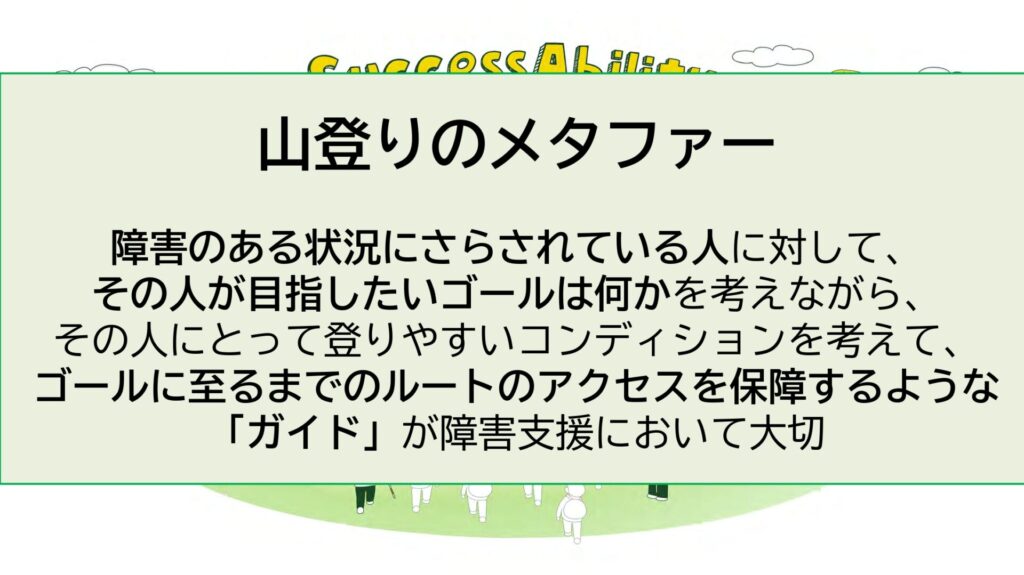
Dr. Sasaki: “I coined the term “succesability,” but it was too confusing, so I created an illustration. I used to like mountain climbing, which I am not able to do much of now, but I used the metaphor of mountain climbing. The goal of mountain climbing tends to be to reach the summit, and for that reason there are some paths that are like ordinary roads. Here is a big mountain and a summit, and there are mob-like people around who are trying to reach the summit. They are the neurotypicals. They are what we call typical development. The question arises, ‘What is stereotypical development?’ It is possible that I am not only talking about individual development, but also about the diversity of goals that these people are aiming for in the first place. Aiming for the summit is not the only goal; some people, like me, think it is important to take a bath after climbing to the top of the mountain.
The goal the person is aiming for is represented by this flag. Some people may have various barriers to walking or climbing while checking or searching for the goal that the person is aiming for in the support. Even if the person has a disability themselves, such as ‘cannot read,’ ‘has difficulty reading,’ or ‘has a large load,’ how can we help them get as close to their goal as possible? I believe that this can be done by a human being, or by a human being with the help of a machine, or by the machine itself. I use this as a metaphor for the importance of diverse ways of mountain climbing. (▲Picture 11▲)
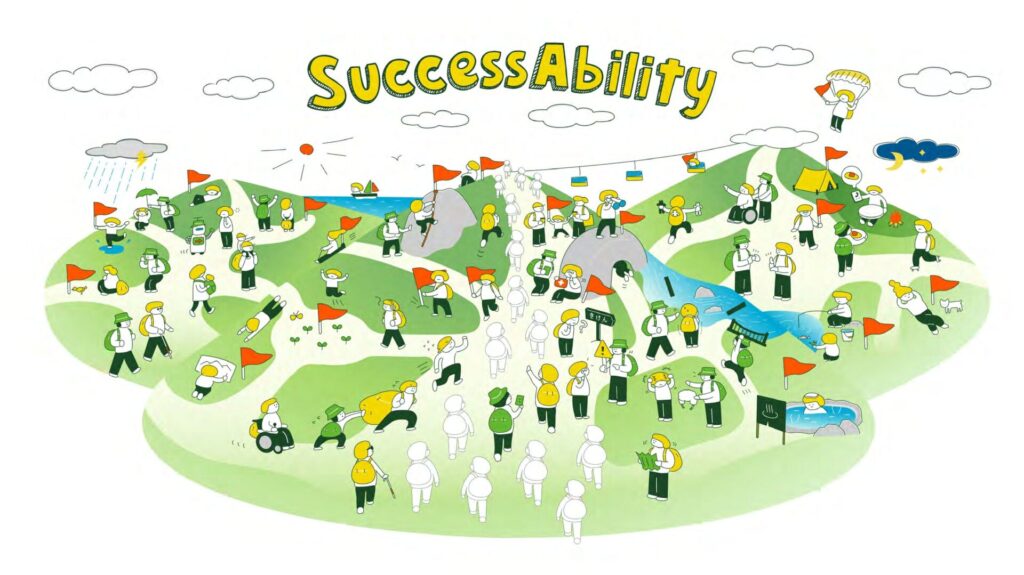
How can we guarantee each person’s route to access to the goal? I think such a guide is important, and borrowing the word accessibility, the way of disability may change as society changes for those with social disabilities. To guarantee fair access, where the person wants to go, and to clarify such methods and conditions of how to reach the goal. This is what we are aiming for through our research approach.”(▲Picture 12▲)
Ishido: “It was a very easy-to-understand analogy of mountain climbing. The word “success” is the same, and concepts such as wellbeing have been spreading recently, but I felt again that it is very important to accept the diversity of goals as a matter of course, as the form of success and happiness that each individual is aiming for is different. Machines and humans support each other in harmony to solve problems and expand each person’s options. I hope that “Brain World for Everyone” will serve as a catalyst for a society in which everyone can walk toward their own personal success, and I look forward to working with you in various ways. Thank you very much for your valuable talk today.”