In an environment of neurodiversity What is the ideal form of communication to deepen mutual understanding?
9/25/25
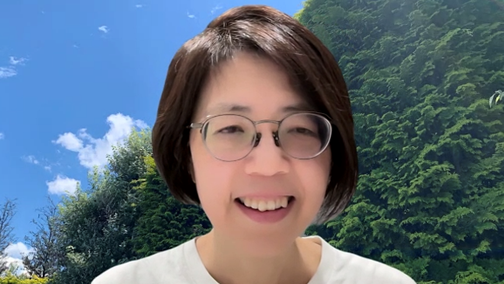
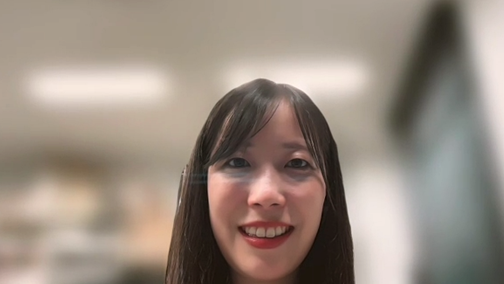
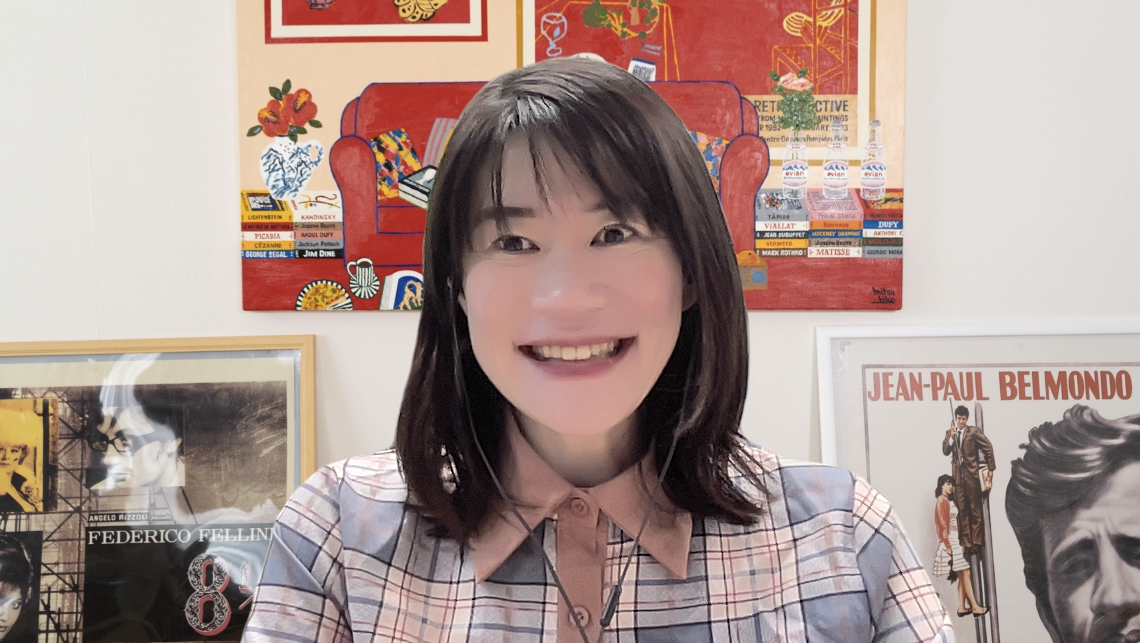
At “Brain World 2024 for Everyone: Super Diversity,” visitors can explore cutting-edge research from various companies, universities, and research institutions dedicated to realizing a neurodiverse society. The JST Future Society Creation Program [1], specifically the area of “Realization of a Society Optimized for Individuals” and the project “Bidirectional Communication Support in a Neurodiverse Environment,” features an exhibit where neurotypical (TD) individuals can experience the eye movements of those with autism spectrum disorder (ASD) through VR. Additionally, using the Implicit Association Test (IAT), the exhibit explores “unconscious true feelings” to see if participants are genuinely enjoying communication, encouraging them to reconsider how to deepen mutual understanding. Nanako Ishido (▲Photo 8▲), Director of B Lab and promoter of the “Brain World for Everyone” exhibition, spoke with Dr. Rieko Osu (▲Photo 1▲), Professor at the Faculty of Human Sciences, Waseda University, and Dr. Ayaka Tsuchiya (▲Photo 2▲), Junior Research Associate (Assistant Professor) at the Advanced Research Center for Human Sciences, Waseda University, about the exhibit and their latest research findings.
<MEMBER>
Dr. Rieko Osu, Waseda University
Dr. Hirotaka Kosaka, University of Fukui
Dr. Ikuhisa Mitsugami, Ritsumeikan University
Mr. Naoto Muranaka, Representative / CEO, Neurodiversity at Work
Dr. Ayaka Tsuchiya, Waseda University
Dr. Naoki Takada, Waseda University
Mr. Mizuho Omura, Hiroshima City University
> Interview videos are also available!
TDs do ASDs, and ASDs do TDs,
and a system of mutual understanding that includes themselves.
Ishido: This is your first time exhibiting at “Brain World for Everyone”. Please tell us about your exhibit, your latest research, and your efforts toward a neuro-diverse society.
Dr. Osu: We are researching “Interactive Support for Communication in a Neurodiversity Environment” in the Future Society Creation Project. First of all, we believe that while the importance of diversity is attracting attention, in an organization with high diversity but low wellbeing and productivity, the people who make up that organization are unhappy with each other. In contrast, our goal is to realize happy organizations with high diversity and high wellbeing and productivity. We are researching the tools necessary to achieve this. In this exhibition, we will introduce some of these tools. (▲Picture 3▲)
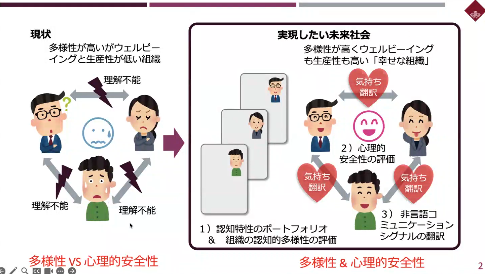
Our research targets adult people with ASD (autism spectrum disorder), but we are trying to create a “tool for TD (typical development) people to understand ASD people” rather than a “tool for ASD people to use. One such tool is a system that allows people with TD to experience the world as seen by people with ASD, and to compare the eye movements of people with ASD with those of people with TD as a tool for TDs to approach the ASD side. We are also developing other systems to learn how people with ASD feel about communicating with others, including people with TD. The goal of these efforts is to promote mutual understanding between people with ASD and people with TD. We are considering a system of mutual understanding, in which “TDs communicate with ASDs, ASDs communicate with TDs, and TDs communicate with themselves” (Photo 4). (▲Picture 4▲)
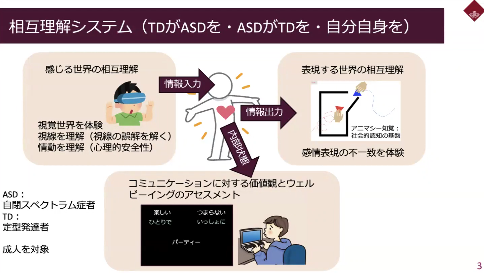
In this “Brain World for Everyone” exhibition, we will exhibit two of our research projects: a system that allows people with ASD to experience their visual world through VR, and a system that measures how they “really feel” when communicating with others.
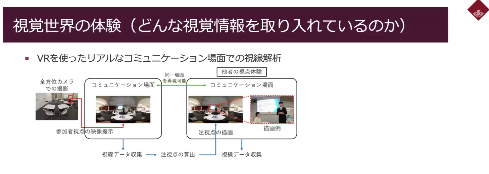
First, the system allows you to experience the visual world in VR, reproducing realistic communication situations in which multiple people with ASD and TD participate. The system also records the eye movement of the participants, allowing the participants to experience the difference in eye movement between people with ASD and people with TD. The eye movement can be displayed on top of the recorded video, so that information can be collected about what the actor, the instructor, spoke and acted out, such as “this person was looking here and this person was looking there. Again, wearing VR goggles also allows us to re-experience the world of eye movements that others have seen; by re-experiencing the gaze of the person with ASD, we can understand what information they are taking in. The movements of the eye reflect what kind of information they want to take in, what kind of things they want to see, and what kind of things they want to see. (▲Picture 5▲)
Here are some examples of TD human eye movements collected in previous studies. (▲Picture 6▲)
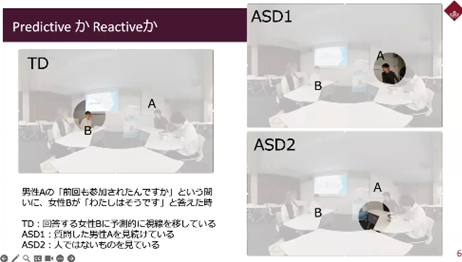
People with ASD have been said not to look at other people’s faces, but those with ASD1 frequently look at faces. On the other hand, people with ASD2 do not look at faces at all. In the “Brain World for Everyone” exhibition, visitors wear VR goggles so that they can feel how different their experience is from what they want to see.
It is noteworthy that the TD person anticipates in advance that Mr. B will answer Mr. A’s question, and looks at Mr. B when Mr. A’s question is over. the ASD1 person is still looking at Mr. A’s person when the question is over, and finally looks after Mr. B has given his answer. the TD person is TD people get information from context, while ASD people look but do not seem to comprehend contextual information. They look at faces because they have been taught to “look at faces when talking to people,” but in reality, it is possible that they are not getting information from faces. We want people to experience that the information they are getting visually is quite different in this way.
You are not aware of your own
Latent Coalition Test (IAT) to understand biases
The other introduces the Implicit Association Test (IAT). This is a test that allows you to understand biases that you are not aware of. The method is to classify the words displayed in the center into right and left. For example, when the words “fun” and “together” are on the left and “boring” and “alone” are on the right, the test asks which way you would classify “party” displayed in the center. Since a party is something you attend with friends or other people, not alone, you would classify it as left. The answers to these questions are categorized as quickly as possible using the keyboard. (▲Picture 7▲)
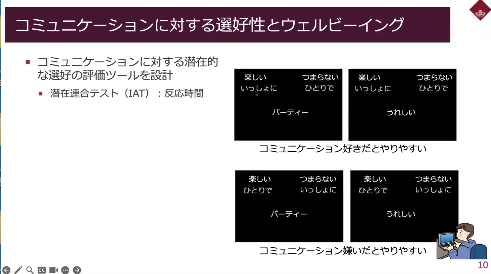
In the case of a party, if “fun” and “together” are paired with “boring” and “alone,” people who like to communicate will be able to respond immediately. If the pairs are turned over to ‘fun’ and ‘alone’ and ‘boring’ and ‘together,’ those who find it uninteresting to be with everyone at the party would classify them on the right, while those who are ‘happy’ because they enjoy being alone would classify them on the left. For those who like to communicate, when the keyword “party” appears, they are not sure whether to classify it as “fun” or “alone”, or “boring” or “together”. The keyword ‘happy’ also makes them think, ‘I don’t want to be alone when I’m having fun,’ and they spend a lot of time thinking about which is the best way to categorize it.
Thus, even if you are not aware of it, it comes out as the length of time of your response. In a famous test example, if you show “black” on the left and “white” on the right, and the words “good” and “bad,” the response will be that black people are bad even if you are black, or even if you are a human rights activist, you may find that deep down you think black people are bad. We want people to experience this IAT.
We believe that this test can tell us whether people with ASD want to communicate or not. There is a tendency in the world to overemphasize the importance of communication and that it leads to happiness, but we created this test to evaluate whether this is really true or not for some people.
Dr. Tsuchiya: I would like people to actually experience the difference in where people with ASD look in VR. I would also like people to experience how many people with ASD have felt when they have been forced to control their gaze and look at other people’s faces.
It takes some time to experience the latent association test (IAT), but those who are interested can use the final results to determine if they are high communicators and high in wellbeing, or if they are people who dislike communication. We would like you to experience this.
Ishido: This is a very interesting theme and fits with the goals of the neurodiversity project we are promoting. There is a movement, including our own activities, to use VR to experience the world as seen by people with developmental disabilities and to incorporate this into corporate training programs. In your research, have there been any cases in which people with ASD and TD experienced differences in eye movement, which led to behavioral changes or innovations in communication in daily life?
Dr. Osu: That is exactly the point, and that is what we are hoping to address in our research and studies. We don’t have that much data yet. At a previous exhibition, a person whose own child has ASD came to us and said, “I now understand how my child looks around me in this way,” or “My child started to look at my face at one point, but maybe it was not a good idea to tell him to look at my face. I think it might have been a bad idea to tell them to look at each other’s faces. I believe that if people can realize such things, they will come to new realizations, which will lead to changes in behavior.
Dr. Tsuchiya: Some people know from literature and knowledge that people with ASD seem to see things differently. However, even those who know this do not always know where they are actually looking. I think it is very rare to actually experience how other people move their gaze when they see the same thing as you in VR. I think you will be surprised at how different it is from the way you thought you would see things. I am looking forward to seeing how your behavior will change from there.
We need to look at ASD as well, including various countries, cultures, and races.
Ishido: Although communication skills are emphasized in the world, each person likes or dislikes communication, and I felt that it is important to recognize how each person with ASD feels about communication and not to impose one’s own norm on others. The first step is to become aware of this, and the next step is to change behavior.
Our goal is to realize a neuro-diverse society where each individual can easily demonstrate his or her strengths and where the wellbeing of each individual can be improved through the realization of a neuro-diverse society. From what you have said, I think that the tendency of Japanese society as a whole to overemphasize communication skills may in some cases hinder the realization of a neuro-diverse society and the improvement of each individual’s wellbeing. I also think it is important what kind of support can be provided to those who want to communicate but have trouble doing so.
So, I have a question regarding research on Unconscious Bias: what research can you tell us about international comparisons of ASD? Are there any differences by country or culture? Can you suggest some issues that Japanese society should be aware of, such as the tendency to overemphasize communication skills, peer pressure, etc.?
Dr. Osu: The reason why we started working on international comparisons is that research conducted by people in Western countries was biased toward Caucasian males; when people talk about ASD, they are talking about Caucasian males, but there was no research from the perspective of “what about women? So we began to think that we should look at ASD from the perspective of various countries, cultures, and races, etc. In some countries, ASD is more prevalent in women, and in other countries, ASD tends to be different in women, and the results have been different in different cultures. It was in this context that we were approached and conducted research in several countries.
In a specific study, we examined how people with ASD behave like TDs, or camouflage, in relation to their wellbeing and mental health. The results showed that in some Western countries, people who camouflaged themselves had lower levels of well-being, but in Japanese society, people tended to do better and be happier when they camouflaged themselves because of strong peer pressure. In this sense, the trend was different from that in other countries.
In the first place, there is the aspect of society in Japan where even TDs themselves are camouflaged, and sometimes we feel that this has become the norm. Especially in job hunting, if you cannot communicate, you will not be able to find a job in many places from the beginning, and you will not even be able to stand on the starting line. I hope to somehow overturn that and create a society where people can find jobs in areas where they can work without communication skills and where they are good at what they do.
Ishido: In the Keidanren’s survey, communication skills are always at the top of the ranking of “skills sought in new graduates. On the other hand, it is also important to evaluate how to evaluate those who demonstrate strength in areas other than communication skills. That is a story that also ties in with the self-esteem of those who are not good communicators. From this perspective, communication is directly related to wellbeing, but I feel that if it becomes widespread that the indicators of wellbeing are also different for each individual, it will make life easier for each person.
A society in which there is no longer an unconscious bias against people with ASD.
Dr. Osu: Research has also shown that communication between people with ASD is rather smooth; when I am invited to join a community of people with ASD, my impression is that communication is not so at odds when people with ASD talk to each other. We feel that the stress of not being able to communicate is low.
However, when TDs and ASDs try to communicate with each other, it is not always easy and a ‘divide’ may occur. In real life, it is not easy to meet people with similar communication styles, but if they meet well, they can communicate smoothly and their wellbeing will be high. With that in mind, the problem is still communication between TDs and ASDs. Finding a way to somehow solve that is the next step in our research.
Ishido: I think there are two ways in which we can support people who want to communicate but are unable to do so well, and therefore their wellbeing is lowered. one is to help people with ASD find places to meet people who fit their communication style I think there are two ways to do that. However, it is not good if a division occurs, so we can support communication between people with ASD and TD, for example, with tools such as a translator between English and Japanese. From this perspective, is there anything you would like to challenge or think about in the future?
Dr. Osu: We are thinking about it, but it is still a secret.
Ishido: On another occasion, when I spoke with Joichi Ito, he told me, “It seems that neurotypical people have a very hard time living. I heard that he said that because they can understand other people’s feelings too well, they are worried about what people around them think of them. We have also started a project called “Troubleshooting Translation,” and we are researching approaches and technical approaches to improve mutual understanding, including for people with ASD and TD. Together with various researchers in neurodiversity, we are also talking about the possibility of a ‘chatbot-like’ thing that can fill in ambiguous expressions in communication. I would like to ask you about your off-the-record research, if you are willing to share it with the public, but I think that your research has two aspects: one is to support people with ASD in their difficulties in life, and the other is to connect people with ASD and TD using some kind of technology so that there is no discrepancy between them and others. I think there are two aspects to Dr. Osu’s research. In terms of supporting people’s difficulties in life, you have been researching neurofeedback and brain stimulation, etc. Can you talk about that aspect as well?
Dr. Osu: In our research on brain stimulation, we are studying whether it is possible to suppress the workings of areas of the brain that are hyperactive and overly active. Specifically, we are studying people with anxiety disorders and social anxiety. These people often pay too much attention to themselves and become more and more anxious about being nervous or nervous, and they often have trouble speaking or giving a good speech. At that time, brain activity was measured and it was found that the frontal lobe was too active, so the idea is to suppress that area. It is said that if a magnet is placed on the head for 20 or 10 minutes, brain activity can be suppressed for a while afterward, and when the person is asked to give a speech in that state, compared to the speech before that, the number effectively decreased in the person with high social anxiety, although it is subjective. This research suggests that it may be possible to deal with people who have trouble with excessive anxiety by lowering their brain activity.
I don’t know if this will be directly effective for people with ASD, but I hope it can be applied to those who have a great deal of anxiety and need help.
Ishido: I am impressed by the research being conducted to realize a neuro-diverse society through diverse approaches. There are various other researches besides these two exhibits, and I would be very much looking forward to working with you. Finally, I would like to receive a message from you.
Dr. Tsuchiya: Please take a look at the various research results at the “Brain World for Everyone” exhibition and let us know what you think of them. We also hope that you will be interested in our future research results, and together with you, we would like to put our research results to practical use one by one, and that is what we are aiming for.
Dr. Osu: While I hope that eventually the unconscious bias against people with ASD will be eliminated, on the other hand, I think it is a very distant world. First of all, I hope that by providing TD people with tools to understand people with ASD, we can move closer to such an ideal society, and I will continue to work on my research.
[1] Ending March 2025