We want to work together to create a better future with technology that extends brain function.
4/19/25
At “The World in Our Minds 2024: Ultra-Diversity,” visitors can experience cutting-edge research from various companies, universities, and institutions striving to realize a neurodiverse society. The “Moonshot Goal 1: Kanai Project — Internet of Brains” works on initiatives that enable people to communicate thoughts without speaking or control robots through thought alone. By harnessing brain research, the project aims to empower everyone to live more freely by performing various activities just by thinking.
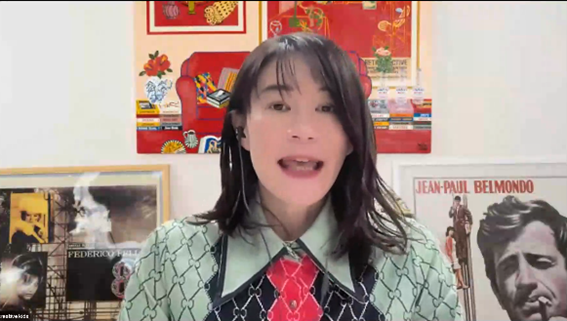
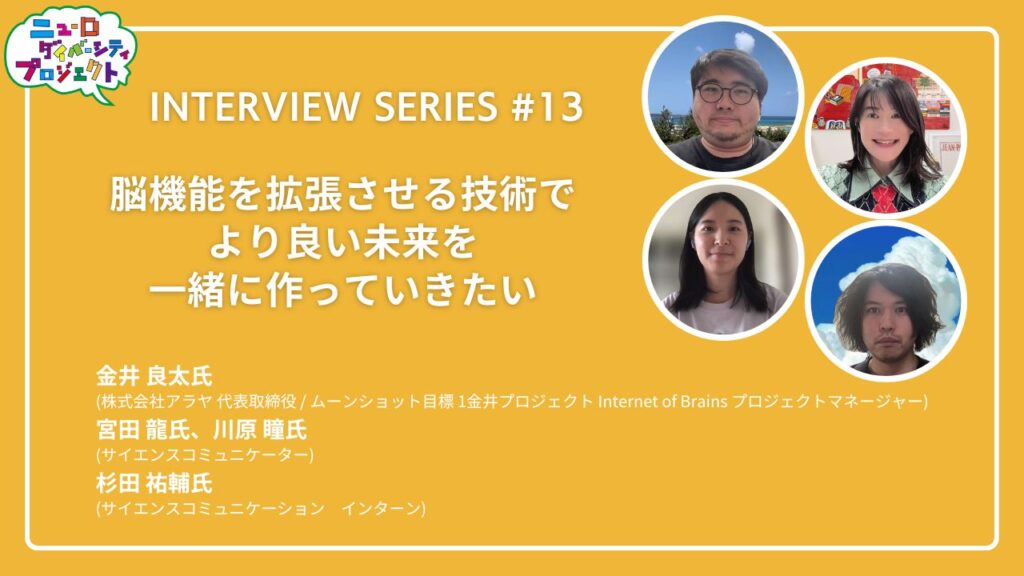
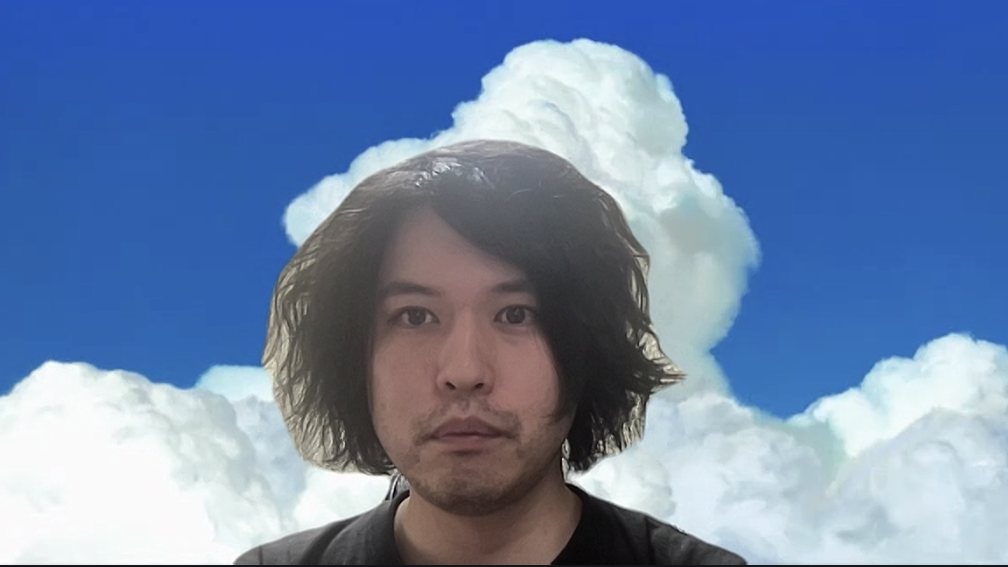
Nanako Ishido (▲Photo 8▲), Director of B Lab and promoter of “The World in Our Minds” exhibition, spoke with Ryu Miyata (▲Photo 1▲) and Hitomi Kawahara (▲Photo 2▲), Science Communicators at Araya Inc., along with intern Yusuke Sugita (▲Photo 3▲), about the exhibition and their latest research findings.
<MEMBER>
Ryota Kanai
CEO, Araya Inc. Project Manager
Moonshot Goal 1: Kanai Project — Internet of Brains
Ryu Miyata / Hitomi Kawahara
Science Communicators
Yusuke Sugita
Science Communication Intern
> Interview videos are also available!
Initiatives to think and create the future together through stories
Ishido: “’Moonshot Goal 1: Kanai Project — Internet of Brains’ is a follow-up to last year’s exhibit. Could you tell us about your exhibit, the background of your research, and your latest research findings?“
Mr. Miyata: “The Neu World project we are working on is a project to communicate and think together with many people about the content of the “Moonshot Goal 1: Kanai Project — Internet of Brains” (hereafter, IoB) research, the future vision we are aiming for in our research, and how we want to utilize the results of our research in society. This project is to communicate and think together with many people about the content of the IoB’s research, the future vision it aims to achieve, and how it wants to use its research results in society. To introduce these efforts, a total of four posters were digitally displayed at “The World in Our Minds” this time. The first poster introduces the IoB initiative. (▲Picture 4▲)
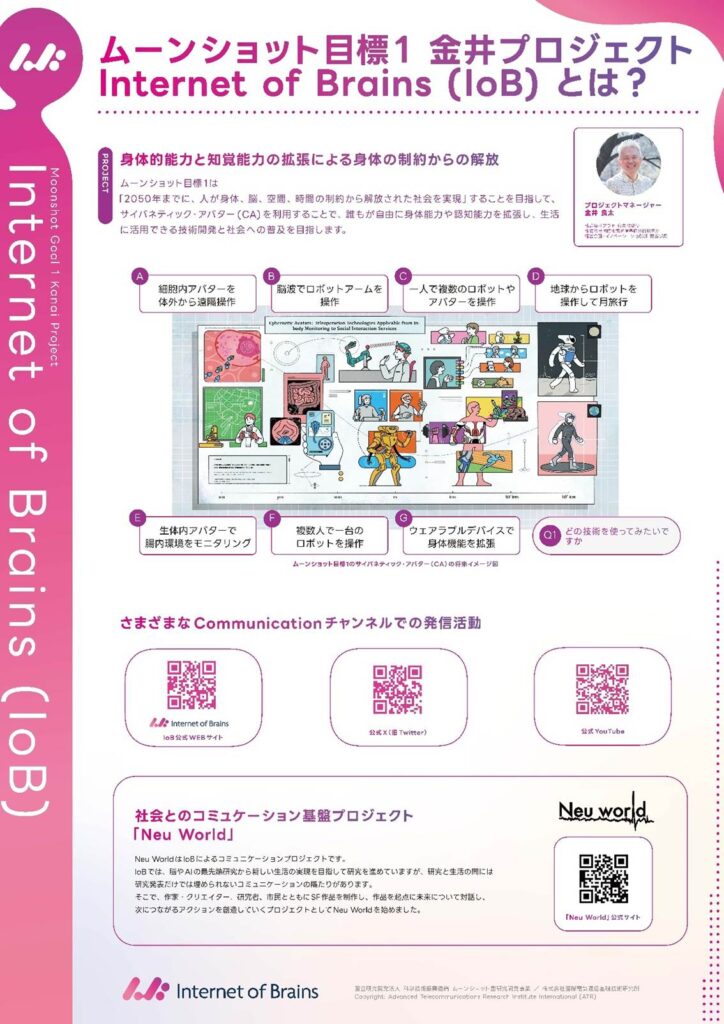
Under Moonshot Goal 1, we are working on R&D in collaboration with various projects with the aim of “achieving a society in which people are free from physical, brain, space, and time constraints by 2050. Each person has different physical characteristics, and these physical characteristics can make it difficult for people to live freely in society. We aim to solve such problems through technology, and at the same time, by working together with many people to create rules for things that cannot be solved by technology alone, we aim to realize a society in which people can live freely without being restricted by physical limitations.
One of the core technologies is “cybernetic avatars. We are working to solve problems through research and development related to cybernetic avatars, including avatars in digital space, avatar robots, and technology that further develops prosthetic arms and legs that augment bodily functions.
Cybernetic avatars include, for example, technology that allows two people to operate one avatar robot and utilize the skills of each person in a single avatar, technology that allows one person to operate multiple avatars, and technology that allows remote control of avatar robots in places where humans cannot easily go, such as space or deep sea. Other technologies include Other technologies include the in-body cybernetic avatar, which examines the health condition of the body and explores what approach to take.
Among them, we are focusing on brain research and studying technologies that allow us to remotely control avatar robots just by thinking, use them as if they were part of our own bodies, and communicate our thoughts and feelings to others without having to speak. Focusing on research on BMI (brain-machine interface), a device that connects the brain to a machine and allows it to move and communicate its intentions as if it were its own body, I am promoting research and development of cybernetic avatars in collaboration with researchers from other projects. Ishido-san, is there any technology you would like to use in this project?“
Ishido: “I want to use all of them. One of the themes of “Brain World for Everyone” is how to realize a society in which each individual can live comfortably by extending his or her own body functions, including brain functions. The technologies you have just introduced to us, Mr. Miyata, are all things that I hope will soon be developed and implemented in society. I would like to use these technologies as soon as they are implemented.“
Mr. Miyata: “There are people like Mr. Ishido who would like to try various things with these technologies, but I think there are also people who are a bit worried or afraid. Especially our research area is related to the brain. For example, in BMI research, there is a technique called invasive surgery, in which a machine or other device is surgically attached directly to the brain to extract brain signals. We are conducting research using various approaches, including invasive and non-invasive methods, but there are still many people who feel uneasy, are concerned about privacy issues, and would like to see “proper rules and regulations” in place. We would like to conduct our research projects in accordance with each individual’s sense of values.“
Creating science fiction works as a first communication opportunity to think about the future
Mr. Miyata: “That is why we started to think about the future of this research together with more people, aiming to be close to each person’s sense of values, and the “Neu World” project, a communication infrastructure project with society.“
Ms. Kawahara: “’Neu World’ project is a communication project within the IoB. In “Neu World,” writers, creators, IoB researchers, and citizens work together to create science fiction works. Using the works as a starting point, we are discussing together what the future should be like.“
Mr. Miyata: “Through science fiction works, I would like to communicate with many people about how IoB research will be implemented in society in 2050. The science fiction works in “Neu World” do not represent a vision of what the IoB will look like in the future. What do you expect in such a future? What are your concerns? What would you like to do if it were you? We create SF works as a first communication opportunity to create a better future.
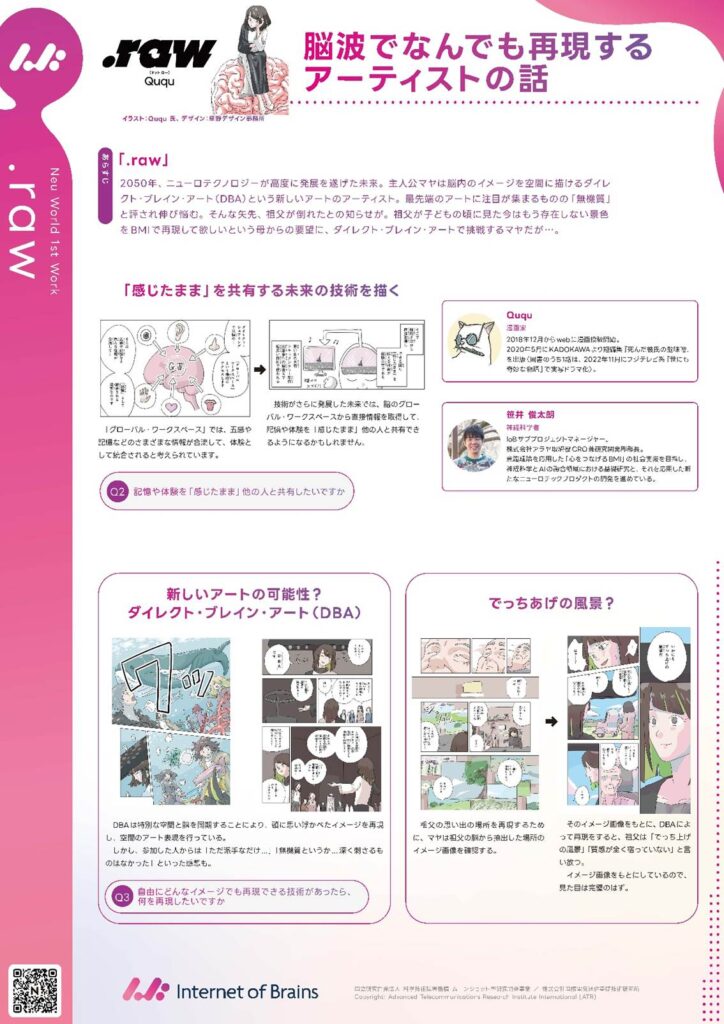
The first work, “.raw” (▲Picture 5▲), was created together with manga artist Ququ and IoB researcher Shuntaro Sasai (Director, CRO and Head of R&D Department, Araya Inc.). This is a story about an artist who can reproduce anything with brain waves. The synopsis is “In 2050, in a future with highly developed neurotechnology. The main character Maya is an artist of a new art form called “DBA” (Direct Brain Art), which can draw images in the brain in space. Although her cutting-edge art attracts attention, it is regarded as inorganic and her career is sluggish. Just then, he receives news that his grandfather has collapsed. Maya tries her hand at direct brain art to meet her mother’s request to use BMI to recreate a landscape her grandfather saw as a child that no longer exists…” This is the story of Maya. The world has become a place where the technology to reproduce what you imagine in your mind as a work of art with images in the real world has been implemented in society. As you read the manga, you will find that cutting-edge research is also being conducted to share memories between people, and the story is about Maya’s struggle to recreate her grandfather’s memories using this technology.
All of the works in “Neu World” are available for free on the website, and we hope that many people will read them. At the same time, at the “Everyone’s Brain World” booth, we gathered opinions in various ways, such as actually allowing people to read the works and discussing what kind of future they would like with us based on their impressions after reading them.
For example, the questions ‘Do you want to share your memories and experiences with others?’, ‘Can direct brain art be called art?’ from the point that the work was called inorganic and was not stretched, ‘What is the difference between my grandfather’s memories and the landscape reproduced by direct brain art? as a starting point for discussion with the audience. Would you like to share your memories and experiences with others?“
Ishido: “I think that is something that needs to be discussed. In the Neurodiversity Project, we are also considering how to respond to people who are having trouble communicating, both from a technological and environmental perspective. Some people think that perhaps the easiest way to communicate is in a world where brain-to-brain connections are made without language and information is shared, but that is not what we want. If all information is shared, we may not be able to understand each other and get along better than we do now. In fact, there is a possibility that divisions will widen. I often talk about these issues with the researchers of “Brain World for Everyone. I would like to create a place where we can all think about what kind of future we want to create by utilizing new technologies, and I would like to make Everybody’s Brain World such a place. I feel that this is in line with the direction that Miyata and his colleagues are taking.“
What is theIoB’s goal ofreaching technology in 2050?
Ishido: “From this perspective, I would like to ask you how far do you think IoB technology will have evolved and become practical by 2050? In your work this time, you describe a society in which technology that extends the power of the brain is realized, such as direct brain-to-brain transmission of images. Research has already shown that we can send what we imagine in our minds by e-mail and output images we have drawn in our minds. So, how far have you come, or how far do you aim to get, in 2050, in the area of what you call “brain tech?“
Mr. Miyata: “Even in 2024, we are able to measure brain waves when a person whispers a word-level phrase inaudibly using a device attached to the scalp, and identify the extracted information by combining it with AI technology. By the year 2050, by advancing such research, we hope to be able to output the expressions envisioned in the mind and remotely operate robots in collaboration with AI, and then implement them in society and use them as social infrastructure in a positive direction for all of us. We are also working on research to stimulate the brain. We are also advancing research on brain stimulation. It is difficult to say how far we have come, so we can only tell you that we have reached this point in the course of our research.“
Ishido: “So, these things are becoming a reality. At ‘The World in Our Minds,’ Masatane Muto, who lives with ALS, performed a show where he DJ’d using only his brainwaves. I feel that such a world is steadily approaching. This year’s exhibition features several Moonshot teams, including two from Goal 1. Professor Kota Minamisawa’s team at the Keio University Graduate School of Media Design focuses on bodily augmentation, while Dr. Kanai’s team works on brain augmentation. Because bodily extensions like eyeglasses, hearing aids, and wheelchairs are already familiar to us, the psychological resistance to them is relatively low. On the other hand, brain augmentation—partly due to invasive technologies—seems to face a higher hurdle for social acceptance. As science communicators, what is your take on the current public perception of the brain-tech field?”
Mr. Miyata: “In reality, I think that many people are not aware of the fact that research is being conducted at the level I have just described. Some of the extensions of bodily functions have already been implemented in society, so it is easy to imagine them as extensions of those functions, but many people do not even know that brain function extensions have been studied for some time. I think it is easy to imagine the brain function expansion. I think it is important to gradually communicate things like, “This kind of research has already been conducted,” “We are using medically approved products,” and “We will make rules together with you,” so that it does not come “out of the blue. Please share your thoughts with our intern, Ms. Sugita, who is doing the research from a student’s perspective.“
Mr. Sugita: “In talking with many visitors to “Brain World for Everyone”, some of the opinions that actually came up were that they would like to use it, but others said that it was a cheat or that it would be better to restrict it to certain professions or specific situations. I still think we need to continue to have a dialogue with everyone to ensure that we are using the system appropriately, and not just in a positive way.“
Ishido: “Before we are afraid or anxious about this kind of technology being introduced to society, there is a lack of understanding of the fact that the technology is so advanced. I totally agree with you. I am often surprised at the results of research and am amazed at how far we have come, but I am not so sure that this has been widely communicated to many people. I would like to work together with researchers to make their cutting-edge research widely known to as many people as possible. For example, we had called on several laboratories to exhibit a game that uses brain waves to run a game, but they often said, ‘We can’t do it exactly right yet. So I said, ‘It doesn’t have to be exact. We told them that it is not accurate, but first we want people to know that we can do this kind of thing, so please exhibit.
I know you also do brain picks and other things at IoB. I would like to talk to you about that as well. Could you tell us what you are doing at Brain Pick, what level of accuracy you have achieved so far, and for what purpose you are holding Brain Pick?“
Mr. Miyata: “For the Brain Pick, we are challenging people to try e-sports using PLUG, a simple headphone-type electroencephalograph being developed by IoB researcher Professor Junichi Ushiba of Keio University. In this game, a special stadium is created within the world-famous video game “Fortnite,” and avatars of “Fortnite” are made to run by simply attaching plugs and thinking, competing for time to reach the goal. Gyro-sensors are installed in the brainwave meter, so players can move their avatars left and right by tilting their heads, and compete with each other to reach the goal by running the course just by thinking. Trained players will be able to run and stop at will to some extent. There seems to be a so-called ‘chemistry,’ so I think there is a difference in whether or not it is working the way you think it should, depending on the person.“
Ishido: “Does that mean that if I train harder, I will get better at it, or does it mean that I will be able to know how to think better and be able to control it?“
Mr. Miyata: “Just as with exercise, there may be different strengths and weaknesses in different people, but you may be able to enjoy e-sports in the form of exploring how to use your brain by practicing over and over again and getting a good feel for that feeling when your avatar starts to run.“
Ishido: “If I can practice and train myself to use my brain, is there a possibility that I will be able to move my body better or play games better even when I don’t use brain waves?“
Mr. Miyata: “I would have to ask Professor Ushiba about that. But perhaps it is similar to how people who play sports or ride bicycles become able to move as they expect after training.“
IoB also focuses on rulemaking related to Braintech
Ishido: “What Mr. Sugita mentioned earlier is also very interesting. I heard that some people thought it was cheating. In other words, there are people who feel that extending the brain and operating it with the brain is cheating or dishonest.
In the future, when it will be possible to implant chips in the brain, as depicted in science fiction, some people will ask, “To what extent am I me?” I think some people will wonder, “How much of me is me? What concerns or fears have you heard from the various people you have communicated with so far, in addition to those who are anxious, scared, or think it is cheating?“
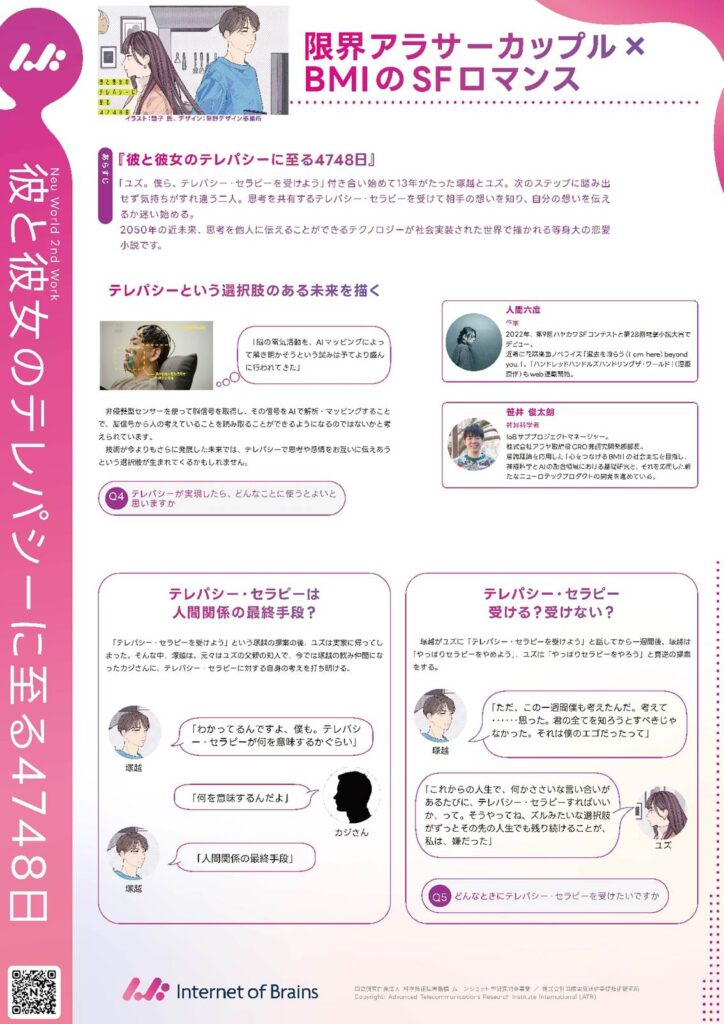
Mr. Miyata: “One of the things I often hear about is privacy. The second work of “Neu World” (▲Picture 6), created by the artist Ningen Rokudo based on the theme of Mr. Sasai’s research, depicts a world where telepathic therapy, in which all memories and feelings in the head can be shared without having a conversation with others, is used as therapy. In this work, a “marginal couple in Alaska” who are in a rut in their relationship wonder what their next step should be and whether or not to undergo telepathic therapy. Since telepathic therapy feels like having one’s mind laid bare, we received some concerns from readers of this work about the possibility of being seen by people with whom they do not want to share their thoughts, or being left as data. They wanted only a portion of the data to be shared, not all of it, for the data to be erased immediately, and for the technology to be used within rules that would protect their privacy.
I am sure that similar discussions have been held on genetic information, but there were many voices heard in the dialogue of this exhibition that said that if it is possible to take brain memory, they would like us to pay attention to such things. Mr. Kawahara, were there any other opinions that were different from what we have heard so far?“
Ms. Kawahara: “One interesting comment came from a visitor. He said that when directly connected to the brain, the brain processes information too quickly, and that he did not want to have a conversation so quickly. For example, when we used to communicate by letter, we would have been able to take time to think deeply and convey our thoughts in a slow exchange, but now that we can do it by chatting, we may send sentences without thinking deeply because we can respond immediately, or we may connect our brains directly However, when we are able to chat with each other now, it is possible to respond immediately, and therefore, people may send messages without thinking too much.
Another thing I thought was interesting was the opinion that it would be nice if we could choose our own mode, instead of having our brains connected all the time, like ‘now we talk directly with our brains connected,’ or ‘now we talk face-to-face with words.’“
Ishido: “Certainly the pace of communication is different for each person. If we can share what we are thinking in an instant, it may be easier to communicate what is difficult to convey. On the other hand, there may be times when we cannot build a relationship that takes time to build with each other, or we cannot take time for introspection to think about how to build a relationship. I felt that this could also diminish my understanding of the situation.“
Mr. Sugita: “A visitor mentioned that the Japanese people’s sense of depth and respect for others is being lost in recent education. The person’s concern was that when such telepathy becomes possible, the ability to respect others and to imagine will be even more lacking and will not be nurtured well. We realized that there is a need to strike a balance between humanity and technology that facilitates communication.“
Ishido: “In the field of education, in my activities of holding workshops to think about the future with children, one thing that always comes up is that ‘if we could input knowledge directly into the brain without studying. While I think the way of education will change, I think it is quite difficult to write knowledge into the brain. Is it still a high hurdle?“
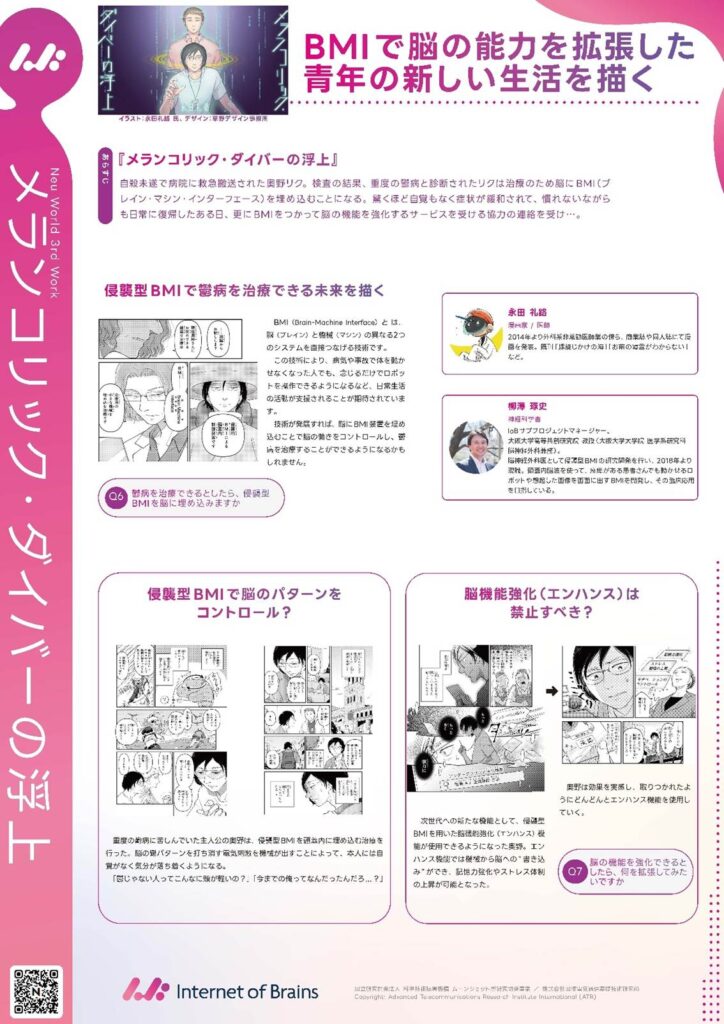
Mr. Miyata: “I believe that ‘writing’ to the brain will take even longer to achieve social implementation than ‘reading’ from it. This challenge is depicted in the third manga work, ‘The Melancholic Diver’s Ascent’ (▲Photo 7▲), created by Reiji Nagata, who is both a manga artist and a physician. Professor Takufumi Yanagisawa of Osaka University, an IoB researcher who collaborated with us on this project, also emphasized this point.”
Ishido: “‘The Melancholic Diver’s Ascent’ is truly a story about the enhancement of memory, isn’t it? I found it fascinating. Within the fields of IoB and brain-tech, do researchers themselves engage in discussions such as, ‘Could it be dangerous if this technology continues to evolve at this rate?’ or ‘To what extent should this be permitted?'”
Mr. Miyata: “The IoB has published evidence books and guidebooks on digital media that serve as guidelines for rulemaking related to BrainTech. It was created through discussions among researchers on questions such as, ‘Is this based on correct scientific evidence? I am sure that such discussions are held in a variety of venues.“
Ishido: “The last thing I wanted to ask you about was exactly what you said about the BrainTech guidebook and evidence book. This is available to everyone for free. As the technology advances in the future, I think there are things that need to be prepared to ensure that users can use the technology safely and with peace of mind. Specifically, there is a code of ethics and a guidebook on how to use the system, which IoB is also enthusiastic about.“
Mr. Miyata: “The guidebook is not the end of our efforts to publish it, but rather, as we have done with version 2, we will update it in accordance with changes in the times and the progress of research, while obtaining your opinions and through public comments. We are trying to continue that activity in the future.
As “safety and security are not the same thing,” the goal of the science communication side of Neu World is to help people understand that we can “build the future together” so that everyone will feel “comfortable leaving IoB to IoB researchers. We would like to conduct activities other than the release of science fiction works.
For example, we are currently developing workshops where we can think together with junior high and high school students. I hope that by creating opportunities for communication while expanding our base, we can successfully build a relationship of trust with society.“
A future that is happier than the present while staying close to each and every one of us.
Ishido: “At ‘The World in Our Minds,’ we also held a symposium titled ‘Super-Futurology.’ I served as the moderator, joined by Professor Hirotaka Osawa—President of the Science Fiction and Fantasy Writers of Japan (SFWJ) and Director of the Keio Science Fiction Research Center—along with other SF writers and Professor Minamisawa from KMD.
At that symposium, we discussed how there is always a time lag between technological advancement and social acceptance, and it takes even longer to establish the frameworks and systems needed to ensure proper usage. While we have high expectations for technological progress, it is equally essential to discuss the kind of society we want to envision using those technologies, and to play a role in sounding the alarm regarding potential concerns.
Our symposium was held with the concept of using ‘SF Prototyping’—a participatory approach involving users—to think about the future society we aspire to create. I felt that this is perfectly aligned with the direction of your work. Could you share your thoughts on the unique advantages and strengths of utilizing science fiction (SF) in this field?”
Mr. Miyata: “I am also a member of the SFWJ and the Keio Science Fiction Research Center. Even before joining the IoB project, I had been working on SF prototyping since my time at the National Museum of Emerging Science and Innovation (Miraikan).
To answer your question, what I find valuable about imagining the future through science fiction as a science communicator is the ability to ‘fail’ in the future. In the world of SF, we can experience dystopias or ‘bad endings’ before they happen in real life. This allows us to anticipate challenges and get ahead of potential issues. I believe a key advantage of SF is that it makes it easy to start by identifying the kind of future we don’t want, and then work backward to imagine what we need to achieve by a certain year to avoid it.
The other thing is that science fiction is a story, and I believe that being able to put myself in the shoes of the characters in the story means being able to put myself in the shoes of others who are not me. When we engage in science communication, people often tell us what they would have done, but I think it is important to think about how we can reconcile our ideas with those of others and take action toward a future where no one is left behind, as each of us has a different set of values. I believe that science fiction is effective as a catalyst for imagination. I think the appeal of SF prototyping is that it puts you in the perspective of others, not yourself, in a story.“
Ishido: “By using SF, you can practice thinking. I have high expectations for SF prototyping in that it will provide an opportunity to think about ‘how to deal with technology’ and ‘what kind of usage is acceptable’ through repeated practice. Finally, could you give us a message from each of you?“
Mr. Sugita: “Through this science communication, we would like to first let you know about the IoB. Then, we would like to discuss with you about innovation in science and technology and what kind of future we would like. I would be delighted if we could have a positive exchange.“
Ms. Kawahara: “The science communication we are conducting in ‘Neu World’ is a creative initiative. We hope to broaden the gateway to dialogue and provide an opportunity for more people to learn about the research being conducted today. In the future, we also intend to promote overseas expansion. First of all, we are planning to translate science fiction works so that they can be read by people overseas.“
Mr. Miyata: “In “Neu World,” we would like to continue to collaborate with various researchers and artists to produce new works in the future. We will also hold more and more workshops and events in conjunction with these efforts. We hope you will keep an eye on our future activities.
We tend to think that these technologies are advanced by researchers and the great people of the country, but each of you is the protagonist of the world’s future. I would like to work with each and every one of you to create a future that will make you happier than you are now, while listening to your voices. I look forward to working with you in the future.“
Ishido: “The very concept of “The World in Our Minds” is to create a society in which all people can exercise their own abilities in their own way, with the participation of everyone. Thank you very much for your time today.“