Choose the learning style that works best for you Creating an “easy-to-learn” environment for each student The Challenge at Benesse Correspondence Support School
8/12/26
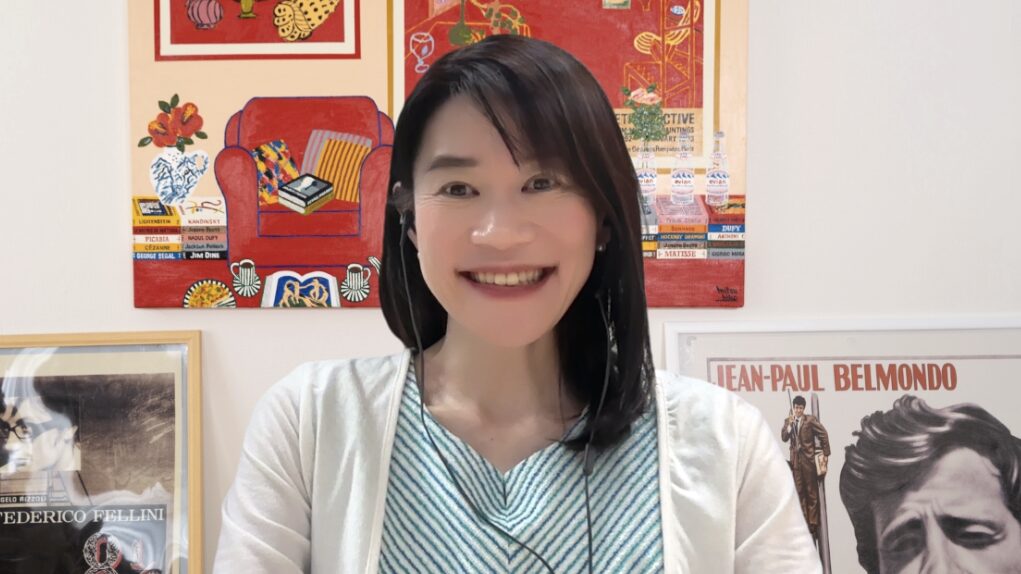
The “Neurodiversity Project,” organized by B Lab, aims to respect brain and neurological diversity and create a society where everyone can reach their full potential while being true to themselves.In this installment of the Neurodiversity Project interview series, we spoke with Takiko Shiroza (▲Picture 1▲), Director of Diverse Learning Development at Benesse Corporation, about Benesse Correspondence Support School, a correspondence support school for high school students.Nanakko Ishido (▲Picture 2▲), Director of B Lab, spoke with Ms. Shiroza about the school’s initiatives, which focus on supporting students who have struggled in traditional schools by implementing learning methods tailored to each individual.

>> Interview videos are now available!
Choose between in-person and online classes
Creating an environment where you can learn at your own pace
Ishido: “We’re pleased to welcome Ms. Shiroza from Benesse Corporation today. I understand this will be your first time exhibiting at ‘The World in Our Minds.’ First, could you tell us about your exhibit and your usual initiatives?”
Shiroza: “At Benesse Corporation, I’m involved in developing diverse learning programs. Benesse Correspondence Support School, which we operate, opened in April 2025 as a correspondence support school for high school students.It offers an “Advanced Course” for students aiming to enter college and a “Basic Course” for those aiming to graduate from high school. In addition to an online-centered learning style, students can choose the frequency of in-person attendance that suits them best—such as once a week, three times a week, or five times a week.”
The philosophy that our academy holds dear is “Be you. Become more.” We use the phrase “True First Choice” to describe the process of discovering who you truly are and finding your own path to the future.
While considering the concept for our school’s founding, we discussed research indicating that a person’s level of happiness as an adult is more closely linked to the sense of having “made their own life choices” and “determined their own path” than to household income or educational background.We want children to discover their own futures based on their thoughts, individuality, and interests. Our school was founded on the desire to carefully support them through this process and create a learning environment where they can make their own decisions.
Subsequently, because we received many requests for such learning opportunities not only from high school students but also from middle school students, we opened a middle school division. The middle school division operates as a free school, providing a place where children who are enrolled in local schools but find it difficult to attend can learn at their own pace.
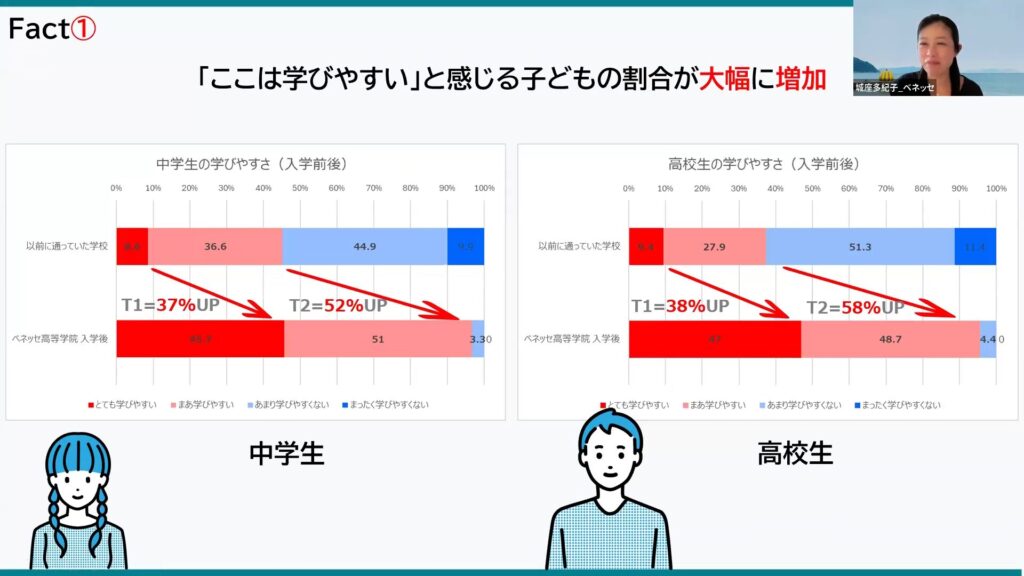
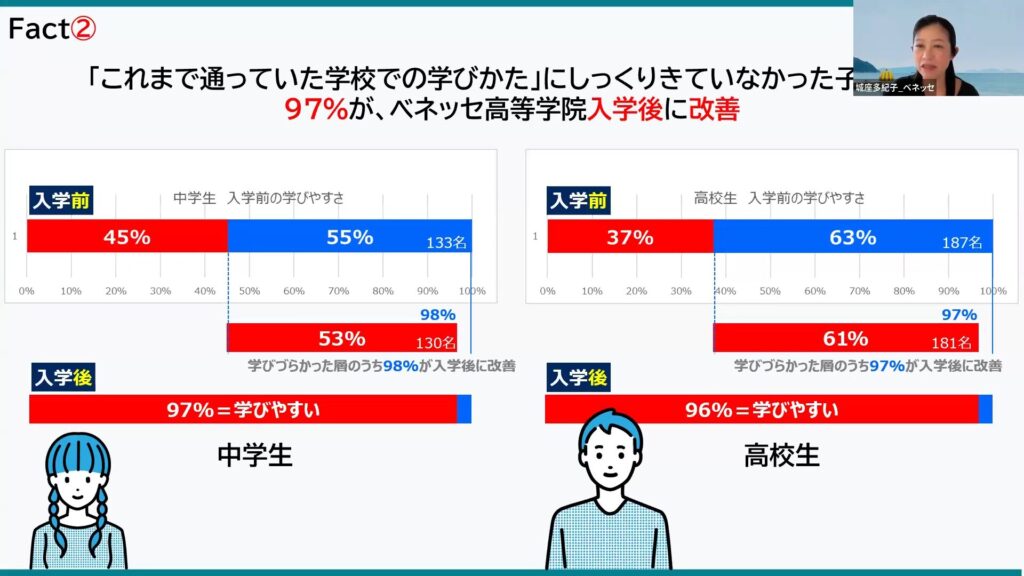
While considering what to feature in this issue of ‘The World in Our Minds’, we conducted a survey among our students. The results were quite interesting. At their previous schools, a significant proportion of students had answered that “it wasn’t easy to learn,” but since enrolling at Benesse Correspondence Support School, approximately 96% of both middle and high school students responded that “it is now easy to learn.”(▲Picture 3▲)
In addition, approximately 97% of the children who had found it difficult to learn at their previous schools reported that “their ability to learn has improved.” (▲Picture 4▲)
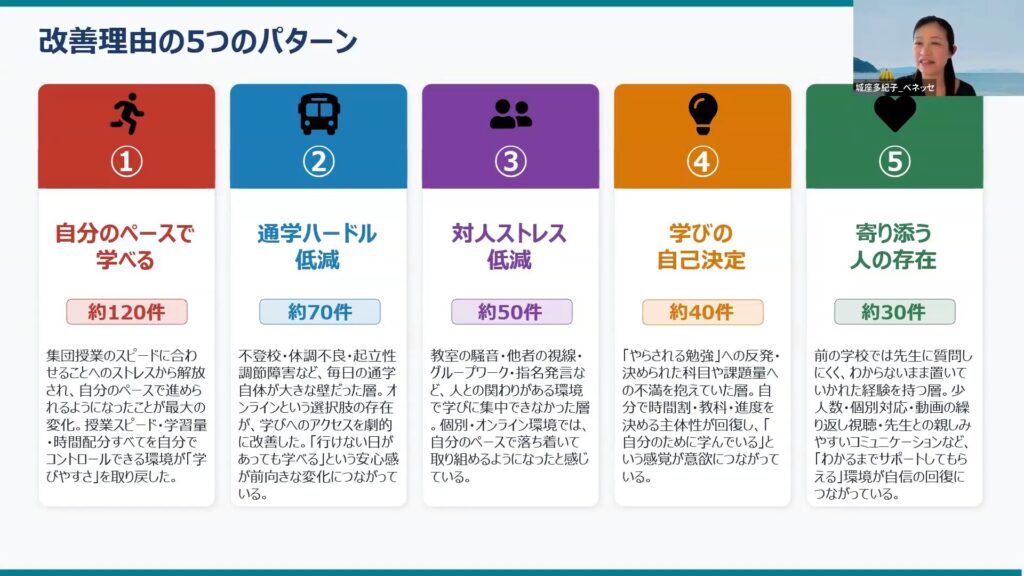
So, why has learning become easier? An analysis of the open-ended responses revealed five main reasons: “I can now learn at my own pace,” “The barriers to attending classes have been lowered,” “Interpersonal stress has decreased,” “I can now decide for myself what to study,” and “There are people who support me.” (▲Picture 5▲)
“At this point, we’re sharing this as a preliminary report, and we plan to delve deeper into the matter as part of our preparations for the exhibition, while also taking Dr. Ishido’s opinions into consideration.”
Ishido: “That’s a wonderful result. It feels as though the reasons why I’ve found learning difficult up until now are clearly reflected in the data.”
Shiroza: “We, too, truly felt, ‘This is what the children were struggling with.’ The most common feedback we received was that students ‘were able to learn at their own pace.’ For example, they can choose how often they attend school in person, and even on days they’re scheduled to attend, they can freely switch to online learning if they feel unwell or aren’t in the mood, deciding, ‘I’ll do online today.’”
At Benesse Correspondence Support School, we’ve established a system where, in principle, all classes can be taken online. Even students who come to campus participate in live online classes from individual booths or similar spaces. As a result, switching from in-person to online learning does not compromise the quality of instruction or put students at a disadvantage.I believe that this sense of reassurance—not thinking, “I have to go to school today,” but rather, “It’s up to me today”—is what contributes to the students’ psychological safety.
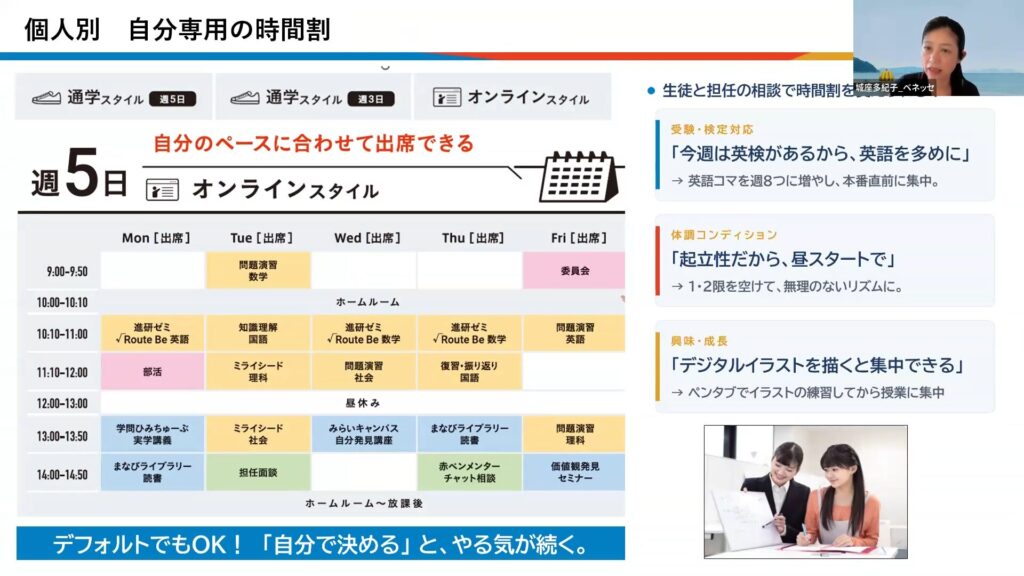
We provide a sample schedule, but students aren’t required to follow it exactly. For example, since some students have a hard time getting started in the morning, they might spend the first period drawing their favorite illustrations and begin academic studies starting in the second period. Students can adjust their class schedule to suit their interests and how they’re feeling. (▲Picture 6▲)
“Some students start their day slowly with online classes in the morning and come to campus in the afternoon. While this might be difficult at a traditional school, here they’re free to decide for themselves how to spend each day, thinking, ‘Today, I’ll do it this way based on how I’m feeling.’ Both students and parents are gradually getting used to making these kinds of choices.”
You Don’t Have to Fit In with Everyone Else
You can choose the way to participate that feels right for you
Ishido: “So, the ability to seamlessly choose between online and in-person learning is a major feature, isn’t it? How do you foster connections among the children who are learning online?”
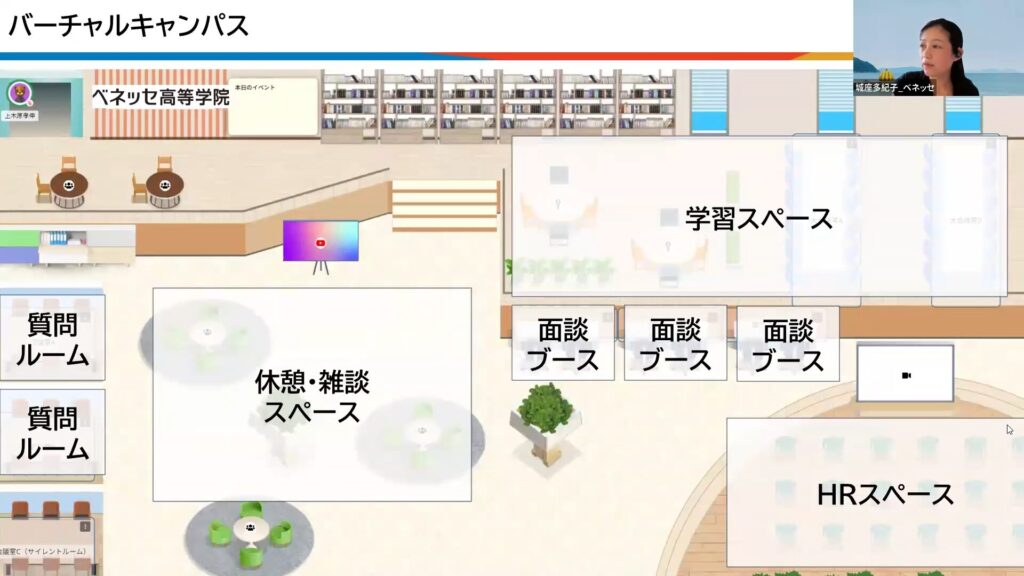
Shiroza: “We have a virtual campus. In the morning, the children log into the online campus and ‘go to school.’ Whether they’re attending in person or online, they all start by entering the same virtual campus. (▲Picture 7▲)
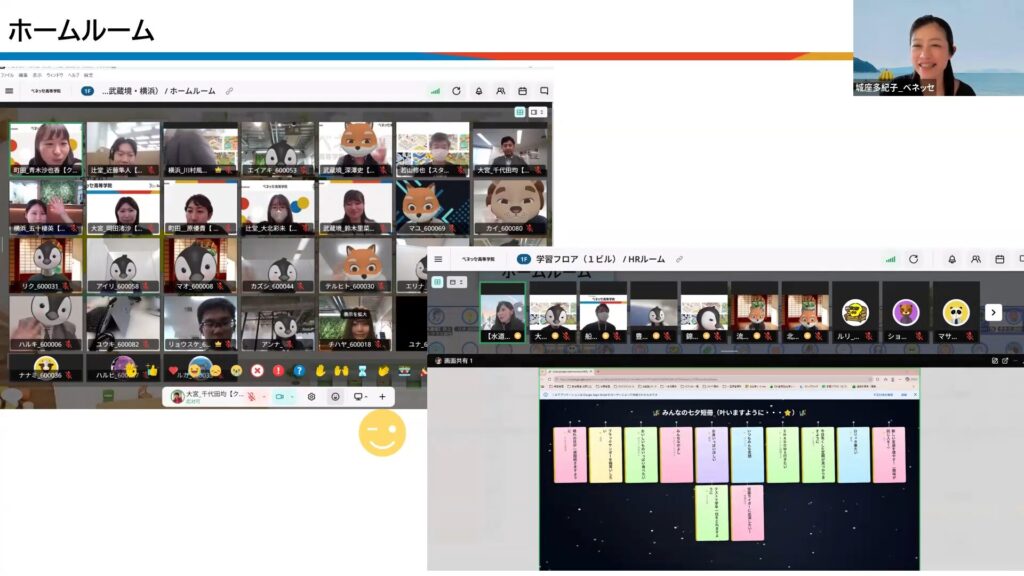
During homeroom, some students join by showing their faces, while others participate using avatars, and still others keep their cameras off and respond only with reaction buttons. For example, when Tanabata is approaching, we incorporate fun events such as writing wishes on paper strips online and sharing them. (▲Picture 8▲)
There is also a system called “Be Log,” where the children write down their mood and what they want to do each morning. They make a personal declaration—such as “This is the kind of day I want to have today”—and their homeroom teacher reviews it and provides feedback.
By continuing these practices day after day, things like taking a step back to view your own state, engaging in metacognition, and deciding for yourself what to do each day gradually become habits. At the same time, this fosters a sense of security that comes from knowing there are adults who will accept you just as you are.
Another common response in the survey was that “interpersonal stress has decreased.” We often hear from students that at their previous schools, they “didn’t like large groups,” “found the noise too overwhelming,” or “found group work painful.” At Benesse Correspondence Support School, we operate on the premise that students can choose the way of participating that makes them feel most comfortable.Even during lunch break, some students want to eat with everyone else, while others prefer to eat quietly by themselves in a private booth.
In online events, you can participate with your camera on, or you can participate without speaking, using only your avatar or reaction buttons. For example, in a quiz contest, you can answer by moving your avatar to zones labeled A, B, or C on the screen. You might be participating in the quiz without showing your face or speaking—that’s also a perfectly normal way to participate.
In addition to card and board games, new games created by the children themselves are emerging every day. Anyone who wants to join in is welcome to do so. You can participate online if you like. Or you can just spend some quiet time on your own.We try as much as possible to avoid creating the kind of peer pressure that makes people feel they have to go along with what everyone else is doing.
As children gain these experiences, they naturally learn to value their own way of being while also respecting that of others. Of course, we don’t focus exclusively on online activities. We also have club activities and interest groups, and we hold in-person field trips and cultural festivals.At the cultural festival, students actually gather to play music, perform skits, and showcase their own creative works. It’s not an either/or choice between in-person and online—in-person is fine, and online is fine too. It’s okay to show your face, just use your voice, or even just use the reaction buttons. I believe that this wide range of options is what makes students feel so comfortable here.”
From “forced learning”
Toward “What I Want to Learn” That I Choose Myself
Shiroza: “Another major change that was mentioned was that ‘students are now able to make their own learning decisions.’ When we listen to the children, it’s not uncommon to hear them say they previously felt they were ‘forced to do things’ or ‘got tired because they couldn’t keep up.’ So, we start by helping them discover what they like and what they’re good at, and then guide them into learning based on their interests and curiosities.”
For example, there is a live lecture series called “Gakumon Himichu-bu.” In this series, professionals from various fields serve as instructors and talk about their work and the fascinating aspects of the world. At “Mirai Campus,” students engage in exploration alongside people active in diverse fields, such as artists, designers, architects, and entrepreneurs.
In addition, we offer “Self-Discovery Workshops” designed to help participants reflect on themselves and understand their true selves. For example, we have a program for middle school students that helps them understand themselves through art.By combining various artistic elements to design a “room that reflects who I am,” participants engage in dialogue about questions such as “Why did I place this here?” and “Why do I like this?” Through this process, they gain a deeper understanding of themselves, realizing, “I feel comfortable in this kind of space” or “I like these kinds of things.”Based on the idea that there are many different sides to oneself, there are also activities where students draw and name the “little people” living inside them. Through art, they give voice and form to their inner selves, fostering metacognition about who they are. Above all, we prioritize fostering positive emotions—such as “Learning might actually be fun” and “If I start with what interests me, I’ll want to explore more.”
Recently, we’ve also launched courses in the field of digital creativity. In our illustration and manga courses—which utilize content from “Digital Hollywood,” a Benesse Group affiliate—students create their own work while receiving direct feedback from professional instructors; these courses filled up immediately after enrollment opened. Building on this sense that “learning is fun,” students then move on to academic subjects.Benesse has a wealth of educational materials and learning expertise accumulated over many years, including the Shinkenzemi program and school-based teaching materials. Some materials allow students to go back and relearn concepts they struggled with, regardless of their grade level, while others let them repeat problems at their own level multiple times to build a sense of small, incremental achievements.
“What’s important is to pursue the ‘learning that you need’ at your own pace, using a ‘learning method that suits who you are right now.’ I believe that as you gain more of these experiences, it will build your confidence—leading you to realize that ‘learning is fun’ and ‘it’s okay to go at your own pace.'”
Class Teachers and “Red Pen Mentors” Work Closely Together
Building Relationships Where Students Can Trust Adults
Shiroza: “And what’s very important is having someone who’s there for you. While there are many adults involved at the academy, the homeroom teachers and the ‘Red Pen Mentors’ are especially important.” At Benesse, we have “Red Pen Teachers” who have been responsible for grading correspondence assignments at Shinkenzemi for many years. We ask those among them who demonstrate a particular ability and dedication to supporting children to serve as mentors for our academy students.
They offer advice based on an understanding of the child’s progress, listen to their concerns, and share in their joy when something nice happens.Although my language might be a bit casual, I’m someone they can talk to easily—like “the lady next door.” For children who have been hurt by their relationships with others—perhaps because they’ve had a hard time going to school—I believe it’s very important for them to build a relationship with at least one or two adults whom they can trust.
“I’m happy when my homeroom teacher talks to me,” “They listen to my concerns with genuine care,” “They respect each of us as individuals”—as students begin to feel this way, the sense that “maybe adults are people I can trust” gradually begins to take root. With a conscious effort to foster such relationships, we engage in daily communication.
“It’s important that the children find school life ‘fun,’ but what that ‘fun’ means is completely different for each individual. The way they enjoy it is different, too. That’s precisely why I believe it’s important to create an environment where each child can feel, ‘This is where I belong.'”
Caught between school and home
Creating a New Space for Learning
Ishido: “I listened to your story with deep emotion, realizing that the role of the ‘Red Pen Teacher’ is shifting toward that of a ‘Red Pen Mentor.’ Benesse is a company that has long supported school education while also supporting home learning through programs like Shinkenzemi. I imagine there were many discussions leading up to the decision to launch your own correspondence school support program.What was the background behind this decision?”
Shiroza: “For a long time, Benesse has supported children in two main ways. One is through services for schools.The other is services for families, centered on ‘Shinkenzemi’ and ‘Kodomo Challenge.’ While supporting children from the school’s perspective, we have also created educational materials and services for the home with the mindset of partnering with parents in raising their children, always keeping their needs in mind. I myself have been involved in service development in both of these areas.”
Amid all this, I noticed relatively early on that the number of children not attending school was increasing. For children who want to go to school but can’t, simply studying at home using the Shinkenzemi program isn’t enough. They need opportunities to interact with others and to experience being recognized by someone.
I felt there was a need to bridge the gap between school and home. Children who are not attending school or who have developmental differences are also participating in learning environments such as inquiry-based learning, language programs, and coding classes. As I interacted with these children, I became increasingly convinced that “creating a learning environment truly suited to these children is, in essence, a process of reflecting on the ideal nature of learning itself.”
“It’s not just about changing school education, nor is it just about evolving Shinkenzemi. Wouldn’t it be easier to envision the future of education if we shaped the ideal learning environment surrounding children itself? I recall that the creation of the academy began with that very discussion.”
It’s not a choice made simply because you can’t go to school
We’re entering an era where people choose correspondence education “because it suits them”
Ishido: “The number of correspondence high schools and support schools has increased significantly in recent years.I believe there are statistics showing that one in ten high school students attends a correspondence high school. Benesse possesses one of Japan’s largest educational databases—why has the number of children who refuse to attend school increased to this extent, and why is the demand for correspondence high schools and support schools growing? Also, have children changed compared to ten years ago, and how do you analyze these trends?”
Shiroza: “Speaking with the realization that this applies not only to school education but also to the educational services we have developed so far, for a long time, Japanese education has been based on the premise that ‘everyone learns the same things at the same pace, all at once.’ People who start from the same starting line are evaluated based on who reaches the finish line first or who scores the highest.
During the period of rapid economic growth, that system likely played a certain role in enhancing the nation’s strength. Achieving high test scores and high standardized test scores, gaining admission to a top university, and securing a job at a prestigious company were, so to speak, considered the sure path to happiness.
However, over the past 20 or 30 years, haven’t adults also begun to realize that happiness isn’t necessarily guaranteed at the end of that single path? Children, too, have started to speak up, saying, “This way of doing things is too hard.”In the wake of the COVID-19 pandemic, it has become easier than before to express the choice not to attend school, and adults, too, have begun to choose work styles that suit them, such as working from home. I think society has, in some ways, become more accepting of the idea that “it’s okay to choose a way of learning or working that suits you.” A system that forces everyone into the same mold and makes them do the same things is no longer sustainable.
In a society where AI is set to bring about major changes, it is more important than ever to create an environment where each individual can express their unique qualities. We believe that, by nature, children have the ability to learn on their own, with a sparkle in their eyes. However, I think there are aspects of today’s learning environment—which should allow them to fully exercise that ability—that are no longer a good fit for today’s children.”
Ishido: “I think that among the children who actually choose correspondence high schools, there’s a growing number who are actively making that choice not just because they’re not attending school, but because they want to spend their time doing what they’re interested in. How is that at Benesse Correspondence Support School?”
Shiroza: “While they aren’t the majority, there are definitely some students who choose this path for proactive reasons. I’d estimate they make up about 10 to 20 percent. For example, there are students who say, ‘I want to start my own business, so I want to see how new ventures are created at Benesse.’Attending a regular school means spending a lot of time commuting and on school life, but there are also students who want to organize their own time and spend it on what they want to do—such as programming, game development, video production, or part-time jobs.
On the other hand, there are many students who initially enroll for negative reasons—such as ‘my previous school wasn’t a good fit’—but who change as they spend time at the academy.They realize, “It’s actually okay to decide for myself what I want to do,” and when they look around, they see other students who are passionately engaged in their own interests. That’s when they realize, “This is what I’ve always loved,” and from there, they take off—I’ve witnessed many such positive transformations.”
The first step is
feeling that “it’s okay for me to be here.”
Ishido: “I imagine that for about 90 percent of the students, their decision to choose Benesse Correspondence Support School wasn’t based solely on positive reasons. If that’s the case, I think many students enter the school having gone through some kind of trauma or painful experience. What steps do these students typically go through before they’re able to return to learning? Also, may I ask what kind of support the school provides for these students?”
Shiroza: “I believe the changes that occur in children happen in several stages—it’s like a gradient. The most important thing at the beginning is for them to feel, ‘It’s okay for me to be here.’ There are adults who accept them for who they are. Whether a child can feel, ‘It’s okay to be myself around this person’—that’s what matters.It’s not uncommon for children to view themselves negatively at first. However, once they realize there are adults and peers who will help them discover, ‘I have these good qualities too,’ they gradually begin to accept themselves. When they put this into concrete words—saying things like, ‘I have this about me,’ ‘I like this,’ or ‘I’m good at this’—they become more firmly aware of these aspects of themselves.”
Once they reach that point, whether it’s learning or playing, they’ll naturally feel motivated to try things on their own—making friends or starting to engage with their studies. By that time, they’ve also begun to build a foundation of self-confidence, little by little.Because they feel secure knowing that “the homeroom teacher won’t laugh at them even if they fail,” “the Red Pen Mentor will offer advice,” and “their peers will accept them,” it becomes easier for them to engage in their studies.
“We will carefully assess where each person is at right now, engage in dialogue, and work together to figure out what to do next.”
Ishido: “Not everyone progresses through that stage at the same pace, right?”
Shiroza: “Of course not. The pace at which children recover and the timing when their interest in something is sparked vary from person to person. Their mental states, family environments, and developmental stages are all different. Some children may have been tormented by expectations like, ‘You have to be like this by this point,’ or ‘You have to have improved this much by now.’That’s why we try as much as possible not to impose such expectations.
If we feel the time is right, we’ll help them flip that switch together. If we feel it’s not the right time yet, we think of it as ‘a time to nurture their roots.’ It’s not the case that the only ‘good’ state is when everyone is actively participating. Some children just quietly observe their surroundings. I believe it’s important to create a space that embraces the whole group—including those children—and understands them as they are.”
Believing in Children and Standing by Them
Harnessing the educational expertise Benesse has cultivated
Ishido: “I imagine there are some parents who find it difficult to accept the situation when their child can no longer attend school. How do you provide support to those parents?”
Shiroza: “I believe parents play a very significant role. While we do our best to engage with the children, it is the home environment that has the greatest influence on their daily lives. Therefore, it is crucial that parents and we share the same perspective on the children. We maintain communication through various methods, such as holding parent-teacher meetings, sharing updates on the children’s activities, providing information from the school, and facilitating direct consultations between homeroom teachers and parents.”
“This child has the potential to grow.However, I think this is just a phase they’re going through right now,” or “Today, they really seemed to be having a great time”—in this way, we convey to parents the child’s behavior as we actually observe it. As a result, parents may feel a little more at ease; they may come to see us as allies, view their child with a gentler eye, or become more accepting of their child’s behavior. In this way, it is important to share our “view of the child” with parents.
“Of course, that doesn’t mean everything will go smoothly. I think we need to take our time and gradually come to understand each other.”
Ishido: “With the number of correspondence high schools and support schools on the rise, what do you think sets Benesse Correspondence Support School apart?”
Shiroza: “I think one reason is that Benesse as a company has a culture of ‘being there for children.’I’ve worked at Benesse for a long time, and internal discussions are truly filled with the question, ‘What’s best for the children?’ How can we provide a better learning experience? How do we want the children to grow? The academy is built by people who hold these aspirations and have the ability to support children. People who resonate with this vision are joining our staff one after another.”
Furthermore, Benesse has a wide range of educational services and expertise cultivated through its work in school education and home learning. Of course, this doesn’t mean we should simply provide all of it to children. If we gave them everything, it would actually end up exhausting them. Instead, we select and combine the elements that each child needs at this moment to find the truly optimal learning experience.
“We don’t just espouse a philosophy; we carefully observe each child individually to determine whether it truly leads to a future and path that is right for them. We believe our strength lies in creating a learning environment together with the children, while drawing on the resources we’ve cultivated over the years.”
Toward a “Forest” Where Diverse Learning Thrives
Aiming for a Future Where Education Itself Transforms
Ishido: “While the expansion of correspondence high schools and support schools can lead to a society that embraces diverse learning styles, there is also the possibility that existing schools will remain unchanged, creating a situation where only those children who cannot adapt end up moving to alternative settings. In other words, I think there is a debate over whether we should continue to increase the number of schools to accommodate this diversity, or whether all schools should undergo change. What are your thoughts on this point?”
Shiroza: “I believe we are currently in a sort of ‘development phase,’ where we are beginning to create a ‘forest’ with the depth and breadth to embrace all forms of diversity. I hope that in 10, 20, or 30 years, the world of education itself will have undergone significant change. That is my personal hope, as well as that of our company, and I intend for Benesse to play its part in that process.”
Right now, new learning environments like ours are springing up in various places. There is a growing number of settings—such as so-called alternative schools—where children can choose the education that best suits them from a diverse range of options. I believe that rather than simply developing in isolation, these environments will influence one another by drawing on each other’s strengths.
“New initiatives are emerging from the private sector, and existing schools are incorporating some of these—including technology—into their practices. As everyone pushes each other to improve, the system will evolve into a richer ‘forest.’ I believe we will eventually see such a mature educational environment take shape in the future. To that end, we intend to do everything we can.”
Ishido: “The Neurodiversity Project aims to go beyond education alone and redesign society as a whole to create a new norm. Even if schools change, we won’t have a society where diverse people can live authentically unless businesses and society as a whole also change. What do you think is required of businesses to make such a society a reality?”
Shiroza: “I think that, not just for companies but for society as a whole, the vision of the ideal world—what constitutes ‘the right kind of thing’ or ‘a successful way of life’—has been relatively uniform up until now. I believe that what’s important from here on out is to “increase the number of receptors.”
Of course, we need to create more environments in society that embrace diversity, but we also need to cultivate within each of us a greater capacity to think, “This is okay, and that is okay, too.” I believe that experiencing spaces like ‘The World in Our Minds’ is one way to do that.We all have experiences of belonging to various groups and communities. In some places, we may be part of the majority, while in others, we may be part of the minority. There will be times when we can draw on our own strengths, and other times when we’ll need support from others to overcome our weaknesses. I hope we can build a society where diversity isn’t just present in society at large, but is also woven into the fabric of each individual’s life through these diverse experiences.
Companies, too, need to develop a grand vision of “what kind of future they want to create” and consider what role their business will play within that vision. Rather than simply aiming for an extension of the world as it has been, they must ask themselves: When we envision the future, what can we do?
If you think about it that way, doesn’t it naturally lead to the conclusion that “it’s better to have people with a variety of values”?
“Even if someone tells us, ‘You need to change like this,’ the culture of a person or a company doesn’t change easily. We must design our own future ourselves. With the world undergoing such dramatic changes right now, I believe companies are expected to adopt this kind of mindset. At Benesse, we also intend to move forward while keeping this principle close to our hearts.”
Ishido: “We, too, hope to take on the challenge of creating ‘hyper-diverse’ organizations and societies—beyond the scope of ‘The World in Our Minds’—where people from all walks of life can share their respective strengths and weaknesses, and where each individual can thrive in their own way. We hope that our participation in this event will serve as a starting point for continued collaboration in various forms. Thank you very much for today.”