Empowering Individuals Through ‘Robotics × VR × Psychology’ to Build a More Inclusive Society
5/1/26
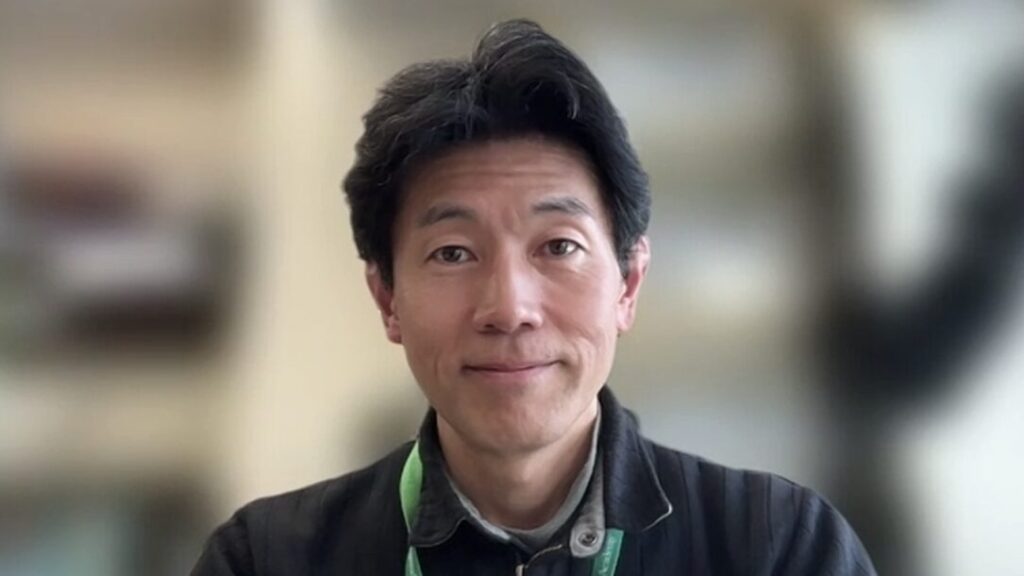
The Neurodiversity Project, sponsored by B Lab, aims to realize a society in which the diversity of the brain and nervous system is respected and everyone can demonstrate their abilities in their own way. In this Neurodiversity Project interview series, we introduce the efforts of Professor Tetsunari Inamura from the Brain Science Institute at Tamagawa University (▲Picture 1▲), who also participated in “The World in Our Minds” in 2025. Dr. Inamura is working to create a system to support the daily lives of people with impaired motor skills not only through physical assistance such as robot arms, but also through VR experiences that foster a positive self-efficacy, “I can do it myself”. Nanako Ishido, Director of B Lab (▲Picture 2▲), spoke with Dr. Inamura about his research.

> Interview videos are also available!
Combining VR and Robotics to Boost Self-Efficacy: Fostering the ‘I Can Do It’ Spirit
Ishido: “Today, we are joined by Professor Tetsunari Inamura from Tamagawa University. Professor Inamura showcased his work at ‘The World in Our Minds’ exhibition in 2025. We look forward to hearing more about his exhibit and the research he conducts on a daily basis.”
Dr. Inamura: “At the Brain Science Institute, Tamagawa University, I conduct research that integrates robotics, VR, and psychology to develop systems that support people in their daily lives. There are many different types of such assistive and support systems, but one goal is to help people who have become physically disabled.
It is important for people to feel that using an assist system “makes it easier to move around,” but if, for example, a robot did everything for the person, would that really benefit the person? Do we really lead to the person’s happiness? We always keep such a question in mind while creating an assist system. Assistive robots that assist people with impaired motor functions, such as in rehabilitation and nursing care, have already been very much in use for 20 to 30 years, and have been used in various ways to help many people who cannot move their bodies well or who have weak legs and backs that prevent them from exerting their strength. However, even if a person is physically able to stand up on his/her own legs or grasp an object with his/her hands, is it really an ideal assistance if he/she still feels that “I can’t do it anyway” and is only able to do it because a robot is assisting him/her? Is this really the ideal assistance? This is the question that remains unanswered.
Against this backdrop, we have been working over the past several years on a project called “Adaptive and Flexible AI Robots for Creating a Vibrant Society. (▲Picture 3▲)
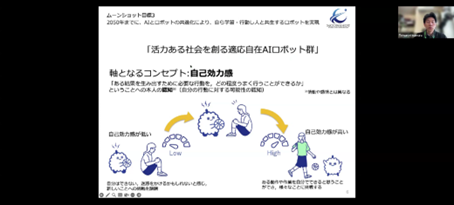
This work was conducted as part of the Moonshot Research and Development Program (Goal 3), a major initiative promoted by the Japan Science and Technology Agency (JST) entitled ‘Co-evolution of AI robots that adapt to people and the environment for a vibrant society’ (FY2020–FY2025). The core focus of this project goes beyond providing simple physical assistance, like helping someone stand up; instead, we aim to develop robots that offer psychological support, empowering individuals and enhancing their sense of self-efficacy in their daily lives.
Self-efficacy is the power to believe in oneself in the future, a positive feeling that one can do well, or that one will be able to do well even if one cannot now, or that one will be able to do well if one works hard. The core of this project is to create an assistive robot that fosters this sense of self-efficacy, and a rehabilitation and care system that fosters such a sense of self-efficacy.
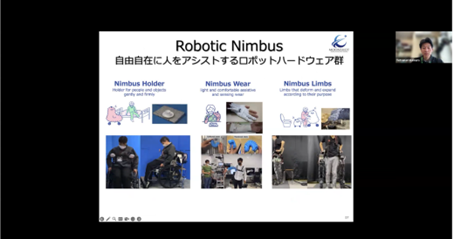
Specifically, it is important to have a system that can respond to various situations and users using various types of robots. (▲Picture 4▲)
There are various robots that can assist people to stand up or enable them to move their immobile hands, but my mission is to add an element of virtual reality (VR) in addition to physical assistance by robots. By having a person experience various physical movements in VR, I am combining the technology of positive illusion, which means that the person is not fully able to perform the movement, but ‘pretends’ that he or she has been able to. It is not only a physical aid to physical movement, but also a mental aid.
In ‘The World in Our Minds’, a VR illusion system for the motion of throwing a ball was exhibited. (▲Picture 5▲)
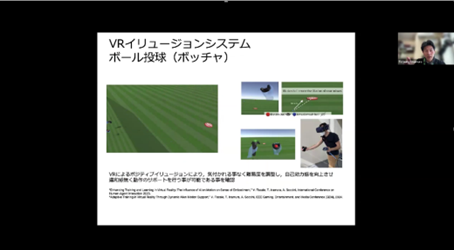
This system measures the speed of the hand when throwing a ball in boccia, a game known at the Paralympics and other events, and uses VR to pretend that the ball “successfully reaches” the desired location even though it does not reach it at that speed, allowing the player to experience that success in a virtual space. This system integrates that VR system with an assist robot that physically assists the hand movement. This is intended to increase self-efficacy and make rehabilitation more effective and efficient. (▲Picture 6▲)
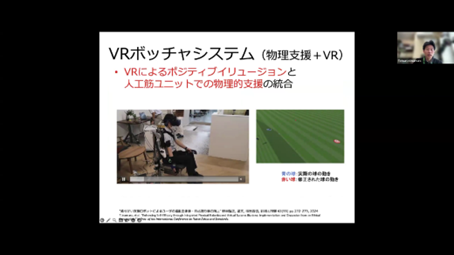
Let me explain in more detail. First, the user wears a physical support robot in his or her hand that increases the force and speed of the throw. Then, the user wears a VR head-mounted display so that he/she can see an image as if he/she were flying, even if he/she is not really flying very far. In this way, while physically assisting the user’s hand movements, the user is also able to see the image of flying at a distance. This will improve the user’s motivation and sense of self-efficacy. This is what we are aiming for with this system.
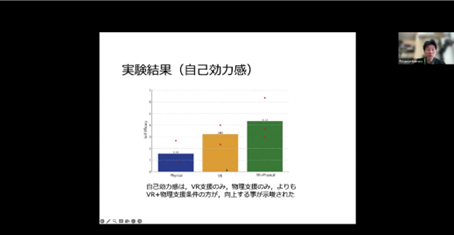
At the ‘The World in Our Minds’ exhibit, we took a questionnaire from users. When asked questions such as “How well do you think you will be able to do this by yourself in the future?” and “How positive do you feel now that you have experienced the VR boccia system at the booth?”, the answers tended to be more positive than those for VR alone or physical assistance alone. Self-efficacy was the most important factor. The mechanism that produced the greatest increase in self-efficacy was a combination of VR and physical support. We plan to conduct further experiments and summarize them in a research paper. (▲Picture 7▲)
For this reason, we think it is important not only to say, “Let’s do our best in rehabilitation,” but also to use VR to show them a “slightly better version of themselves,” so that they can experience a “slightly better version of their future selves” and experience a positive feeling of “I can do this,” while continuing rehabilitation and exercising. We believe it is important for them to experience a positive feeling of ‘I can do this’ while continuing their rehabilitation and doing exercises. It is important to support people through a system that combines physical and mental support.
I believe that if one steps out of the negative place of thinking that one cannot do it anyway or that rehabilitation is difficult for one, and enhances one’s sense of self-efficacy, then one will naturally work harder at rehabilitation and then be able to do it without the VR illusions. We are conducting research and development based on the recognition that bringing people to such a state is an important role of the assistance system.”
Finding the Perfect ‘Flow’: Tailoring Challenge Levels to Each Individual
Ishido: “I found your research very interesting. I was deeply impressed and recognized once again that support is not to do what a person cannot do, but to create a state in which he or she thinks ‘I might be able to do it,’ so that he or she can exert his or her own strength. Let me ask you a few questions. First of all, you said that the system combining VR and robots led to the result of the highest self-efficacy.”
Dr. Inamura: “There are not many subjects yet, and further analysis is still needed, so I will speak on the assumption that this is my personal opinion. First of all, I think that sometimes people think they can do it just by watching the ball fly by in VR. However, in reality, I find it difficult to move my hands and exert force, and I am not physically able to move my hands quickly. If you have good intuition, you may realize, ‘There must be something wrong with me that I can’t move my hands that fast and yet I fly so far. This may lead to doubts about yourself, and it will not be easy to feel that you can do it. On the other hand, if you make it possible to move the robot’s hand without physically applying force to it, or if you physically boost its speed, even if the robot feels that it has moved the hand, it will actually be able to move it physically, and this will be a factor in the synergistic effect. This is a hypothetical stage, but that’s what we are thinking.”
Ishido: “I feel that there is a big difference in the way self-efficacy is heightened between success that is easily obtained and success that is achieved after hard work. Considering this, when designing a success experience to enhance self-efficacy, I think the key point is how to make people feel the sense of ‘I did it by myself’ and the reality of it. How are you designing in this regard?”
Dr. Inamura: “You make an astute point. That is also the subject of our research. For your reference, let me explain the flow theory of psychology. It is a theory proposed by a psychologist named Mihai Csikszentmihai. ” (▲Picture 8▲)
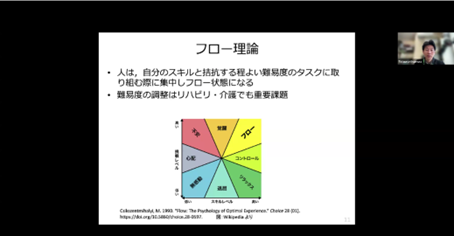
Taking a person’s skill on the horizontal axis and level of challenge on the vertical axis, the figure shows that the relationship between the two can change the way a person feels in various ways. The best flow is the one in the upper right-hand corner, where both skill and level of challenge are high. We often say that the person is “in the zone,” and this is the most ideal and positive state. When a person’s skills are high, the level of the task they are trying to challenge is high, and both are high, they are in flow.
On the other hand, having a highly skilled person do something simple, for example, Shohei Ohtani, who has great skills, deal with elementary school students does not result in flow. If something is too simple, no matter how many times you do it, it will only put you in a relaxed state, not a positive one.
On the other hand, if you are asked to do something challenging when your skills are not up to par, you become anxious. This is the state that often emerges in rehabilitation settings, where people become anxious when asked to do a difficult rehabilitation program when they cannot do it. It is very important to bring the person to just the right flow state. It is difficult to suddenly make a person’s skills higher or lower, and that can only be done gradually through hard work. What we can do is to raise or lower the level of challenge. We are also working on technology to increase or decrease the level of difficulty in VR to create a flow state that is just right for that person.”
Learning from Others: The Four Factors That Build Self-Efficacy
Ishido: “I felt that the ability to meticulously adjust the level of difficulty to lead to a successful experience is very beneficial in terms of accumulating successful experiences in stages. On the other hand, if we consider it to be only an illusion, I am concerned about whether it affects the brain in the same way as a real-life successful experience. What is the extent of the effect in the long run? On another point, this may be a bit of a nasty question, but is it possible to envision a case where the successful experience gained through VR could, in some cases, have the opposite effect?”
Dr. Inamura: “Your first question is a very important and difficult one. To be honest, we haven’t solved it yet: you experience various illusions in VR, and when you feel like ‘I can do anything’ or ‘I can move my body lightly,’ you also feel like ‘Today’s rehabilitation is over. In rehabilitation and training using VR, it is very problematic to keep people in a state where they are told “you can do it,” and then quickly lose it when the rehabilitation is over. It is very problematic to keep the clogs on and say, “You can do it,” in VR rehabilitation and training.
Therefore, we try to gradually increase or decrease the degree of VR illusions both at the beginning and at the end. We have seen that this tends to be better for the person to maintain a positive feeling in the long term. In other words, we gradually bring them back to the real world. The method of this return is also different for each person, so there are still issues to be addressed. The simple way is to lower it gradually. Also, if you gradually raise it but keep it raised and keep the degree of illusion, you will think you can do it. After gradually raising it, it is also important to move it constantly, sometimes lowering the illusion. If you always show the same steady illusions, people will get used to it, so I think it is also effective to avoid keeping the illusion steady as much as possible.”
Ishido: “Am I correct in understanding that by appropriately adjusting the degree of VR in such a way, we have not confirmed any particular cases of successful experiences with VR acting in a negative direction at this point in time?”
Dr. Inamura: “Yes, that’s right. There is one more interesting story. Earlier, you mentioned that it is important to experience success in order to increase self-efficacy. According to psychologist Albert Bandura, who advocated self-efficacy, there are four factors that contribute to self-efficacy. (▲Picture 9▲)
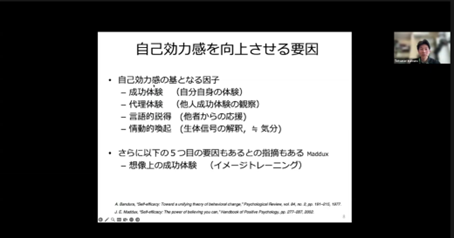
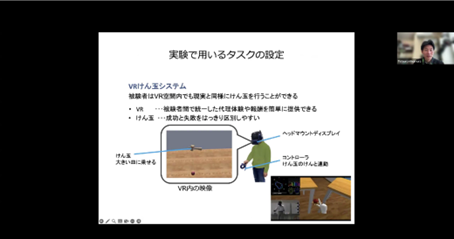
It is said that it is important not only to accumulate successful experiences, but also to have “vicarious experiences” where you see others succeeding and think, “If that person has succeeded, maybe I can do it, too. I have conducted an experiment using VR to observe other people’s success. This is an experiment using kendama. (▲Picture 10▲)
The Success Gap: Why Seeing ‘Too Much’ Success Can Lower Self-Efficacy
An experiment was conducted to see whether self-efficacy increases or decreases when people who are not good at kendama wear a head-mounted display and watch someone who is good at kendama play. The first pattern was to do it yourself and then watch others do it well, and the second pattern was to watch others do it well and then do it yourself. I changed the order in which I do it and see others succeed. (▲Picture 11▲)
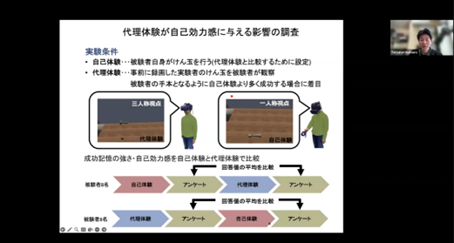
When they did so, there was a pattern of lower self-efficacy. The surprising result was that when I did it after seeing others do it well, my self-efficacy went down because I was not as good at it. (▲Picture 12▲)
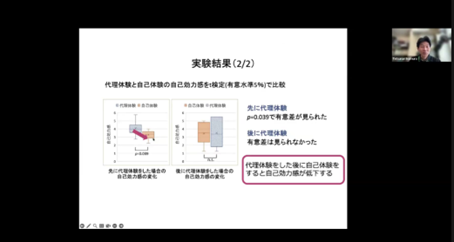
According to the conventional theory, self-efficacy would go up when people think that if he/she can do it, I can do it, but it has gone down. However, the tendency was that self-efficacy would drop when the gap between the excellence of others’ performance and the inadequacy of one’s own performance was large.
We further investigated the difference between others’ and their own performance and the decrease in self-efficacy, and found that the greater the difference between others’ and their own performance, the greater the decrease in self-efficacy. (▲Picture 13▲)
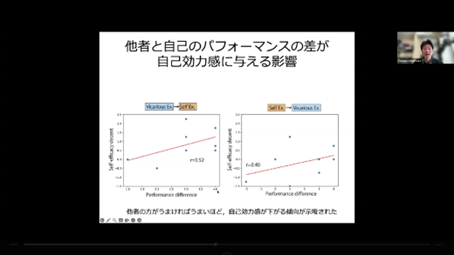
In a sense, this is natural. If someone who is not a good baseball player is told that Shohei Ohtani is hitting more and more home runs and that you can do it too, he will feel depressed. The difference is too great. However, if a kid in the next class shows you that he is a little better than you, you will think that you can do it too if you work hard. If someone who is at the same level as you shows a slightly better performance, you will think that you can do it. If someone shows you something too perfect, you will get discouraged, so you need to be patient here. If you find that the person’s skill level is at this level, for example, then show them something a little better than that, and you will get a good performance out of them. We have seen this trend, so we are now researching this area as well.”
Ishido: “By the way, how are the indicators designed to measure self-efficacy?”
Dr. Inamura: “We can’t measure them quantitatively with sensors, so basically, we ask them to answer qualitative questionnaires and questions after they have experienced various things. (▲Picture 14▲)
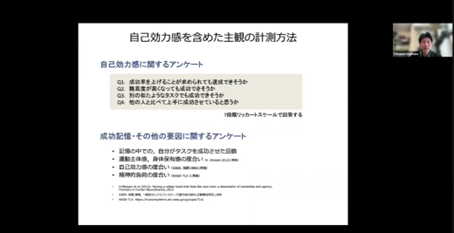
However, if this is also asked over and over again, the person may be drawn to past responses, so we wanted to measure this in real time. One way we are trying to do this is to have people hold a button and press the button harder when they think they can do it, or to have the person report their impressions using the button. However, how to evaluate people’s subjectivity and feelings is very difficult in research. Standard psychology would be this kind of measurement. We also have to study the estimation from blood pressure, heart beat, and facial surface temperature, but we haven’t gotten to that point yet. This is one of our future challenges.”
Ishido: “I feel that consideration of individual differences is very important when designing a successful experience. Please allow me to ask you a few questions related to this point.
First, people are generally said to have high or low self-efficacy, but are some people born with high or low self-efficacy as an innate brain characteristic? Second, to what extent are acquired factors, such as past experiences and the surrounding environment, influential on self-efficacy? And third, how do you analyze the differences between those who tend to have high self-efficacy and those who do not?”
Dr. Inamura: “My answer is based on the knowledge I have gained from various literatures and experiments I have conducted in my research, but I feel that whether a person has a high or low self-efficacy is not inborn. Furthermore, I think many people would agree that the ability to believe that ‘I will be able to do well’ is influenced by the kind of experiences a person has had. It has been pointed out in various places that a child who has experienced many successes will have a different future than a child who has been subjected to verbal abuse such as “You can’t do it,” or “Of course you can’t do it. We believe that high or low self-efficacy is determined by how many positive memories and experiences of being able to do something build up in the brain.
I believe that whether one’s sense of self-efficacy is easy or difficult to increase is also linked to what we have just discussed. I think that once there is an experience of being able to change from a negative state to a positive state, it will lead to the idea that “I was able to do it then,” and that one can do it if one works as hard as one did in the past.
Furthermore, self-efficacy can be subdivided into general and specific self-efficacy. Specific self-efficacy is the self-efficacy of whether or not you think you can do a certain exercise or task, such as riding a bike or throwing a ball, for example. General self-efficacy is a general feeling, regardless of the task or sport, that you may not have done this before, but ‘Do you think you could do it if you tried? And there is evidence in psychology that the two are linked. I think we can say that if you increase your specific self-efficacy in a particular genre, such as a certain sport, and then build on that experience/experience in other genres, your general self-efficacy will also increase. For example, in children’s lessons, I think it is a general feeling that a mindset that can respond positively to various things can be developed through a wide range of experiences, rather than just swimming or soccer all the time.”
Seeing Yourself Through the Eyes of Others: Research on Fostering Metacognitive Skills
Ishido: “The Neurodiversity Project is involved in various efforts to realize a neurodiverse society, including the holding of ‘The World in Our Minds’. From this perspective, it has been pointed out that children with developmental characteristics inevitably have difficulty accumulating successful experiences, and as a result, tend to have a low sense of self-efficacy. I felt that Dr. Inamura’s research could be an opportunity for such children to gain successful experiences, and that it has the potential to make a significant contribution to the realization of a neurodiverse society. In this regard, I would like to ask you, have you conducted any research on people with strong developmental characteristics so far?”
Dr. Inamura: “We have not yet done any research with people with developmental characteristics. However, VR has great potential. I think it could be applied to research on people with developmental characteristics. If there is an opportunity, I would love to take on the challenge.”
Ishido: “From what you have said so far, I feel that whether or not a person is “able” or “unable” to do a certain thing is greatly influenced by whether or not he or she has grown up in an environment where he or she can experience “being able”. This leads to the question of what ability is in the first place. Until now, it has been common to measure ability based on the results of “can-do” and “can’t-do,” but it seems that the “sense of thinking one can do it” that precedes this has a significant impact on actual results. In other words, I feel that ‘thinking I can do it’ itself can be considered as one of the abilities, but I wonder if there is any discussion on the definition of such abilities or if it is being considered as a subject of research.”
Dr. Inamura: “There are endless discussions about ability. In simply throwing a ball, there is the ability to move one’s arm quickly and to throw with good control, but another ability I consider is the ability to look down on oneself and ‘recognize that one has this ability. This is also called meta-cognition. It is the ability to recognize what kind of situation you are in right now, whether you are still not very good at what you do or whether you are getting pretty good at it, and if you are not good at it, to think about what you need to work on and how to plan how to get closer to your goal as quickly as possible. I believe that metacognitive ability, the ability to look at one’s current state from a third-party perspective from a bird’s eye view, is another dimension of ability.
What I talked about today is an initiative as part of the Moonshot Program promoted by JST, as I mentioned at the beginning, but I would like to shift the axis of the program a little and create a VR application that fosters metacognitive abilities. Just around the time we exhibited at ‘The World in Our Minds’, we were selected for “CREST (Core Research for Evolutionary Science and Technology),” another of JST’s strategic creative research promotion projects, and we have been working on this project since the fall of 2025. We are now in the process of creating VR avatars to foster metacognitive abilities.”
Ishido: “I understand that you will be able to exhibit that at the ‘The World in Our Minds’ in 2026.”
Dr. Inamura: “Yes, that’s right. We have about six more months to go, so we would like to prepare to show you many interesting things.”
Ishido: “Thank you very much for your time. Let me ask you about the future a little further ahead. What kind of situations and sites do you envision where the various technologies you are currently researching will be used in the future? Also, what kind of initiatives and activities do you think will be necessary to implement them in society?”
Dr. Inamura: “I explained that our program has been selected for JST’s CREST. I will talk about what kind of application we are trying to make there. (▲Picture 15▲)
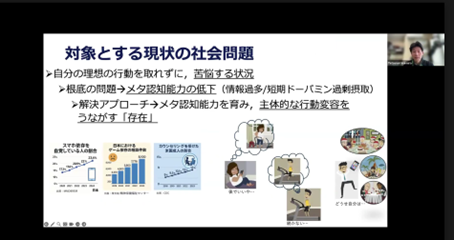
There are different aspects from people with developmental disabilities. For example, they may procrastinate tasks due to smartphone dependence, become mentally negative, or amplify their own experiences of failure by seeing other people’s successes, and I think these situations are increasing in this age of social networking. I would like to create a presence that can lean on in such situations, a presence that says, ‘You don’t have to think negatively.
If there is a presence around you that is not looking down on you, but is there for you, and is willing to give you a stern opinion at times, you may feel as if you have a twin brother or sister supporting you. If there is an avatar who looks just like you but is not you, looking at the avatar is actually looking at yourself, which fosters metacognition and a feeling that you can do it.
This is why we came up with the concept of “Self Mirroring Twins. (▲Picture 16▲)
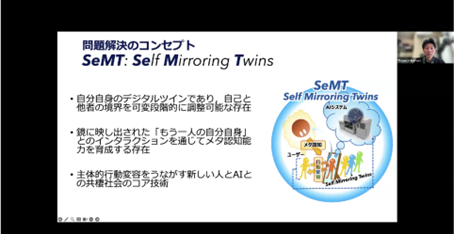
It is the other self reflected in the mirror, the one that inspires you to say, “Oh, he is doing his best,” and “I have to do my best, too. One of our goals is to use this system to improve a person’s lifestyle by showing him or her a slightly better or worse version of himself or herself depending on the situation, so that he or she can look at himself or herself as if he or she were talking to someone else. For example, one of our goals is to help people adjust their lives so that they study English or go for a run every day, but we are also thinking that this could be applied to people with developmental disabilities who are not late for work or meet deadlines.”
Ishido: “In ‘The World in Our Minds’, we introduce a variety of initiatives aimed at realizing a neurodiverse society. These include attempts aimed at understanding ourselves. Considering this perspective, I felt that utilizing one’s own digital twin could provide a bird’s eye view of oneself, deepen one’s understanding, and potentially improve one’s relationship with society. In the future, will we have a society in which our own digital twin is always present and interacts with it, enhancing both ourselves and our mirroring partners?””
Dr. Inamura: “I think it would be nice to have something like a twin existence. But we have to be careful about this, too. For example, you point out the danger that if we consult a generative AI all the time, it will close down there and distort our thinking, making it impossible to return to modern society. I think we need to be very careful and make sure there are no negative effects. We live in an age where consulting with generative AI is the norm, and I believe that this will be one of the positive ways to interact with virtual agents.”
Scaling Impact: The Importance of Enhancing Self-Efficacy Across Society as a Whole
Ishido: “This is a bit of an abstract question, but how do you think society will change if the sense of self-efficacy of society as a whole increases? While listening to what you have said so far, I have been interested in the difference between a society that develops people’s potential and one that shuts it down. Taking this into consideration, what kind of society do you imagine will be realized in the future when self-efficacy is enhanced through your technology?”
Dr. Inamura: “What we talked about today is the self-efficacy of one person, but the self-efficacy of society as a whole is also a very important perspective. I think the relationship with the digital twin I just described is a small society. The best way for twins to grow is through friendly competition and stimulating each other. Two twins spread out to form a group of three, then four, and so on, but it is not desirable to have one person in the group in a very good state and the others in a negative state. Polarization of the group, i.e., half the people are very good, half are not, and the average is mediocre, is clearly not a good society. For twins, N=2, but as this number increases to 3, 4, and 5, what kind of difference in distribution is best would be the theoretical way to conduct the research.
Another thing is that even if we lump society together in one word, there are more than 100 million people in Japan, and since more than 100 million people do not communicate at once, it is also important to know what kind of grouping is best. For example, even in a preparatory school, there may be a class of students with high grades, while there may be a class of students who are not interested in university and want to acquire skills to quickly enter the workforce and earn money. If the value that going to college is a matter of course spreads there, the class that wants to go out into the world will lose its purpose. I think we need a support system that allows each group to group and classify themselves well along with their values, what they are aiming for and where they think they are good enough to go. For this purpose, it is important to have a meta-awareness of oneself. I hope to consult with my twin brother and sister to create a community where I can raise my sense of self-efficacy by leading them to groups in which they are good at what they do.”
Ishido: “I felt that there are two sides to this: the use of technology as a means to metacognitively understand what happiness means to each individual with different values, and the use of technology as a support to help one move closer to a happier state of being. Finally, could you give us a message for the realization of a neurodiverse society?”
Dr. Inamura: “In our CREST project, we are working on creating virtual beings, but at the same time we are also collaborating with the medical field by creating physical prosthetic arms and legs. In addition to that, we are also incorporating brain measurement techniques and hormone analysis techniques into our research, and collaborating with groups that examine ethics from the perspective of so-called ELSI (issues related to ethics, law, and society). Issues of social acceptability and ethical technology are outside my area of expertise, so I would like to discuss these issues with the researchers and experts exhibiting at ‘The World in Our Minds’, and I hope that the interaction between our group and other groups will lead to better collaboration.”
Ishido: “This is exactly where ‘The World in Our Minds’ is intended to deepen such discussions and is positioned as a device to enhance social acceptability. We would be delighted if you could exhibit at the next and subsequent editions. Expanding people’s abilities through technology is one of the important approaches of the Neurodiversity Project, but through today’s talk, I felt that technology can not only expand our abilities, but also expand the “power to believe in oneself” itself. Thank you very much for your very interesting talk today.”