
Empowering Each Child Through Personalized Learning in the Metaverse
—The Challenge of EuLa ONLINE Middle School—
3/9/26
The Neurodiversity Project, organized by B Lab, aims to create a society where neurological differences are respected and everyone can reach their full potential. In this installment of our interview series, we feature the work of Shintaro Masugi (▲Picture 1▲), Director of EuLa ONLINE Middle School (hereafter referred to as “EuLa”), who debuted his exhibit at “The World in Our Minds” in 2025. At EuLa, the team supports the learning of students with diverse needs through the use of metaverse spaces. Nanako Ishido (▲Picture 2▲), Director of B Lab, sat down with Mr. Masugi to discuss his innovative efforts.
> Interview videos are also available!
Empowering Children through High-Freedom Learning in the Metaverse: An Initiative by EuLa ONLINE Middle School
Ishido: “Mr. Mazugi is building a new school system, and you exhibited for the first time at ‘The World in Our Minds’ in 2025. First of all, please tell us about your exhibit and your efforts.”
Mr. Masugi: “Atmark Learning, which operates EuLa, mainly operates correspondence high schools. We started Tokyo Inter High School about 25 years ago, when the correspondence high school system was not yet established in Japan, as an offshoot of an American correspondence high school.
Subsequently, in response to the growing needs of local governments for correspondence high schools and the establishment of a system for starting correspondence high schools, we established “Atmark International High School” in 2004, which utilized the most advanced ICT at the time, and “Meihokan High School” in 2009, which specialized in special support. (▲Picture 3▲)
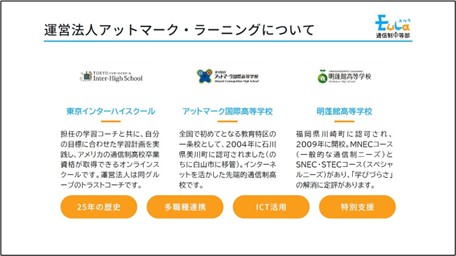
A distinctive feature of Atmark Learning’s school management is the use of ICT and, of course, special support, which involves multidisciplinary collaboration with specialists such as psychologists and physical therapists, in addition to general teachers.
In April 2025, we started EuLa, a learning house in a metaverse space for junior high school students, in response to numerous comments from students who said, ‘I wish I had met this kind of school earlier.’ In 2025, we introduced EuLa in ‘The World in Our Minds’. (▲Picture 4▲)

Please take a look at the actual metaverse.” (▲Picture 5▲)
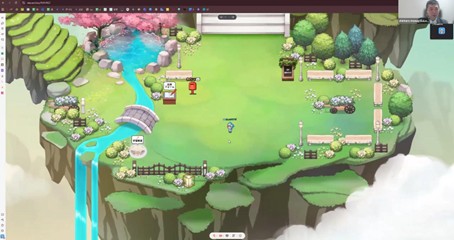
Ishido: “It shows a metaverse space that looks very fun.”
Mr. Masugi: “I am dressed as the avatar of the shark in the center and the children call me ‘Shark.’ A day at EuLa begins with homeroom in the open space. Since the children’s brains are asleep when they wake up, we all play mini-games to get their brains active before moving on to the day’s curriculum.
In fact, at the time of the exhibition, we had children in the lower grades of elementary school experience a mini-game in the metaverse space. This metaverse space is characterized by the fact that even younger children can easily operate it.
We are proud to say that this is the ‘strongest environmental adjustment (creating an environment where people with difficulties do not have problems or are less likely to have problems)’ because children with characteristics or physical symptoms that make it difficult for them to continue learning can access this space from their own rooms.
This is a study space. (▲Picture 6▲)
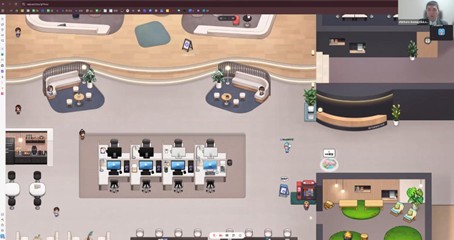
Students and parents who come to EuLa often have problems communicating with their homeroom teachers and classmates, and at EuLa we make a conscious effort not to create walls between students and staff. For example, there is no physical wall in the staff room where I walk around as a shark. Children can come straight in and talk to the teachers.
Recently, we have newly released “Wachawacha Room” as a recommended room. (▲Picture 7▲)
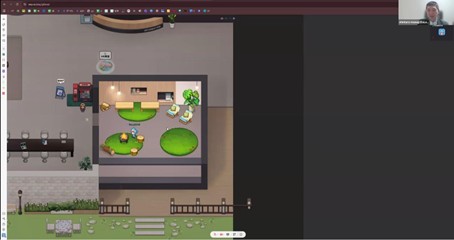
Originally, we had two “moku-moku rooms” that were used when the students wanted to concentrate alone without being approached by anyone. However, looking at the children at EuLa, we felt that they were better suited to a learning style where they could share the screen with someone else or where the teacher would wander in and comment on their assignments, and we received feedback from the children that this was also the case.
Therefore, we renewed one of the “Mokumoku Rooms” to create a space for relaxing and learning. Children who come to this room also exchange non-genre knowledge, such as solving math area problems together around a campfire or talking about the structure of art, which is illustrated from simple symbols. Although the metaverse space itself is an environmental adjustment, EuLa’s strength is that even within that metaverse there is further adjustment.
Taking the lead in their own learning through “MyPro,” students gain a wealth of knowledge driven by their own interests.
Let me explain the curriculum, the most important thing at EuLa is the “demonstration of individual characteristics” (▲Picture 8▲).

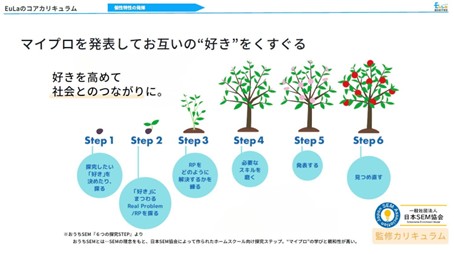
Our core curriculum is based on our desire to value the diversity of our students the most. And we have a curriculum called “My Pro” that allows each student to explode his or her own favorite things. (▲Picture 9▲)
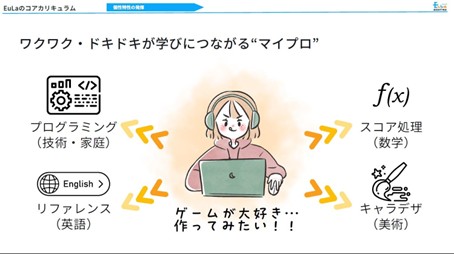
I believe that many schools are already working on the idea of MyPro as ‘My Project’. My” means “My”, but “Pro” can be a project, a “Professional” who pursues something, or a “Product” who creates a product by himself/herself.
Rather than having teachers and staff prescribe something, we have a form of learning in which students steer their own learning and absorb a variety of knowledge based on their own interests. For example, if you like games, you may want to be able to speak English to read references as well as programming skills. Math is also necessary for score processing. If you delve into your likes in this way, you will eventually become involved in the study guidelines.
The ideal situation is for students to ‘find themselves able to do a lot of things’ as they work on what they like to do. We also provide an opportunity for them to present their MyPro works to each other. We value the cycle of learning by exposing students not only to their own interests, but also to the various interests of their peers of the same age. (▲Picture 10▲)
And Eula has three mechanisms to support this core curriculum. The first is “cultivation of culture and humanity. In two special lectures each day, EuLa teachers give lectures on a variety of genres, including their own favorites, interests, and what they think junior high school students need. Children watch in real time. (▲Picture 11▲)
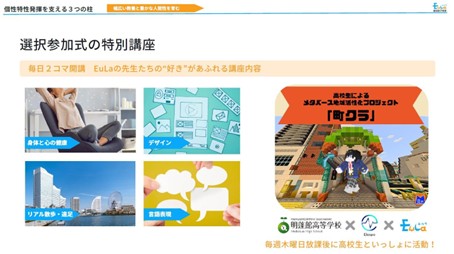
In metaverse space, when you move your avatar with your own hands, before you know it, your consciousness may be projected into the metaverse space. Although you are physically separated from each other, when you are interacting on the Internet, before you know it, you are psychologically closer to each other. By deepening our relationship on the Internet in this way and being exposed to a variety of knowledge, before we know it, our interests will expand, leading to the myprofession mentioned earlier.
The second mechanism supporting the core curriculum is “Expansion of Basic Knowledge. Students study the five main subjects using “Dekitas,” a digital teaching material provided by Jonan Institute of Technology. (▲Picture 12▲)
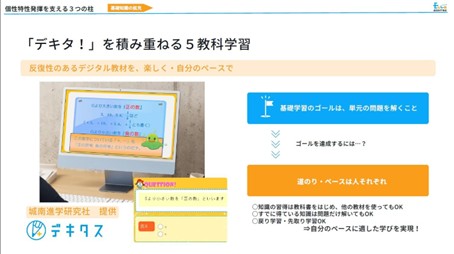
This is our form of accompaniment and support for ‘what the student needs’ and ‘what career path he/she wants to pursue. Some students may want to do everything in their power to learn on their own, while others may not be in a place where they are overwhelmed because they are not focused on learning right now. We are the accompaniment. We make adjustments to suit the student.
The third mechanism is “social skills development. The students themselves adjust the timetable by changing their own classes. Students are able to choose which subjects to take on which days of the week, which special classes to attend, and so on. (▲Picture 13▲)
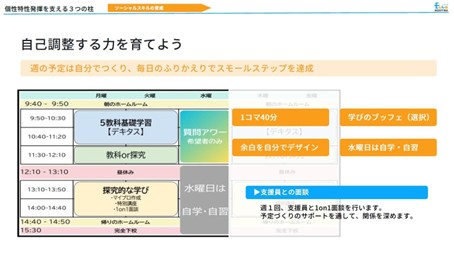
Although the students are gathered in the Metaverse, an environment that we have adjusted, the ultimate goal of education in the Metaverse is for children to hone their ability to adjust their environment so that they can act on their own and in a way that is appropriate for them. So we allow them to design their own learning.
In summary, the activities of the EuLa Communication Secondary School are centered on “MyPro,” in which students can demonstrate their characteristics, and special courses and subject studies are held in the Metaverse space to support these activities.”
Voices from EuLa: “The children’s faces have brightened,” and “They’ve started to believe in themselves.”
Ishido: “It is a very attractive school, and I felt I could understand why people were saying they wished they had encountered it earlier.
Earlier you mentioned children’s characteristics, and I believe that some children come to EuLa because they have strongly expressed some characteristics that did not fit in with the environment of the schools they had attended in the past. I understood that the school makes use of the Metaverse and the “MyPro” curriculum to make it easier for these children to learn and feel at ease in school. What other kinds of support and environment are you providing?”
Mr. Masugi: “We create individual support plans. Based on the interview with the psychologist, we discuss the next challenge as a short-term goal, and also find out what I can do, what I feel are my challenges, and what I would like to improve,” he says.”
Ishido: “Recently, we often hear in the news that the number of children who are not attending school is increasing, and I believe that some of the students at EuLa may have been traumatized by some experience at the schools they have attended.
Some of those students may not yet feel comfortable in a state of ‘learning’. What are the actual circumstances of many of these students? And what kind of support and involvement does EuLa provide for children who are not yet ready to learn?”
Mr. Masugi: “Everyone has some kind of hurtful experience. To support these children, EuLa has a homeroom-like teacher who is in regular contact with the children as a support person. Once a week, the support staff gradually closes the emotional distance with the students by chatting with them in their spare time while working on their timetables.
Then, students will gradually grasp the idea that they will feel safe if they communicate in this way. From there, they will naturally take the first step toward communicating with people of their own age. We also offer special lectures by psychologists, such as “Let’s think about how to relate to others” and “Let’s think about how to use language.
Although children may not show it openly, each one of them has some kind of hurt. We provide an environment that fosters compassion for them even if they don’t show it, saying, ‘I’m sure they have been hurt in some way.”
Ishido: “How have children and parents reacted to not only the “EuLa Correspondence Secondary School” you introduced this time, but also to the high school?”
Mr. Masugi: “I don’t want to be too forward, but the expressions on the students’ faces have really changed. When I see the students at these events, their expressions have relaxed considerably, and I feel that is a big change.
Parents have told us that the experience of unconditional acceptance at EuLa has brightened their hearts and helped them to embody “I am fine with who I am”. I am fine with who I am,'” says one of the parents.”
Ishido: “It is a great and wonderful change to be able to affirm oneself in life. In fact, do you have any kind of “indicators of change” that the staff members value? Also, please tell us about your core values and how you want children to grow through EuLa.”
Mr. Masugi: “Our wish is that ‘we want our students to become independent learners. The schools that we have been operating originally aim to become ‘Motivated Learners’ and ‘Independent Learners,’ and EuLa is following this trend.
Ultimately, it is about how students can take action in society. We emphasize the development of students’ ability to understand themselves and to ask for help where they lack it, and to actively seek knowledge on their own, rather than passively.”
Finding the “Right Fit” at EuLa: How a Trial Enrollment Helps Students Reconnect with Their Own Values
Ishido: “You mentioned earlier that EuLa students have often experienced hurt in the process of coming to EuLa. Have you seen any changes in the parents since becoming involved with EuLa?”
Mr. Masugi: “At EuLa, we interview parents and guardians regularly, not only before enrollment, but also after enrollment. Through this process, I feel that the impression of the parents during the interviews is changing in a positive way. ‘Did he/she have this kind of expression on his/her face?’ are topics of conversation among the staff.
Originally, homeschooling with your child has its limitations at home. Seeing their children doing well at EuLa not only brings peace of mind to the parents, but also allows them to reclaim time for themselves that they were not able to have before. This is a positive change that is being conveyed to us.
Ishido: “This may be a bit of a nasty question, but while we see wonderful changes in the children who attend EuLa, I imagine that not all children are immediately comfortable in this environment from the start. What are the actual cases?”
Mr. Masugi: “That is a good question. At that point, we know if a child is a good fit or not at EuLa, and those who are a good fit come to EuLa.
What do children who feel that EuLa is not the right place for them do? I will go to school little by little,” or, “I will have a professional teacher guide me to realize my dream.
I have seen many cases where a child has rediscovered his or her values through even a fleeting exposure to EuLa, and as a result, found the true path for that child. I think the good thing about free school is that it is not necessarily a case of ‘come to EuLa because it is good.”
Ishido: “Through careful communication in advance, you enroll children who are a good fit for EuLa, and even if they are not, you provide each child with the opportunity to find a place that suits him or her.
From here, I would like to broaden my perspective a little and ask you about education in Japan as a whole. In recent years, we have often seen reports of an increase in the number of children who are not attending school, and I suspect that many children feel somewhat distressed even though they are attending school. What aspects of the current school system do you feel are leading to burdens and difficulties for children? Also, based on your experiences and practices at EuLa, how do you think the Japanese school and education systems should be changed?”
Mr. Masugi: “The ‘uniform school education’ that has not changed for more than a hundred decades is now becoming a subject of criticism, but it also has a positive aspect in that it has created the soil of Japan so far. It is important for school education to function today as a place that guarantees this ‘uniform quality. Teachers in the field are not unaware that there are children who do not fit into the school education system. Until now, school teachers have provided a place where children can be saved, but this is gradually changing now.
For example, local governments are paying tutoring schools to provide after-school visits by tutoring teachers in the form of study support, and are teaming up with NPOs that provide support for truancy. Public schools are also turning to public-private partnerships. These developments show that schools are working to fulfill their function as schools, while at the same time showing other options to children who are struggling there. I think the concept of diversity is beginning to function in a positive way.”
Cultivating a “Soil of Tolerance” to Realize Neurodiversity and Enrich Every Life
Ishido: “Rather than a uniform change in all schools, it is important for society as a whole to provide a variety of learning options, and by utilizing the metaverse and online, as EuLa does, we are now in an era where children who have not fit into the school environment can be provided with a place to learn. I felt that the time has come to provide a place for learning for children who did not fit into the school environment. We would like to contribute to expanding such options.
On the other hand, in Japan, there is a reality that children who have difficulty adjusting to a uniform education are separated and educated in the form of “special support. From the perspective of inclusive education, the United Nations has issued recommendations regarding such segregated education.
What are your thoughts on the current situation in which children with special characteristics are educated separately as special needs? Also, what kind of efforts and changes do you think are necessary in the future to realize inclusive education? “
Mr. Masugi: “I feel that inclusive education is really difficult. Discrimination should never be tolerated, but I believe that distinctions based on reasonable considerations are necessary. When we go out into society, there is a division of roles, isn’t there? In order for children to have an opportunity to think about what their roles in society are, inclusive education is essential in the sense that they are exposed to diverse values and characteristics from the childhood stage.
In order to establish inclusive education, staff members also need time for discussions to expand each other’s awareness, such as ‘what kind of assistance can be provided to make this happen’ and ‘who can provide that assistance? After acknowledging what each child can and cannot do, we discuss what can be done in the same space. I think this can only be done if there is room on the part of the adults as well.”
Ishido: “It is never simple to be inclusive if we are physically in the same space, but it is important how to create a psychologically inclusive situation. How do we build a society that is tolerant of diversity, not only for children but also for adults? I felt that the base of this process is very important.
It is said that we are now at a turning point where education itself is undergoing major changes due to the emergence of generative AI and other factors. Mr. Masugi, who has been involved in innovative education, could you give us a message to the education community from the perspective of diversity?”
Mr. Masugi: “Let’s look at the children.”
Ishido: “You are right. I think the most important thing is to look at each child carefully, not something that can be put into a manual or set of rules. Specifically, what kind of support and efforts are you making to practice “looking at the individual?”
Mr. Masugi: “We have established training opportunities for professionals within our organization. Our professional staff also actively participates in external networks, and the latest knowledge gained from these networks is returned to the field.
Educators tend to judge children based on their own past educational experiences, saying, “This child must be in this condition. We believe that it is important to understand the child’s condition as it really is, not only through one’s own filter, and to provide support for what comes to light by reconciling this with the perspectives of each staff member.”
Ishido: “I felt that it is very ideal that teachers are also acting spontaneously and that this has taken root as a culture.
Finally, could you give us a message about what you value and what you expect from us in order to realize neurodiversity?”
Mr. Masugi: “Personally, I always try to make room in my life. In order to understand diversity, you have to be comfortable with yourself, otherwise you will not be able to look at other things.
When I think about what it would be like for all people living here and now to be able to afford themselves, I felt firsthand that the various exhibits I encountered at the Neurodiversity Project would enrich the lives of each and every one of us. I strongly hope that this event will continue to expand in the future.”
Ishido: “Thank you very much for your kind words. In order to meet your expectations, we would like to continue to expand our events and convey the importance of tolerance for diversity to more and more people. To this end, I would like to reiterate that it is important for us to be open-minded ourselves first. Thank you very much for your valuable talk today.”