mahora notebooks are easy to use for everyone.
5/28/25
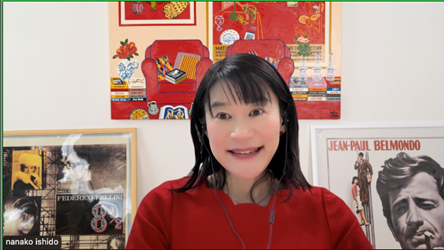
In conjunction with “Brain World 2024,” B Lab held the first Neurodiversity Awards to recognize technologies, products, and social actions that have made outstanding achievements toward the realization of a neurodiverse society. The winner of the Neurodiversity Award in the social implementation category was Ohguri Shiko Co., Ltd. Nanako Ishido (▲Photo 14▲), Director of B Lab, spoke with Kayoko Ohguri (▲Photo 1▲), Director of Ohguri Shiko, about the development background of the award-winning “mahora notebook”—created by listening to the voices of people with developmental disabilities—as well as user feedback and future initiatives.
> Interview videos are also available!
After meeting with a support group for developmental disabilities
Worked on the development of mahora notebooks
Ishido: “Today we are talking with Ms. Kayoko Oguri, director of Ohguri Shiko, which won the Neurodiversity Award in the social implementation category of the first Neurodiversity Awards. Ohguri Shiko designs, produces, and sells “mahora notebooks” that are easy to use for people with developmental disabilities and other various difficulties. Please tell us what kind of notebook it is and how it was planned and developed.”
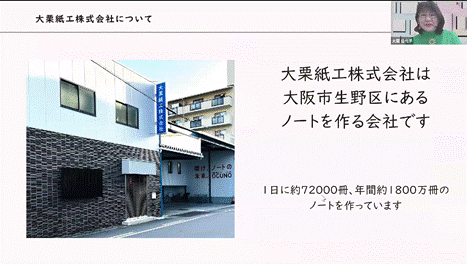
Ms. Ohguri: “Ohguri Shiko makes about 72,000 notebooks a day, or 18 million notebooks a year, at its headquarters and factory in Ikuno Ward, Osaka City. founded in 1930, the company will celebrate its 95th anniversary in 2025.
The impetus for the development of mahora notebook came when I heard from a lecturer at a seminar that ‘notebooks sold in general are difficult to use for people with developmental disabilities. The lecturer was supporting a support group for people with developmental disabilities called Unbalance, and after hearing from the people involved, he asked me if I could create a notebook that would be as easy to use as possible. So I met and talked with the people from Unbalance and found that they felt the notebooks were difficult to use in places we had not noticed before.
Although we make a lot of notebooks, most of them are products of major stationery manufacturers. We had little experience in planning and producing notebooks ourselves. We often manufactured notebooks according to instructions from major stationery manufacturers, so when we heard requests and opinions from people with developmental disabilities, we wondered, “How should we go about making this? So, we decided to give it a try anyway and carefully interviewed about 100 people with developmental disabilities about their difficulties in using the notebooks and took questionnaires, and then planned the notebooks focusing on the issues that emerged from the interviews. This was the beginning of the “mahora notebook” of inclusive design.
The light reflection is dazzling” and “Ruled lines are hard to distinguish.”
Improved problems with notebooks based on interviews with about 100 people.
From the interviews and questionnaires, three major problems emerged. (▲Picture 3▲)
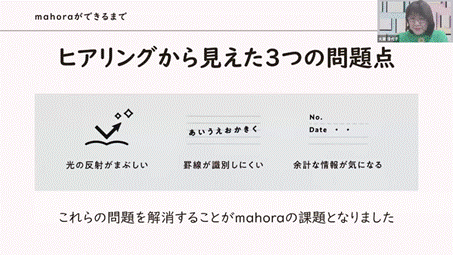
The notebooks are “too bright to use due to the reflection of light,” “the ruled lines are drawn in the same color shade, making them difficult to distinguish,” and “the extra information in the upper margin, such as the date column, is bothersome.
In addition, we found that there are various other things that are very bothersome to those who ‘receive a lot of information,’ such as the fact that threads visible at the edges of thread-bound notebooks make it difficult to concentrate, and photos and designs on the cover of the notebooks bother me.
We have thus identified many problems, and we first worked to develop a notebook that is easy to use for people with developmental disabilities, aiming to eliminate the three problems mentioned above.
First, for the problem of “glare from light reflection,” we thought of reducing light reflection by using colored paper for the inside of the notebook, so we prepared 13 colors of paper and asked the participants to actually look at them, We decided to use these two colors for the development of the paper.
We also considered the problem of “ruled lines being difficult to distinguish,” and asked the participants to consider what kind of ruled lines would make it easier to distinguish, to write letters straight without distortion, and to not lose sight of where they were writing, and presented them with a variety of ruled lines to actually see. The two chosen were “Thick and Thin Alternating Horizontal Lines ” and “Amikake Horizontal Lines” [Kadai 4]. The alternation of thick and thin lines on the inside of the paper makes it easier to identify them, and by printing alternating light-colored strips called “Amikake yoko ruled”, we devised a way to prevent losing sight of where you are writing. (▲Picture 4▲)
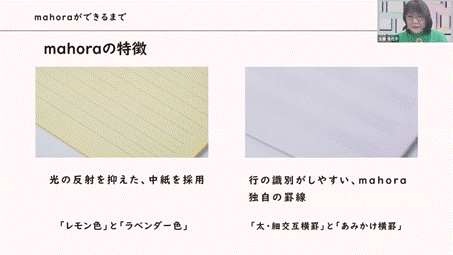
As for the thread-bound notebooks, we adopted a binding method that we specialize in, called “wireless binding,” which is durable and allows the notebooks to open easily. Some people said that they did not need a date column in the notebook, but only ruled lines, and that they did not need anything on the cover, so in the end we decided on a simple design with only ruled lines inside the notebook and a cover that shows what the inside ruled lines look like. (▲Picture 5▲)

The lemon-colored notebook is “thick and fine alternating horizontal ruled” and the lavender-colored notebook is “Amikake horizontal ruled.” Two types of mahora notebooks were completed and 3,000 copies of each were test sold on February 27, 2020.
Three things we did to get the word out about mahora notes
The word “mahora” in “mahora notebook” is based on the Yamato word “mahoroba,” which means a wonderful place or a comfortable place to live. Mahoroba” means a wonderful place or a comfortable place to live, so we named the notebook “mahora notebook” in the hope that it would lead to a comfortable notebook.
Since our focus has been on making notebooks, we have had no sales channels. Therefore, we have launched an e-commerce site to sell these two types of notebooks. We also needed to make some kind of announcement to let people know about the new products. So we sent out a press release. Several media outlets showed interest, and on the day of the launch, the product was featured on the front page of the evening edition of the Sankei Shimbun newspaper. Other newspapers also picked up the story.
Until now, we had been producing notebooks as a subcontract factory of a major stationery manufacturer, so we had never heard directly from our customers, but with the launch of mahora notebooks, we were able to hear directly from our customers for the first time. We were very happy to receive messages directly from many of them. (▲Picture 6▲)
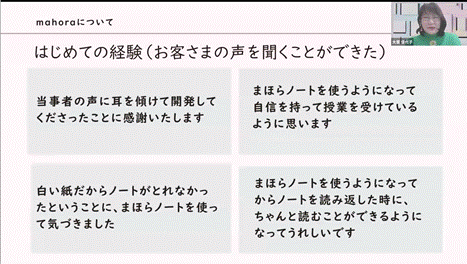
Among the messages were: “Thank you for listening to the voices of the people concerned and developing this notebook,” “I realized that I couldn’t take notes because of the white paper,” “I feel more confident in class since I started using Mahora Notebook,” and “I am glad that I can read my notes correctly when I read them back after I started using Mahora Notebook. I am glad that I can read my notes correctly when I read them back after using the notebooks. We were very happy and encouraged by these comments, which showed that the students were really pleased with the notebooks and could feel it.
However, there were still many places where people did not know about mahora notebooks. Therefore, in order to make mahora notebooks more widely known, we undertook three initiatives: “visits to support schools and stationery stores,” “free distribution of samples,” and “challenge to crowdfunding. (▲Picture 7▲)
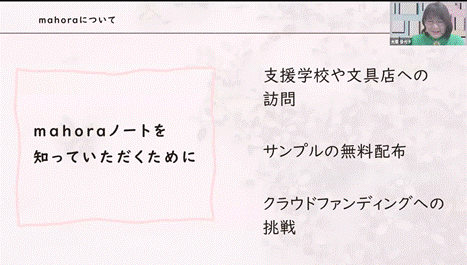
Visits to support schools and stationery stores brought new insights to my attention during my visit to the employment support school. At the high support school and employment support facility, they teach, ‘You must not forget, so just take notes,’ and everyone is taking a lot of notes. However, the mahora notebook is the same size as a college notebook, so it is too large to take notes. So we were told that a notebook that can be placed in the palm of your hand and fits in a pocket would be easier to use.
When we visited the stationery store, it was because of the advice from the stationery store owner. He introduced us to a wholesaler and said, “I think it’s a very good notebook, so you should try to get stationery stores to carry it, not just on their e-commerce sites.
The free sample distribution was started in response to requests from customers who wanted to “try it before buying it” and “try it once before using it. We are very happy to be able to offer our notebooks to our customers. We continue to send samples of our products to customers who request them.
Through visits to support schools, facilities, and stationery stores, we received a variety of feedback on the colors and sizes of the notebooks. We launched the lemon-colored mahora notebooks with thick and thin ruled lines, and the lavender-colored ones with amikake ruled lines, but we received some comments that they wanted the opposite as well. So, we initially released two types of notebooks, but we quickly increased the number of notebooks to 24. We then took on the challenge of crowdfunding to let various people know about the increase in the number of types. As a result, we received support from 190 people and achieved 840% of our goal.
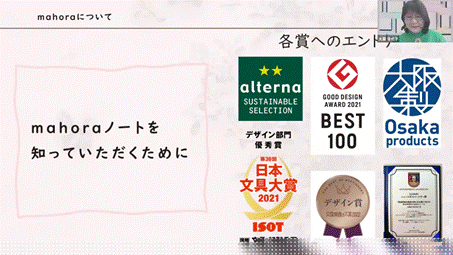
I also applied for various awards, hoping that if I could win some kind of prize, it would trigger widespread publicity. Fortunately, I received various awards and was featured in the media. (▲Picture 8▲)
Even as we continued these efforts, we still felt that MAHORA Note was not yet reaching those who really needed it. Therefore, we implemented the “Pay Forward Mahora Note Project,” which incorporates the concept of pay-forwarding. (▲Picture 9▲)
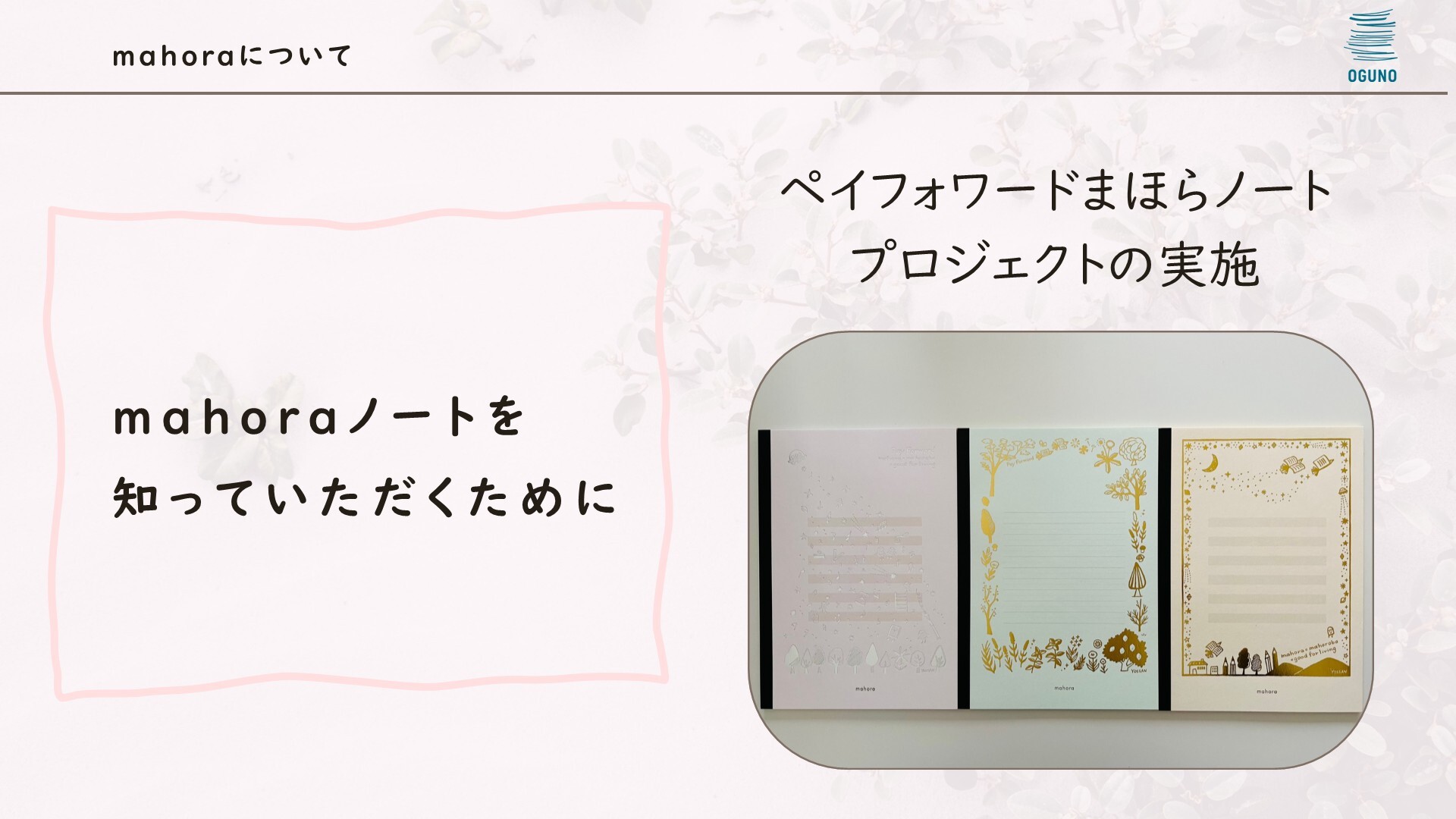
Specifically, for every mahora notebook with a cute design foil-stamped on the cover, two copies will be donated to a support school or facility. So far, more than 4,200 people have received donations. We are very happy that we were able to deliver the warm feelings of the many people who purchased our foil-stamped mahora notebooks.
Developed for elementary school students.
“Mahora Yorozu Gakushu-cho” (study book for relaxing and grabbing)
Next, I would like to explain the development of “Mahora Yoroshiku Gakushu-cho,” a study notebook for elementary school students. We received many requests for a study book with a mahora feel, and we gave it a lot of thought.
A typical study book contains a cross-leader with crosses written in dotted lines in the squares. Most notebooks are white, with the squares divided into four sections, and the top, bottom, left, and right sides of the squares can be seen.
The study book we devised adopted a “balanced center point” and took the form of a plain row and a row of faux furrows placed in a single row. The colors of the paper were lemon, lavender, and mint. (▲Picture 10▲)
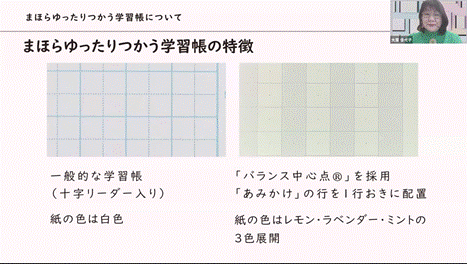
By writing the center point of the balance in the center of the square, it is possible to tell up, down, left, and right based on the center point, even though the squares are not separated by dotted lines. Through our survey of monitors, we also found that the reduced number of lines allows those who have difficulty with lines to clearly recognize the squares, which reduces stress. We have created a study book that allows the user to write letters in a relaxed manner.
In the square grid study book, there are three types of grid lines: 10 squares, 15 squares, and 10 mm grid, and the alternation of amigake and nonamigake lines makes it possible to write in a straight line without losing sight of where you are writing.
We have heard some people, especially in arithmetic, say that the place value is distorted and that even if they go to the trouble of calculating, the answers are different, so the alternating Amikake and Non-Amikake rows are designed in such a way that the place value can be taken straight. (▲Picture 11▲)
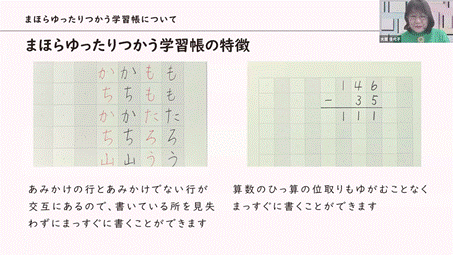
The notebooks for studying Kanji characters are made with large squares so that students can write in a relaxed manner. We have heard some people say that they are frustrated because most kanji notebooks have small cells, and the space for writing reading kana is too small. We have improved on these problems. (▲Picture 12▲)
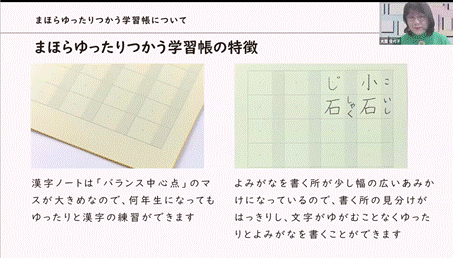
We also received some comments that it was difficult to write the reading kana between the narrow space enclosed by lines and lines, so we made the space for writing the reading kana amikake. We found that you can write the reading kana at the amikake, and we have tried to reduce stress by not surrounding it with lines and lines.
By selling this study notebook, we have received comments such as, ‘I can relax my shoulders and write with ease. Also, the paper used for mahora notebooks is approximately 10% thicker than that of ordinary notebooks, so we have received comments such as, “The paper doesn’t get crumpled when erasing with the eraser, so I don’t get frustrated when erasing. The “Amigake” line has reduced the variation in the size of the letters. The “Amikake” line allows us to clearly see the width of the squares, so we can write in the width of the Amikake line and the width of the unprinted line between the Amikake and Amikake lines, which seems to reduce the variation in the size of letters. We have also received comments such as, “Since there is only a center point, I can clearly see the squares and don’t get confused about where to write. The lack of lines also seems to make it easier to write. (▲Picture 13▲)
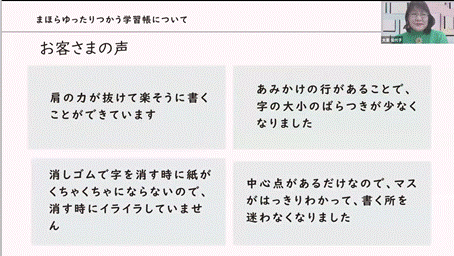
We believe that the MAHORA notebook has not yet reached those who need it. We will continue to make efforts so that it can be used by those who need it. We will also put effort into product development so that we can respond to your requests as much as possible. What we create after hearing from someone in need will be easier to use for many people and for those who are not in need. We have been thinking and believing in this way since we first created mahora notebook, and we hope that it will be used not only by people with developmental disabilities but also by a wide range of people.”
From a person with a developmental disability
Shocked by the phrase “I’m holding back and using my notebook.”
Following the explanation by Kayoko Ohguri of Ohguri Shiko, Nanako Ishido, director of B Lab, talked about how the awareness of employees changed with the development of the mahor notebook, the difficulties encountered in manufacturing, and future prospects.
Ishido: “Thank you very much. It is wonderful to see a new challenge for a company that has been in business for 95 years. Your company, which was originally a made-to-order company, has taken on a variety of new challenges, such as developing original products, developing sales channels, and launching an e-commerce site. From a management perspective, there must have been a variety of opinions, such as “What if the products don’t sell? What were your feelings behind taking on these challenges, and what kind of management decisions did you make?”
Ms. Ohguri: “When I first spoke with people with developmental disabilities, the words that I think triggered the conversation were, ‘We are looking for various notebooks that are easy for us to use, but there is no notebook that is really easy to use. So, we have to be patient with them. As a notebook manufacturer, I was very shocked and shocked to hear him say that he was “patiently using” a notebook. It made me feel strongly that we want our customers to use notebooks that they feel are easy to use. I think the most important trigger for me was the phrase ‘they are using it with patience,’ and I wanted to do something about that reality.”
Ishido: “The paper color of the notebook is lemon or lavender. While we forget to suspect that the paper color of notebooks is white as a matter of course, I believe that this was an opportunity to question our conventional way of thinking and what has been the norm up to now. Please tell us how your employees and those who were actually involved in the development of this project perceive this initiative and whether there have been any changes in their awareness.”
Ms. Ohguri: “What I felt during the development of mahora notebooks is that the usual and common sense, such as “Normally, people don’t do this” or “Normally, people do this,” are in fact very subjective assumptions. I realized that. I think it was really significant for our company to realize that there are many different kinds of people, and that what is normal and usual differs from person to person.
We are usually confident in our notebooks and are proud that our skills are improving, but we were given the opportunity to take on a new challenge and make the most of it. It was a big step for us as well. I feel that it has encouraged all of our employees and given them confidence.”
Ishido: “As we promote the Neurodiversity Project, there are many events that make us keenly aware of what we thought was normal and natural. I believe that the norm in the future will be something that is in tune with each person’s sensibilities and values the way each person feels.
When we initially heard from people with developmental disabilities, we felt that there are ten different people. Ultimately, each person may need a different notebook. However, that would be difficult to achieve. This time, you said that you developed this notebook focusing on the problems of people with visual sensitivity, but perhaps there are still diverse voices that have not been fully addressed. Could you tell us what kind of voices you have, how you plan to address them, or what solutions you envision?”
Ms. Ohguri: “As you pointed out, there were so many different voices that we really couldn’t pick up or respond to all of them, so we narrowed it down to three this time. Specifically, we focused on people with visual sensitivity and people who receive all information through their senses, and we focused on the problems of these people. In fact, the survey also showed the exact opposite, so we were very unsure where to focus. However, many people mentioned that the paper of their notebooks reflected light and made them feel dazzled, so we decided to pick up on that.
We are currently receiving request after request as to what we should do about the areas that we have not fully picked up. We are working on it little by little, starting with ‘maybe we can do this. The production of notebooks of different sizes and sheet-type notebooks, as I explained earlier, is part of this effort. We will be releasing a new plain notebook, but this is also in response to the request from people who currently only have white notebooks and would like to be able to use it as a free notebook by having it in color. These efforts are truly hands-on. We can’t produce a large quantity from the start, so we have to keep looking for ways we can do something about it, and we have to think about how we can meet various requests, even if it is little by little, and keep working on it.”
Ishido: “When I hear about the study notebooks, you are really thinking about how to address the problems in a very detailed manner. In the Neurodiversity Project, I hope that in the future, not only notebooks, but also various other products in society will be developed while reflecting the opinions of the people involved, who have problems. From this perspective, I would like to hear more about how you picked up the voices of the people concerned.
I heard that you initially took questionnaires from the people concerned, but when I heard about the development process of the mahora notebook, I felt that you proceeded as if you were a tripod, repeatedly asking for their opinions about the measures to be taken. What kind of team did you form with the people involved and how did you proceed with the development?”
Ms. Ohguri: “When we created the first mahora notebook, we extracted problems from the feedback we gathered from about 100 people with developmental disabilities, devised ways to improve the notebook, made a prototype, had the people look at it, and repeated improvements while receiving further feedback from them.
Since the study book was intended for elementary school students, we thought about what kind of squares would be best for them. However, not all elementary school students can say for themselves whether a notebook is easy or difficult to use. Therefore, we asked the people at the after-school day care service to use several prototype notebooks. Specifically, we asked the daycare services, instructors, parents, and other people who are usually close to the children to actually observe the children using the notebooks and give us their opinions on how they felt the notebooks were different.
One of them said, “It used to take my child about an hour to write a page in a notebook, but he wrote it in less than 20 minutes,” and another said, “I always have strong pressure when I write, but I was able to relax my shoulders. I think we were able to understand that this is good and that it could be better, etc., because of the feedback from the adults who were watching us.”
Different people, not just those with developmental disabilities, have different ways of using it.
Ishido: “Certainly, with small children, there are cases where they do not realize why they are struggling there. The truth is that the reason they cannot take notes is because they are dazzled, but there are children whose self-esteem is lowered because they think they are not keeping up with their studies. In such a situation, it is wonderful to experience that just by changing their notebooks, they can keep up with their classes. That is why I hope that stationery that caters to more children with special needs will be created.
Earlier, you mentioned that products made for people in need are better for more people. A similar example was found in this year’s Neurodiversity Awards. For example, he mentioned that one store created a “Quiet Hour,” a time of the day when sound and light are reduced to make it easier for people with sensory sensitivities, and as a result, seniors and parents with small children began to come during this time and sales increased. I assume that you feel the same way in product development, but what kind of people, other than those with visual sensitivities or developmental disabilities, are demanding mahora notebooks? Have you received any feedback?”
Ms. Ohguri: “First of all, we received feedback from people with cataracts. We were surprised to receive a series of comments from people with cataracts who said, ‘I used to feel dazzled by white paper notebooks, but now I can write with mahora notebooks. Another person who had brain surgery and lost the use of his dominant hand was pleased when he practiced writing with his non-dominant hand during rehabilitation, saying, “I can write straighter with the Amikake notebook. We were very happy to hear that people we had not expected to use our notebooks happened to use them and were pleased with them.
Another elderly person who enjoys writing haiku said, “When I use mahora notebooks for vertical writing, the thin line in the center of the notebook helps me to write in a straight line. I like it and use it all the time. We are happy to see a variety of different ways to expand the use of mahora notebooks. As a result, we now have more than 150,000 books, including study books, and we feel that the number of users is expanding.”
Ishido: “You mean that the notebook is loved and spread by many people. I think there must have been a big technical challenge in creating the mahora notebook this time. What were the difficulties in terms of manufacturing?”
Ms. Ohguri: “The area of the Amikake strip in an Amikake notebook occupies about half the area of the notebook. In a general notebook with ruled lines, the area is so small that even if all the lines were gathered together, it would not even amount to a single Amikake strip. In other words, the size of the area to be printed is completely different. At first, we did not realize this and printed at the same speed as the general notebook. This resulted in a messy printing, with the Amikake strip printing poorly and becoming broken and uneven. We made adjustments, such as slowing down the speed, and checked as we went along.
As a result, we found that we had to reduce the speed to less than one-third to print clean lines; reducing the speed to less than one-third meant that it would take more than three times as long to complete. However, we worked on this project thinking that we could not sell it at such a high price even if it took more than three times as long.
Based on these experiences, we carefully repeated the test many times when printing the study book. Before printing, we made samples many times to test which one was easier to read at various densities. This was a different process from the general process of printing ruled lines, and we manufactured it with a great deal of difficulty.”
Ishido: “This is exactly the kind of notebook that has overcome and made its way into the world because of your high technological capabilities, strong desire and passion. Thank you very much. Finally, I would like to close with a word of encouragement for mahora notebooks to reach as many people as possible.”
Ms. Ohguri: “The MAHORA notebook was created with the hope that people with developmental disabilities would feel comfortable using it. However, it is not only for people with developmental disabilities, but I think there are different ways for various people to use it. I hope that this notebook will grow to be loved by a wide range of people. If you like it, please take a look at it.”
Ishido: “I urge everyone to pick up a copy. And, using the pay-forward system, there is also a mechanism in place for the notebooks to be delivered as donations to special-needs schools and other organizations, so we hope you will support us. We are looking forward to more challenges from Ohguri Shiko.”