Two exhibits: tactile transmission focusing on temperature and VR experience of menstrual pain Does the technology to transmit “warmth” shorten the distance between the heart and mind?
1/8/26
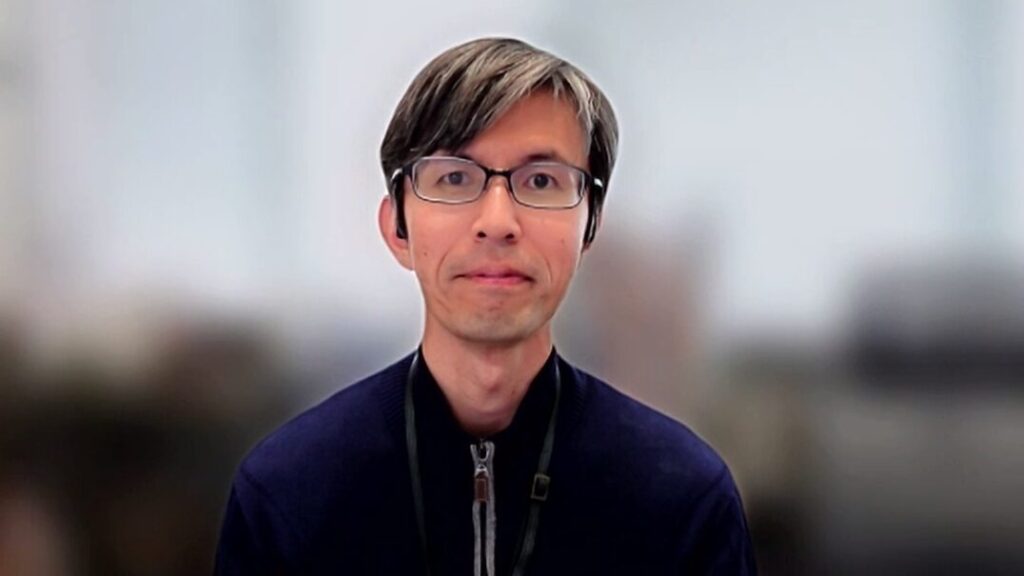
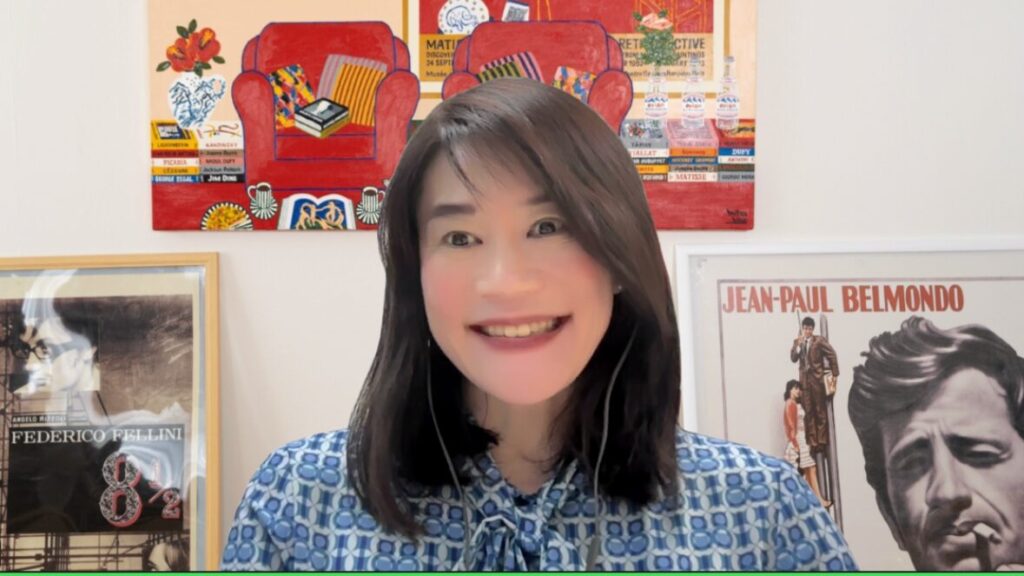
The Neurodiversity Project, organized by B Lab, aims to realize a society in which the diversity of the brain and nervous system is respected and everyone is able to exercise their abilities in their own way. In this Neurodiversity Project interview series, we will introduce the efforts of Katsunari Sato (▲Picture 1▲), Associate Professor, Graduate School of Engineering, Nara Women’s University, who exhibited at “Brain World for Everyone” for the first time this year. Sato Laboratory introduced two initiatives: “warm” tactile transmission and VR experience of menstrual pain. Nanako Ishido (▲Picture 2▲), Director of B Lab, asked about the background behind these research efforts, current research results, and future prospects.
Technology for transmitting and sharing tactile sensations to remote locations
Tactile transmission with “warmth
Ishido: “This year, Dr. Sato exhibited for the first time at “Brain World for Everyone”. Could you tell us about the contents of your exhibit and Dr. Sato’s research theme?”
Dr. Sato: “I will explain the background of our research and development efforts and what kind of technology we used for the warm tactile transmission and the menstrual pain VR experience, respectively, which were introduced in “Everyone’s Brain World.
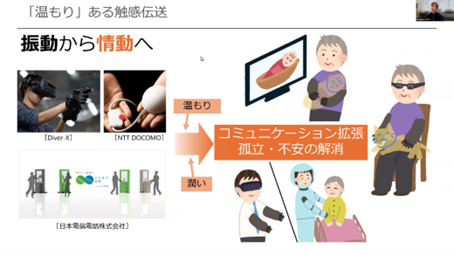
In warm tactile transmission, we are working on research and development of technology to transmit and share the sensation of touch to remote locations. Previous research has focused on vibration among the sensations of touch, and research and development of technology to transmit only the vibrations of shaking and trembling has been the main focus. On the other hand, what most people perceive as tactile sensations includes not only vibration but also various other sensations such as warmth, coldness, moistness, and dryness. By conveying such sensations of warmth and moisture, we hope to realize a tactile transmission that conveys a sense of security when touching a person or an animal such as a pet, for example. (▲Picture 3▲)
In our research, we focus on temperature sensation. The term ‘skin-hunger’ has recently attracted attention regarding the link between temperature sensation and the sense of security gained through touch. This term refers to the craving for skin contact, or the hunger for human contact, or “skinship. It is said to occur in situations where people are deprived of human contact for long periods of time, and is pointed out to have adverse effects on health, such as depression and weakening of the immune system. (▲Picture 4▲)
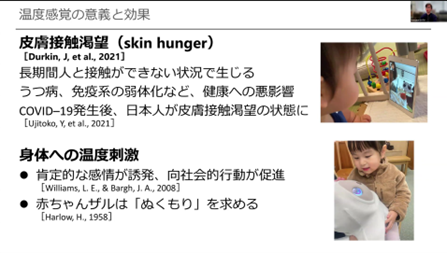
Studies have shown that many people have a craving for skin contact, especially after the coronary disaster. Therefore, we believe that tactile sensation, especially temperature sensation, is important. Regarding the sense of temperature, you have probably felt the “warmth of human skin” when you touched someone. You may intuitively understand that warmth and the temperature you feel when you touch someone are important to humans, but in fact, there is a variety of academic evidence to support this.
For example, research has shown that stimulation of the body with warmth induces positive emotions and promotes social behavior. In addition, research has shown that baby monkeys feel more secure from “warmth” than from being able to eat food.
We believe that interacting with people through temperature stimulation has a positive impact on health, both physically and mentally. Against this backdrop, “Everyone’s Brain World” utilized existing online communication tools to introduce technology that conveys tactile sensations, including temperature. (▲Picture 5▲)
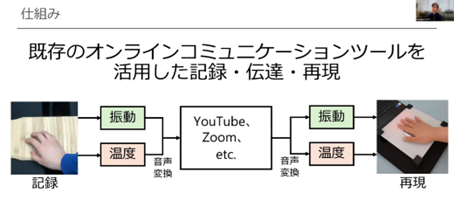
First, the participants are asked to touch a certain material and record the vibration and temperature when they touch it. This tactile information is then converted into audio and transmitted via existing online communication tools such as YouTube and Zoom. Then, when the vibrations of the transmitted tactile sensations are reconverted from voice to vibration and temperature information, the sensations of touching wood, human skin, warmth, and coldness can be experienced together. For this demonstration in particular, we uploaded a video on YouTube that includes these sensations of touch and tactility, so that when the YouTube video is played, the tactile sensations can also be experienced together.
Such tactile communication was originally intended to be implemented to realize a variety of communication, but we also believe that it can be applied to “touch online shopping” using digital haptics archives, a technology that artificially creates a sense of touch (haptics) using digital technology. We believe that this technology can also be applied to the realization of “touchable online shopping. (▲Picture 6▲)
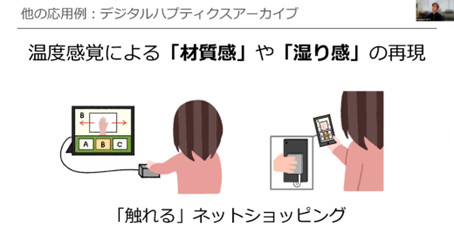
Temperature sensation has a mental effect that makes us feel safe when we touch it, but it is also important to reproduce the sense of materiality of what we simply touch, for example, the difference between wood and metal, or whether it is dry or wet. We believe that in the future, by recording and reproducing richer tactile sensations, we will be able to virtually experience and shop for products without having to actually touch them.
VR experience of menstrual pain
Sympathy and Understanding through VR Experiences of Menstrual Pain
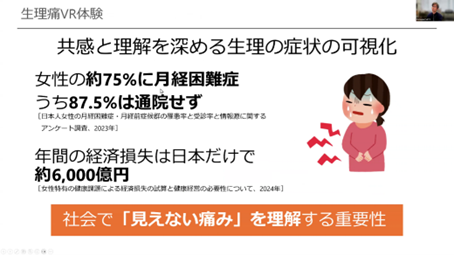
These are the descriptions of the transmission and transmission of tactile sensations. The other exhibit is a VR experience of menstrual pain. This one aims to visualize menstrual symptoms to deepen empathy and understanding. There have been various research studies on menstrual symptoms. For example, it has been found that although about 75% of women have dysmenorrhea, 87.5% of them do not go to the hospital.
The annual economic loss due to menstrual pain is also very large, estimated at about 600 billion yen in Japan alone. We believe that it is important for society as a whole to understand this kind of “invisible pain” that even women do not deeply understand, and to eliminate disadvantages such as economic loss. (▲Picture 7▲)
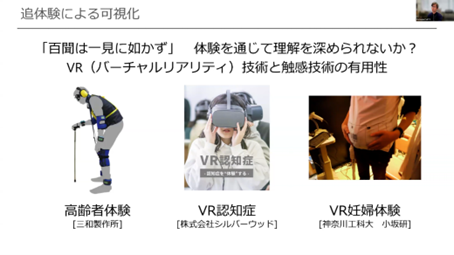
So how do we understand the invisible pain and hardship of menstruation? To do so, we focused on visualization by reliving the experience. There is a saying, “Seeing is believing,” and no matter how much knowledge is acquired through hearsay, it is important to actually see, touch, and experience things for oneself. It is known empirically that the amount of information is overwhelmingly different. In other words, it is necessary to experience the pain of menstrual pain for oneself, rather than just hearing about it from others or reading about it in books. However, it is not possible for men to experience a woman’s period, and individual differences in pain are also known to be very large. Nor can a lighter person experience the symptoms of someone with very severe menstrual pain.
Therefore, we thought that virtual reality and tactile technologies would be useful. In fact, there are ways to restrain a part of the body in terms of experiencing what it is like to be an elderly person, or to place restrictions on how one can see or hear. On the other hand, VR technology can be used to relive the life of a person with dementia from their own perspective, or to experience the growth of a baby in a pregnant woman’s stomach, including the sense of touch, Systems using VR and tactile technology have also been increasing in recent years. (▲Picture 8▲)
We similarly wondered if we could use VR technology to relive the pain of menstruation. Among the symptoms of menstruation, we are particularly focusing on abdominal pain. We know that abdominal pain is caused by excessive contraction of the uterine muscle. In order to have men and women alike experience this, we thought it would be possible to reproduce it by causing the abdominal muscles to contract excessively with the electrical stimulation of EMS. (▲Picture 9▲)
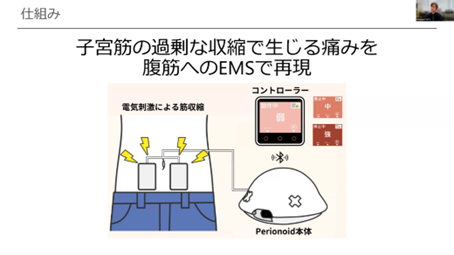
It is an abdominal muscle, so it is in a more superficial location than the uterine muscle, but it is relatively close in location. Moreover, the idea is that the type of pain caused by contraction of the muscle can be the same. We actually had women implement this and received evaluations from a variety of people. It is true that there are some differences because of the electrical stimulation, but the pain caused by the contraction of the muscles is similar in some aspects.
This system is now being socially implemented and offered as a training program for companies. To summarize the process of social implementation, the artist Sputniko originally introduced the system in her artwork! The students of Konan University implemented it as an interactive work in the “IVRC,” a VR contest. The students entered my laboratory and continued their research on the theme of reproducibility of pain. (▲Picture 10▲)
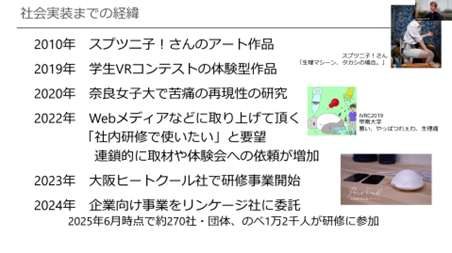
As we continued these efforts, we were picked up by a web media outlet and received a request from a company that saw the article and said, “We would like to use it in our in-house training program. The media picked up on the in-house training, and the number of requests for interviews and trial sessions increased in a chain reaction.
As of June 2025, a total of 12,000 people from 270 companies and organizations have participated. As of June 2025, a total of 12,000 people from 270 companies and organizations have participated in the program, and the number is still increasing.
In this way, we have been working to visualize pain in the form of an experience. Many people have recognized the usefulness of this technology and are experiencing it. At this year’s exhibition, visitors were able to experience “Periodonoid,” a VR device that simulates menstrual pain, which is used in our training business.”
Temperature and “warmth” when touched.
Close the distance between our hearts by transmitting together
Ishido: “I found both themes very interesting. First of all, I would like to ask a question about the first one, ‘warm tactile transmission. I think many people have an everyday realization that warmth affects people’s minds. If you put this into digital information and transmit it through tactile sensation, do you have any data on how the psychological distance between people has changed?”
Dr. Sato: “We are currently conducting research in this very direction. Originally, there was a lot of research on how the sense of distance and communication between humans changes when only vibrations are transmitted, but we decided that temperature is important when considering human-to-human contact. Tools that could transmit temperature together had existed in the past, but they were systems that could only be handled by specialists in the field of robotics, so we started by creating a system that could transmit tactile sensations, including temperature, more easily. We are now at the stage of evaluating the temperature sensation as you have pointed out.”
Ishido: “Since you are conducting research in the engineering field, I understand that your objective is not necessarily limited to the psychological aspect, and that you are also focusing on the technical issue of how to integrate and transmit elements such as tactile sensation, vibration, and temperature. In addition, is it correct to consider shortening the psychological distance between people, as I have just asked, as one of the objectives of this research?”
Dr. Sato: “Yes, that is correct. We are actually collaborating with psychology professors at other universities to plan experiments.”
Ishido: “Given this, I was wondering whether the aim is to transmit actual warmth as faithfully as possible, or whether the information is conveyed by taking into account psychological distance and a sense of security, and converting it into information optimized to make the receiver feel comfortable. I believe that the approach will differ greatly depending on the design policy. I would be very interested to hear about the thinking behind the design.”
Dr. Sato: “Currently, we are close to the former, and we decided to first try to convey physical phenomena as they are. As we see what happens, I believe we will discover that there are more appropriate ways to shorten the distance by taking emotions into account rather than just telling it as it is. We would also like to explore the conditions for more effective communication methods.”
Ishido: “In terms of virtual reality, it is not easy for digital to perfectly reproduce real touch. On the other hand, I feel that digital technology has the potential to create value that exceeds that of the real thing. Earlier, you mentioned the effect of virtual reality in deterring depression, and I think it would be a very meaningful technology if it could be used in the direction of mental health and psychological support. I would like to ask you, what elements or mechanisms do you think would be effective to add in order to further enhance such effects? Even if it is at the hypothetical level, what do you have in mind at this point?”
Dr. Sato: “At this point, I think spatial expansion is important; it’s not as if VR can truly reproduce reality, but only the essence is extracted and defined. Moreover, the essence is more of an essence in the sense of showing the presence of things.
When this happens, it tends to be limited to a limited part of the body, for example, just the fingertips. When it comes to touching someone and feeling a sense of distance with that person, I think it is important to have a more spatial expanse, a feeling of being enveloped, or conversely, a feeling of being enveloped. In that sense, I think it becomes a spatial expanse.”
Ishido: “If it is possible to reproduce warmth and if this contributes to alleviating loneliness and preventing depression, I feel that this is an extremely significant approach. On the other hand, when warmth can be scientifically designed, how will the way of care and affection between people be transformed? I am also very interested in this point. What kind of impact do you think such technology will have on human care and affection?”
Dr. Sato: “That is also a very interesting point. One of the things I was impressed by what I learned before was that if a mother hugs a child who is shaking due to panic disorder tightly, the body tremors will stop. However, upon closer examination, I found that as long as the body is compressed, the tremors of panic disorder can be stopped, leading to the development of a system in which the jacket you are wearing expands and compresses you when panic disorder occurs.
I feel that it is a bit of a disappointing result that the mother does not have to hug the child, but just squeeze him or her. I think it would have been nice if there had been some essential effect in the hugs, but in fact, I think that when you find out what is essentially important, you may end up with a dry result. That is half expectation and half fear.”
Ishido: “This may be a question related to VR for menstrual pain, but in our neurodiversity project, we have never had a situation where people with sensory sensitivity come to our booth and say, ‘This sound is painful’ or ‘This stimulus is hard to bear. In other words, even the same stimulus is perceived and sensed very differently by different people. Given the great diversity of sensations, such as touch, temperature, and pain, how do you take safety into consideration and how do you design your products?”
Dr. Sato: “To be honest, we have not yet incorporated tactile transmission to that extent. In fact, we are struggling in a sense with the aspect that different people feel differently even when the same stimulus is applied.
In our considerations, we first detect skin conditions. We try to prevent it from getting too hot. However, we are also conducting research that if we know how easily the skin warms up, or rather, the thermal physical specificity of the skin, we can estimate, to some extent, the appropriate stimulation intensity. We are also working behind the scenes to use such technology to estimate each person’s skin condition and adjust the stimulation appropriately so that everyone feels the same way when they want to feel warm stimulation without having to adjust the volume themselves.”
The goal is not to reproduce the pain of menstrual pain
Techniques to increase understanding of menstrual pain for all
Ishido: Regarding “menstrual pain VR,” I am guessing that not all people were necessarily positive about the approach of reproducing pain. What kind of voices and reactions did you actually receive? I would also like to know how you faced and overcame such concerns and negative opinions, and what was your process?”
Dr. Sato: “We are also working on adjusting the intensity of stimulation for menstrual pain VR. Currently, we are taking measures such as designing it so that even the strongest stimulation is not like dangerous electrical stimulation by having the user experience it gradually starting with weaker stimulation.
However, we have received a great deal of criticism from people who say, ‘What about inflicting pain in the first place? We are just trying to cover that in our operations. On the other hand, what was surprising was that there were more people who wanted to do it than we had expected, even though it is a device that makes you feel pain. Our stance is that we never force people to do something, and we say, “If you want to experience it, go ahead and do it. Even so, there were many people who raised their hands and said, “Please let me try it,” and many people were willing to try it without any pressure. If we were to force people to experience the program and cause them pain, we would be criticized from the outside for forcing them to experience the program and causing them pain.”
Ishido: “I think it is important to note that the purpose is not to reproduce pain per se, but to design the experience of pain in order to promote understanding. In this sense, I also think that the setting of the objective is very different.
Earlier, you mentioned that they are also used for training and other purposes. Menstrual pain is difficult for men to feel, and even among women, there are large individual differences in how severe it is and how it is felt. I would like to hear about the extent to which the introduction of this VR has led to changes in behavior and awareness, and whether it has yielded any interesting data from the perspective of diversity.”
Dr. Sato: “From the perspective of short-term behavior change, the survey taken on the spot has been very positive. However, since it is immediately after the experience, we believe that we need to look at ongoing changes thereafter.
The student who originally developed the system has completed his master’s degree and is now working for a company, and later returned to graduate school to continue his research as a graduate school research theme. We are also discussing to look closely at the mid- to long-term effects in the future. In the training program, we have received comments that the way the company treats women has changed compared to before, and we feel that this is not a behavioral change but rather a change in the company’s approach, with the added benefit of a benefit package for women that did not exist before. However, I am not sure if this was originally planned and the training program helped to support it, or if the training program was the catalyst for such a development. I have heard that changes are occurring as a community.”
Ishido: “I felt it was a wonderful achievement. From the perspective of diversity training and gender education, there are also social issues such as physiological poverty. What role can technology play in addressing such themes? How do you see it? ”
Dr. Sato: “People tend to think that technology has a major role to play in directly solving problems, but I believe that technology also has a role to play in making people aware that ‘this is a problem.
We sometimes receive feedback from outsiders saying, ‘If you don’t have time to recreate the experience, develop the technology to solve it. They say, ‘Do research on pain reduction and alleviation. However, even if we conduct this activity and create a product in the field of femtec, which is a product that alleviates the pain of menstruation, such as the pill, it is difficult to find it in pharmacies. This is because men who do not understand menstruation make decisions on whether or not to place these products in stores. In this sense, we have received many comments that they hope the VR experience of menstrual pain will break down that barrier. I feel that technology should be used more when making the world more aware of these social issues, which is what I feel when I am involved in this research and development.”
By transmitting tactile sensations.
technology that makes people want to touch each other in real life.
Ishido: “By using technology, we can reach a stage where we not only understand with our minds, but also feel with our bodies. What do you think are the characteristics of the differences in understanding and awareness that come from feeling with the body?”
Dr. Sato: “One is that the resolution will increase overwhelmingly. Also, I believe that it will be more strongly retained in the memory. In terms of resolution, if you are told through words or hearsay that the pain is like this, you can imagine it, but if you have never experienced the kind of pain described, you cannot imagine it, and only after you have had various experiences can you make accurate guesses from the words of others. In this sense, I think it is important to first have it as an experience, to have it as an empirical value. I believe that the only way to understand others, especially in terms of physical sensations that we cannot see or hear, is to experience them ourselves.
Also, even with memory retention, once you have experienced it once, you will be able to recall it after a while. I think it is also difficult to recall if you have only heard about it. Maybe it is because it is especially painful, but when I first experienced it myself, it was quite an intense experience. In my case in particular, it was shocking to suddenly experience the strongest stimulation I had to try out during development. Maybe it is because it is pain in that sense, but I think that experiencing it physically is also more highly fixed in the memory.”
Ishido: “In terms of reproduction of the senses, in the second section of the “Brain World for Everyone” exhibit, all five senses are reproduced using technology to deepen understanding of neurodiversity by sensing the senses of others. From this perspective, I would like to ask you if you have any ideas on how the transmission of warmth and tactile sensations could be used in neurodiversity. Or, if there is a direction you would like to take further in the future, please let us know.”
Dr. Sato: “This may change the purpose of the question, but in terms of the transmission of tactile sensations, I believe that warmth and the comfort of a person touching another person has a context there, of course. If a stranger touches you, you would feel uncomfortable. When you touch someone you know, there is comfort. But I wonder where that comes from, and it would be very interesting to know if it is simply the same soft and warm thing, and to some extent, if it is a favorable thing, it will be so, or if it is physically the same thing and the context is also aligned, but it is not good enough.
We often touch people in class, and when we form groups with people around us, shake hands, and try to guess who we have touched, just by the feel of our hands, we are often right. I mentioned earlier that people have the warmth of human skin, but there are many variations, such as people with cold hands, sweaty hands, dry hands, etc. Individuals can be identified even by the sensation of their skin. That is how much variation there is in the sensation of human skin, but why do people recognize it as human skin? There is a part of the brain that responds to a person’s face, but I believe that there is also a part of the brain that responds to touch only when it touches a specific object. I would like to investigate what is the root of the sense of security that comes from the feeling of touching a person.”
Ishido: “The reason I first asked whether or not to reproduce the real thing was my own question. For example, when someone hugs you tightly, you feel protected, cared for, and relieved. Where do these feelings of security and warmth come from? If we are trying to reproduce them with technology, isn’t the goal not just to reproduce temperatures realistically? It is with this in mind that I asked these questions. I heard that Dr. Sato is also exploring this very point, which I deeply sympathize with and find very interesting.
In addition to this, I understand that the vision of realizing a society in which people can be connected on various sensory levels even when they are separated from each other is the destination of your research. How do you think human relationships will change when such a society is realized?”
Dr. Sato: “It is a very difficult problem, and I feel that relationships are still changing very much. Especially with the Corona disaster, online dialogue is becoming more and more common, and communication on social networking services is also becoming more and more active. Furthermore, communication through avatars, which do not show their true faces, is increasing more and more, and I believe that such transformation is increasing and communication is changing a bit more than before.”
My ideal is that by conveying tactile sensations to such places, I hope that we can return to more realistic thinking. This is really just an ideal, but I am hoping that by conveying tactile sensations, we can evoke the desire to touch people. People often say, ‘If we reproduce even the sense of touch, people will be satisfied with that and will no longer seek human contact. I hope that by conveying tactile sensations, even in an imperfect form, people will feel that tactile sensations are good, and from there, they will develop a longing to touch the real thing, which will lead them to want to touch the real thing.”
Ishido: “So far, we have been trying to use technology to realize communication as if we were face-to-face even when we are separated. I had thought that this idea was the basis of your research. However, after listening to what he had to say, I realized that his ideal is to make better communication possible even at a distance and, conversely, to arouse people’s desire to “meet in real life” and “actually touch each other.”
Dr. Sato: “Yes, I do.”
Ishido: “This ties in with what you just said, but what kind of world would be created if we were to live in a society where we could transmit and share our various senses, including the senses and emotions of others, as experiences? I feel that technology has the potential to expand the scope of empathy and form an infrastructure of the mind, so to speak. What kind of design philosophy do you think should be used to create such a world? What kind of future image do you hope for?”
Dr. Sato: “I am not able to draw a story on such a grand scale. I am happy or comfortable with the feeling of being able to obtain better information and to have a little clarity in areas that I have not been able to understand. I feel as if I am being updated, and I am very interested in sharing and reliving various sensations.
I have not been able to envision what awaits us beyond continued updates, but I just wonder if this is an action that responds to the essential desire people have to know. So, although I have not been able to design it myself, I am currently working according to my own interests.”
Ishido: “No one has a perfect vision of the future. That is why we are building up our vision of ‘this is the kind of society we would like to see’ one by one. That is what we are trying to do with “Minna no Brain World. What kind of world will emerge when we connect the fragments of the future that we can only see in fragments? The “Brain World for Everyone” exhibition is an attempt to challenge this possibility. Finally, what do you hope to convey to many people through this exhibition, including your future aspirations? I would appreciate it if you could give us a message.”
Dr. Sato: “Both of the two exhibits this time fall under the category of tactile sensation, the feeling of touch. This is something that can only be understood by experiencing it. I would like everyone to experience them if they have the chance. The sensations you experience will vary from person to person. If you can frankly tell us how you felt and what you thought, we can link this to our research and development. We would love to hear your impressions of the experience.”
Ishido: “Listening to what you said today, I felt again that the technology of conveying warmth has the power to gently shorten the distance between people’s hearts. I believe that this technology is a science of emotional distance and will greatly expand the possibilities of the act of “touch” and grow into a technology that gently reconnects people with each other, while respecting their differences. Thank you very much for your time today.”